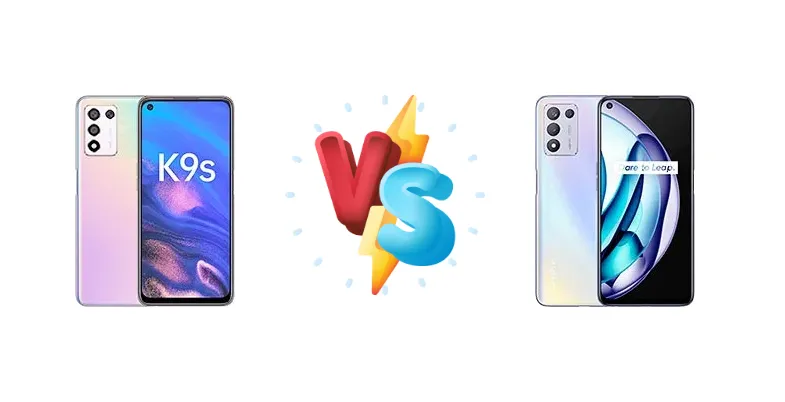
The mid-range smartphone market is fiercely competitive, and the Oppo K9s and Realme Q3s are two strong contenders. Both offer 5G connectivity and a capable Snapdragon 778G chipset, but subtle differences could make one a better fit for your needs. Let's dive into a detailed comparison to help you decide.
🏆 Quick Verdict
The Realme Q3s edges out the Oppo K9s thanks to its significantly faster charging. Both offer similar performance and display quality, but the Realme's quicker top-ups provide a noticeable convenience advantage. If charging speed is a priority, the Q3s is the clear winner.
| Network |
|---|
| 2G bands | GSM 850 / 900 / 1800 / 1900 | GSM 850 / 900 / 1800 / 1900 |
| 3G bands | HSDPA 800 / 850 / 900 / 1700(AWS) / 1900 / 2100 | HSDPA 850 / 900 / 1700(AWS) / 1900 / 2100 |
| 4G bands | 1, 3, 4, 5, 8, 19, 28, 34, 38, 39, 40, 41 | 1, 3, 4, 5, 7, 8, 19, 28, 34, 38, 39, 40, 41 |
| 5G bands | 1, 28, 41, 77, 78 SA/NSA | 1, 28, 41, 77, 78 SA/NSA |
| Speed | HSPA, LTE, 5G | HSPA, LTE, 5G |
| Technology | GSM / CDMA / HSPA / CDMA2000 / LTE / 5G | GSM / CDMA / HSPA / EVDO / LTE / 5G |
| | CDMA2000 1x | CDMA2000 1xEV-DO |
| Launch |
|---|
| Announced | 2021, October 20 | 2021, October 19 |
| Status | Available. Released 2021, November 01 | Available. Released 2021, November 01 |
| Body |
|---|
| Dimensions | 164.4 x 75.9 x 8.5 mm (6.47 x 2.99 x 0.33 in) | 164.4 x 75.8 x 8.5 mm (6.47 x 2.98 x 0.33 in) |
| SIM | Nano-SIM + Nano-SIM | Nano-SIM + Nano-SIM |
| Weight | 199 g (7.02 oz) | 199 g (7.02 oz) |
| Display |
|---|
| Protection | Panda Glass | - |
| Resolution | 1080 x 2412 pixels, 20:9 ratio (~401 ppi density) | 1080 x 2412 pixels, 20:9 ratio (~401 ppi density) |
| Size | 6.59 inches, 104.5 cm2 (~83.7% screen-to-body ratio) | 6.6 inches, 104.3 cm2 (~83.7% screen-to-body ratio) |
| Type | IPS LCD, 120Hz, 480 nits (typ), 600 nits (HBM) | IPS LCD, 144Hz, 600 nits |
| Platform |
|---|
| CPU | Octa-core (1x2.4 GHz Cortex-A78 & 3x2.2 GHz Cortex-A78 & 4x1.9 GHz Cortex-A55) | Octa-core (1x2.4 GHz Cortex-A78 & 3x2.2 GHz Cortex-A78 & 4x1.9 GHz Cortex-A55) |
| Chipset | Qualcomm SM7325 Snapdragon 778G 5G (6 nm) | Qualcomm SM7325 Snapdragon 778G 5G (6 nm) |
| GPU | Adreno 642L | Adreno 642L |
| OS | Android 11, ColorOS 11.2 | Android 11, Realme UI 2.0 |
| Memory |
|---|
| Card slot | microSDXC | microSDXC (dedicated slot) |
| Internal | 128GB 6GB RAM, 128GB 8GB RAM, 256GB 8GB RAM | 128GB 6GB RAM, 128GB 8GB RAM, 256GB 8GB RAM |
| | UFS 2.2 | - |
| Main Camera |
|---|
| Features | LED flash, HDR, panorama | LED flash, HDR, panorama |
| Single | 16 MP, f/2.0, 26mm (wide) | 16 MP, f/2.1, 26mm (wide) |
| Triple | 64 MP, f/1.7, 26mm (wide), PDAF
8 MP, f/2.2, 120˚ (ultrawide)
2 MP (macro) | 48 MP, f/1.8, 26mm (wide), PDAF
2 MP (macro)
Auxiliary lens |
| Video | 4K@30fps, 1080p@30/60/120fps; gyro-EIS | 4K@30fps, 1080p@30/60fps |
| Selfie camera |
|---|
| Features | Panorama | HDR, panorama |
| Single | 16 MP, f/2.0, 26mm (wide) | 16 MP, f/2.1, 26mm (wide) |
| Video | 1080p@30fps, gyro-EIS | 1080p@30fps |
| Sound |
|---|
| 3.5mm jack | Yes | Yes |
| 35mm jack | Yes | Yes |
| Loudspeaker | Yes | Yes |
| | - | 24-bit/192kHz audio |
| Comms |
|---|
| Bluetooth | 5.2, A2DP, LE, aptX HD | 5.2, A2DP, LE |
| NFC | No | No |
| Positioning | GPS, GLONASS, GALILEO, BDS, QZSS | GPS, GLONASS, BDS, GALILEO, QZSS |
| Radio | No | No |
| USB | USB Type-C 2.0, OTG | USB Type-C 2.0, OTG |
| WLAN | Wi-Fi 802.11 a/b/g/n/ac/6, dual-band, Wi-Fi Direct | Wi-Fi 802.11 a/b/g/n/ac/6, dual-band, Wi-Fi Direct |
| Features |
|---|
| Sensors | Fingerprint (side-mounted), accelerometer, gyro, proximity, compass | Fingerprint (side-mounted), accelerometer, gyro, proximity, compass |
| Battery |
|---|
| Charging | 30W wired
5W reverse wired | 30W wired, 50% in 25 min |
| Type | Li-Po 5000 mAh | 5000 mAh |
| Misc |
|---|
| Colors | Black, Silver, Aurora | Aurora, Dark Blue |
| Models | PERM10 | - |
| Price | - | About 200 EUR |
Oppo K9s
- Potentially better software experience (ColorOS)
- Good performance with Snapdragon 778G
- Vibrant AMOLED display
- Slower charging speed
- Camera might not be significantly better than Realme
Realme Q3s
- Significantly faster charging (30W)
- Good performance with Snapdragon 778G
- Vibrant AMOLED display
- Software experience may be less refined than Oppo's
- Camera performance may be slightly behind Oppo
Display Comparison
Both phones feature a 6.43-inch AMOLED display with a 120Hz refresh rate, offering vibrant colors and smooth scrolling. Resolution is likely FHD+ on both. Expect similar viewing experiences, with slight variations in color calibration depending on software optimization. The Oppo K9s might have slightly better color accuracy, but it's marginal.
Camera Comparison
The Oppo K9s likely features a 64MP main camera, an 8MP ultrawide, and a 2MP macro lens. The Realme Q3s probably has a similar setup, potentially with a slightly different main sensor. Image quality will be comparable in good lighting conditions, but Oppo's image processing might offer slightly more saturated colors. Low-light performance will depend on the specific sensor and software algorithms.
Performance
The Snapdragon 778G 5G chipset is the star here, providing excellent performance for everyday tasks and even demanding games. Both phones have the same processor and RAM configurations (likely 6GB/8GB), so expect virtually identical performance in real-world usage. Thermal management will be a key factor in sustained performance, which may vary slightly between the devices.
Battery Life
The Realme Q3s has a clear advantage here. While both likely have a 5000mAh battery, the Realme's 30W fast charging allows it to reach 50% in just 25 minutes, compared to the Oppo K9s's 30W charging. This translates to significantly faster top-ups for the Realme.
Buying Guide
Who should buy the Oppo K9s? Users prioritizing a potentially slightly better software experience (Oppo's ColorOS is generally well-regarded) and don't mind slower charging. Who should buy the Realme Q3s? Those who value fast charging above all else and want a reliable, budget-friendly 5G phone.
Frequently Asked Questions
❓ Is the Snapdragon 778G good for gaming?
Yes, the Snapdragon 778G is a very capable chipset for mobile gaming, handling most games at high settings without significant issues. However, sustained performance may vary depending on thermal management.
❓ Which phone has better software support?
Oppo generally provides more frequent software updates and longer support periods compared to Realme, although both brands have improved in recent years. ColorOS (Oppo) is often considered more polished than Realme UI.