
Oppo K9s vs OnePlus Nord 2 5G: A Deep Dive into Mid-Range Power
| Phones Images | |||||
|---|---|---|---|---|---|
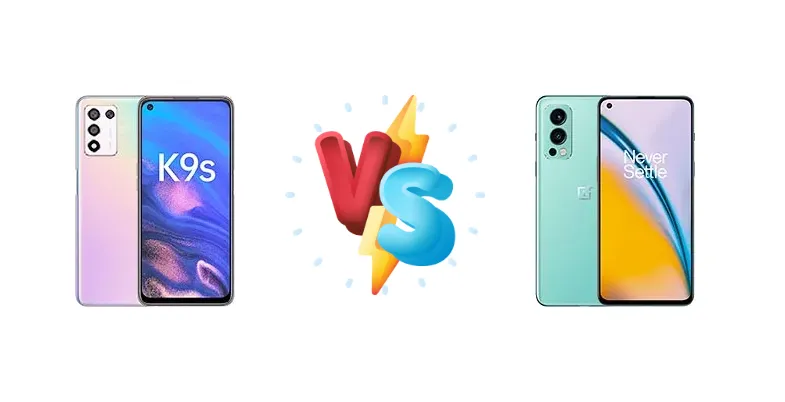
|
🏆 Quick Verdict
For most users, the OnePlus Nord 2 5G emerges as the stronger choice. Its Mediatek Dimensity 1200 offers a noticeable performance edge, and the 65W SuperVOOC charging is significantly faster than the K9s’ 30W charging, reaching 100% in just 30 minutes. While the K9s is a capable device, the Nord 2’s overall package provides a more premium experience.
| PHONES | ||
|---|---|---|
| Phone Names | Oppo K9s | OnePlus Nord 2 5G |
| Network | ||
|---|---|---|
| 2G bands | GSM 850 / 900 / 1800 / 1900 | GSM 850 / 900 / 1800 / 1900 |
| 3G bands | HSDPA 800 / 850 / 900 / 1700(AWS) / 1900 / 2100 | HSDPA 800 / 850 / 900 / 1700(AWS) / 1800 / 1900 / 2100 |
| 4G bands | 1, 3, 4, 5, 8, 19, 28, 34, 38, 39, 40, 41 | 1, 2, 3, 4, 5, 7, 8, 12, 17, 18, 19, 20, 26, 28, 32, 34, 38, 39, 40, 41, 66 - EU |
| 5G bands | 1, 28, 41, 77, 78 SA/NSA | 1, 3, 7, 8, 20, 28, 38, 41, 66, 78 SA/NSA - EU |
| Speed | HSPA, LTE, 5G | HSPA 42.2/5.76 Mbps, LTE Cat18 1200/150 Mbps, 5G |
| Technology | GSM / CDMA / HSPA / CDMA2000 / LTE / 5G | GSM / HSPA / LTE / 5G |
| CDMA2000 1x | - | |
| Launch | ||
|---|---|---|
| Announced | 2021, October 20 | 2021, July 22 |
| Status | Available. Released 2021, November 01 | Available. Released 2021, July 28 |
| Body | ||
|---|---|---|
| Build | - | Glass front (Gorilla Glass 5), glass back (Gorilla Glass 5), plastic frame |
| Dimensions | 164.4 x 75.9 x 8.5 mm (6.47 x 2.99 x 0.33 in) | 159.1 x 73.3 x 8.3 mm (6.26 x 2.89 x 0.33 in) |
| SIM | Nano-SIM + Nano-SIM | Nano-SIM + Nano-SIM |
| Weight | 199 g (7.02 oz) | 189 g (6.67 oz) |
| Display | ||
|---|---|---|
| Protection | Panda Glass | Corning Gorilla Glass 5 |
| Resolution | 1080 x 2412 pixels, 20:9 ratio (~401 ppi density) | 1080 x 2400 pixels, 20:9 ratio (~409 ppi density) |
| Size | 6.59 inches, 104.5 cm2 (~83.7% screen-to-body ratio) | 6.43 inches, 99.8 cm2 (~85.6% screen-to-body ratio) |
| Type | IPS LCD, 120Hz, 480 nits (typ), 600 nits (HBM) | Fluid AMOLED, 90Hz, HDR10+ |
| Platform | ||
|---|---|---|
| CPU | Octa-core (1x2.4 GHz Cortex-A78 & 3x2.2 GHz Cortex-A78 & 4x1.9 GHz Cortex-A55) | Octa-core (1x3.0 GHz Cortex-A78 & 3x2.6 GHz Cortex-A78 & 4x2.0 GHz Cortex-A55) |
| Chipset | Qualcomm SM7325 Snapdragon 778G 5G (6 nm) | Mediatek Dimensity 1200 (6 nm) |
| GPU | Adreno 642L | Mali-G77 MC9 |
| OS | Android 11, ColorOS 11.2 | Android 11, upgradable to Android 13, OxygenOS 13 |
| Memory | ||
|---|---|---|
| Card slot | microSDXC | No |
| Internal | 128GB 6GB RAM, 128GB 8GB RAM, 256GB 8GB RAM | 128GB 6GB RAM, 128GB 8GB RAM, 256GB 8GB RAM, 256GB 12GB RAM |
| UFS 2.2 | - | |
| Main Camera | ||
|---|---|---|
| Features | LED flash, HDR, panorama | Dual-LED flash, HDR, panorama |
| Single | 16 MP, f/2.0, 26mm (wide) | - |
| Triple | 64 MP, f/1.7, 26mm (wide), PDAF 8 MP, f/2.2, 120˚ (ultrawide) 2 MP (macro) | 50 MP, f/1.9, 24mm (wide), 1/1.56", 1.0µm, PDAF, OIS 8 MP, f/2.3, 120˚ (ultrawide) Auxiliary lens |
| Video | 4K@30fps, 1080p@30/60/120fps; gyro-EIS | 4K@30fps, 1080p@30/60/120fps, gyro-EIS |
| Selfie camera | ||
|---|---|---|
| Features | Panorama | Auto HDR |
| Single | 16 MP, f/2.0, 26mm (wide) | 32 MP, f/2.5, (wide), 1/2.8", 0.8µm |
| Video | 1080p@30fps, gyro-EIS | 1080p@30fps, gyro-EIS |
| Sound | ||
|---|---|---|
| 3.5mm jack | Yes | No |
| 35mm jack | Yes | No |
| Loudspeaker | Yes | Yes, with stereo speakers |
| Comms | ||
|---|---|---|
| Bluetooth | 5.2, A2DP, LE, aptX HD | 5.2, A2DP, LE, aptX HD |
| NFC | No | Yes |
| Positioning | GPS, GLONASS, GALILEO, BDS, QZSS | GPS, GLONASS, GALILEO, BDS, SBAS, NavIC |
| Radio | No | No |
| USB | USB Type-C 2.0, OTG | USB Type-C 2.0, OTG |
| WLAN | Wi-Fi 802.11 a/b/g/n/ac/6, dual-band, Wi-Fi Direct | Wi-Fi 802.11 a/b/g/n/ac/6, dual-band, Wi-Fi Direct |
| Features | ||
|---|---|---|
| Sensors | Fingerprint (side-mounted), accelerometer, gyro, proximity, compass | Fingerprint (under display, optical), accelerometer, gyro, proximity, compass |
| Battery | ||
|---|---|---|
| Charging | 30W wired 5W reverse wired | 65W wired, PD, 100% in 30 min |
| Type | Li-Po 5000 mAh | Li-Po 4500 mAh |
| Misc | ||
|---|---|---|
| Colors | Black, Silver, Aurora | Gray Sierra, Blue Haze, Green Wood, Pac-Man Edition |
| Models | PERM10 | DN2101, DN2103 |
| Price | - | € 189.00 / $ 219.99 / £ 148.00 |
| Tests | ||
|---|---|---|
| Battery life | - | Endurance rating 102h |
| Camera | - | Photo / Video |
| Display | - | Contrast ratio: Infinite (nominal) |
| Loudspeaker | - | -24.3 LUFS (Very good) |
| Performance | - | AnTuTu: 512164 (v8) | 598022 (v9) GeekBench: 2792 (v5.1) GFXBench: 38fps (ES 3.1 onscreen) |
Oppo K9s
- More power-efficient chipset (Snapdragon 778G)
- 5W Reverse Wired Charging
- Potentially more affordable price point
- Slower 30W charging
- Less powerful CPU and GPU compared to Dimensity 1200
- Limited display brightness information
OnePlus Nord 2 5G
- Faster 65W SuperVOOC charging (0-100% in 30 mins)
- More powerful Mediatek Dimensity 1200 chipset
- Brighter display (633 nits)
- No reverse wireless charging
- Potentially higher price
- Dimensity 1200 may run slightly warmer under sustained load
Display Comparison
The OnePlus Nord 2 5G boasts a brighter display, reaching a measured 633 nits, compared to an unspecified brightness for the K9s. While both utilize 6nm chipsets, the display brightness impacts outdoor visibility. The Nord 2’s ‘Infinite’ contrast ratio (nominal) suggests a strong OLED panel, likely offering deeper blacks and more vibrant colors. The K9s’ display specifications are less detailed, making a direct comparison difficult, but it likely targets a similar OLED experience, albeit potentially less bright.
Camera Comparison
Both phones offer photo and video capabilities, but detailed camera specs are limited. Without sensor size or aperture information, a direct comparison is challenging. However, the market positioning of OnePlus suggests a greater emphasis on image processing and potentially more advanced features. The K9s likely focuses on delivering solid, reliable images, while the Nord 2 may aim for a more refined and feature-rich camera experience. The absence of details on OIS (Optical Image Stabilization) on either device makes it difficult to assess low-light performance.
Performance
The core difference lies in the chipsets: the Oppo K9s features the Qualcomm Snapdragon 778G 5G, while the OnePlus Nord 2 5G utilizes the Mediatek Dimensity 1200. The Dimensity 1200, with its 3.0 GHz Cortex-A78 prime core and higher clock speeds on its A78 performance cores (2.6 GHz vs 2.4/2.2 GHz on the K9s), delivers superior CPU performance. This translates to faster app loading times and smoother multitasking. While both are 6nm chips, the Dimensity 1200’s more powerful GPU will provide a more substantial gaming advantage. The K9s’ Snapdragon 778G remains a capable performer, but the Nord 2 has a clear edge.
Battery Life
Both devices share an endurance rating of 102 hours, suggesting similar real-world battery life despite unspecified battery capacities. However, the charging speeds are drastically different. The OnePlus Nord 2 5G’s 65W SuperVOOC charging can fully charge the device in just 30 minutes, a significant advantage for users who need a quick power boost. The Oppo K9s’ 30W charging is considerably slower, requiring more time to reach a full charge. The K9s also offers 5W reverse wired charging, a feature absent on the Nord 2, allowing it to top up accessories.
Buying Guide
Buy the Oppo K9s if you prioritize a slightly more conservative, power-efficient chipset and are comfortable with slower charging speeds. It’s ideal for everyday tasks and moderate gaming. Buy the OnePlus Nord 2 5G if you demand higher performance for demanding apps and games, and value incredibly fast charging – a boon for users constantly on the go. The Nord 2 is the better pick for power users and mobile gamers.