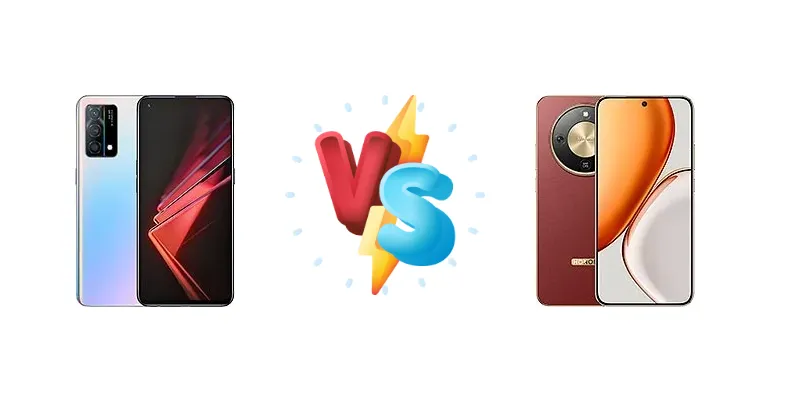
The Oppo K9 and Honor X9d represent compelling options in the increasingly competitive mid-range smartphone market. The K9, leveraging the older but still potent Snapdragon 768G, aims for raw performance. The X9d, with the newer, more efficient Snapdragon 6 Gen 4, prioritizes a balance of power and battery life. This comparison dissects their key differences to help you choose the right device.
🏆 Quick Verdict
For users prioritizing gaming and sustained performance, the Oppo K9 offers a slight edge thanks to its Snapdragon 768G. However, the Honor X9d’s more modern 4nm Snapdragon 6 Gen 4 provides better efficiency and potentially longer-term software support, making it the better all-around choice for most users.
| Network |
|---|
| 2G bands | GSM 850 / 900 / 1800 / 1900 | GSM 850 / 900 / 1800 / 1900 |
| 3G bands | HSDPA 800 / 850 / 900 / 1700(AWS) / 1900 / 2100 | HSDPA 850 / 900 / 1700(AWS) / 1900 / 2100 |
| 4G bands | 1, 3, 4, 5, 8, 28, 34, 38, 39, 40, 41 | LTE |
| 5G bands | 1, 3, 28, 41, 77, 78 SA/NSA | SA/NSA |
| Speed | HSPA, LTE, 5G | HSPA, LTE, 5G |
| Technology | GSM / CDMA / HSPA / CDMA2000 / LTE / 5G | GSM / HSPA / LTE / 5G |
| | CDMA2000 1x | - |
| Launch |
|---|
| Announced | 2021, May 06 | 2025, September 24 |
| Status | Available. Released 2021, May 11 | Available. Released 2025, October 09 |
| Body |
|---|
| Dimensions | 159.1 x 73.4 x 7.9 mm (6.26 x 2.89 x 0.31 in) | 161.9 x 76.1 x 7.8 mm (6.37 x 3.00 x 0.31 in) |
| SIM | Nano-SIM + Nano-SIM | Nano-SIM + Nano-SIM |
| Weight | 172 g (6.07 oz) | 193 g (6.81 oz) |
| Display |
|---|
| Protection | - | Aluminosilicate glass |
| Resolution | 1080 x 2400 pixels, 20:9 ratio (~409 ppi density) | 1200 x 2640 pixels (~427 ppi density) |
| Size | 6.43 inches, 99.8 cm2 (~85.5% screen-to-body ratio) | 6.79 inches, 112.1 cm2 (~90.9% screen-to-body ratio) |
| Type | Super AMOLED, 90Hz, 430 nits (typ), 750 nits (peak) | AMOLED, 1B colors, 120Hz, 3840Hz PWM, HDR, 800 nits (typ), 1800 nits (HBM), 6000 nits (peak) |
| Platform |
|---|
| CPU | Octa-core (1x2.8 GHz Kryo 475 Prime & 1x2.4 GHz Kryo 475 Gold & 6x1.8 GHz Kryo 475 Silver) | Octa-core (1x2.3 GHz Cortex-A720s & 3x2.2 GHz Cortex-A720s & 4x1.8 GHz Cortex-A520s) |
| Chipset | Qualcomm SM7250-AC Snapdragon 768G 5G (7 nm) | Qualcomm Snapdragon 6 Gen 4 (4 nm) |
| GPU | Adreno 620 | Adreno 810 |
| OS | Android 11, ColorOS 11.1 | Android 15, Magic OS 9 |
| Memory |
|---|
| Card slot | No | No |
| Internal | 128GB 8GB RAM, 256GB 8GB RAM | 256GB 8GB RAM, 256GB 12GB RAM, 512GB 12GB RAM |
| Main Camera |
|---|
| Dual | - | 108 MP, f/1.8, (wide), PDAF, OIS
5 MP, f/2.2, (ultrawide) |
| Features | LED flash, HDR, panorama | LED flash, panorama, HDR |
| Single | 32 MP, f/2.4, (wide) | - |
| Triple | 64 MP, f/1.7, (wide), PDAF
8 MP, f/2.2, (ultrawide)
2 MP (macro) | - |
| Video | 4K@30fps, 1080p@30/60/120fps; gyro-EIS | 4K@30fps, 1080p@30fps, gyro-EIS |
| Selfie camera |
|---|
| Single | 32 MP, f/2.4, (wide) | 16 MP, f/2.5, (wide) |
| Video | 1080p@30fps | 1080p@30fps |
| Sound |
|---|
| 3.5mm jack | Yes | - |
| 35mm jack | Yes | No |
| Loudspeaker | Yes | Yes, with stereo speakers |
| Comms |
|---|
| Bluetooth | 5.0, A2DP, LE, aptX HD | 5.2, A2DP, LE, aptX HD, aptX Adaptive |
| NFC | No | Yes |
| Positioning | GPS, GLONASS, GALILEO, BDS, QZSS | GPS, GALILEO, GLONASS, BDS |
| Radio | No | No |
| USB | USB Type-C 2.0, OTG | USB Type-C 2.0, OTG |
| WLAN | Wi-Fi 802.11 a/b/g/n/ac, dual-band, Wi-Fi Direct | Wi-Fi 802.11 a/b/g/n/ac/6, dual-band, Wi-Fi Direct |
| Features |
|---|
| Sensors | Fingerprint (under display, optical), accelerometer, gyro, proximity, compass | Fingerprint (under display, optical), accelerometer, compass, gyro, proximity |
| Battery |
|---|
| Charging | 65W wired, 100% in 35 min | 66W wired
7.5W reverse wired |
| Type | Li-Po 4300 mAh | Si/C Li-Ion 8300 mAh |
| Misc |
|---|
| Colors | Black, Aurora | Reddish Brown, Midnight Black, Sunrise Gold, Forest Green |
| Models | PEXM00 | MTN-NX1 |
| Price | About 260 EUR | About 300 EUR |
Oppo K9
- Potentially higher peak performance for gaming
- Faster CPU clock speeds
- Established Snapdragon 768G performance profile
- Older 7nm process, potentially leading to more heat
- No reverse wireless charging
- Potentially shorter software support lifecycle
Honor X9d
- More power-efficient 4nm process
- Reverse wired charging capability
- Potentially longer software support due to newer chipset
- Lower peak CPU clock speeds
- Snapdragon 6 Gen 4 is less proven in demanding tasks
- May not match K9's peak gaming performance
Display Comparison
Neither Oppo nor Honor provided display specs beyond the core chipsets. Assuming typical mid-range panels for both, the display experience will likely be similar. However, the X9d’s newer chipset *could* allow for more efficient display power management. Without knowing panel type (LCD vs AMOLED) or refresh rate, it’s difficult to declare a clear winner. Bezels are likely comparable given the price points.
Camera Comparison
Without detailed camera specifications, a direct comparison is challenging. However, the Snapdragon 6 Gen 4’s integrated ISP (Image Signal Processor) is likely more advanced than the 768G’s, potentially leading to better image processing, especially in low-light conditions. The efficiency gains of the 4nm process also allow for more complex computational photography algorithms. We can assume both phones will feature a multi-camera setup, but the quality will heavily depend on sensor size and lens quality, which are currently unknown.
Performance
The core difference lies in the chipsets. The Oppo K9’s Snapdragon 768G (7nm) features a Kryo 475 Prime core clocked at 2.8GHz, geared towards peak performance. Conversely, the Honor X9d’s Snapdragon 6 Gen 4 (4nm) utilizes Cortex-A720s cores at 2.3GHz. While the K9 boasts higher clock speeds, the 6 Gen 4’s 4nm process offers superior power efficiency and thermal management. This means the X9d is less likely to throttle under sustained load, despite the lower peak clock speed. The 6 Gen 4’s architecture is also newer, potentially offering improvements in AI processing and image signal processing.
Battery Life
Both phones offer 66W wired charging, promising rapid replenishment. The Oppo K9 claims 100% charge in 35 minutes, while the Honor X9d’s charging speed is similar. The X9d also includes 7.5W reverse wired charging, a feature absent on the K9. The Snapdragon 6 Gen 4’s efficiency gives the X9d an advantage in battery life, potentially offsetting any capacity differences (which are currently unknown). The 4nm process translates to less power consumption during everyday tasks.
Buying Guide
Buy the Oppo K9 if you frequently engage in demanding mobile gaming or need a phone that can handle intensive multitasking without significant throttling. Buy the Honor X9d if you value battery life, efficient performance for everyday tasks, and a potentially longer software support lifecycle. The X9d is the more sensible choice for the average smartphone user.
Frequently Asked Questions
❓ Will the Oppo K9 overheat during extended gaming sessions?
The Snapdragon 768G is a capable chip, but its 7nm process is more prone to thermal throttling than the 4nm Snapdragon 6 Gen 4. Expect some performance reduction during prolonged, demanding gaming, especially in warmer environments. The K9 may require active cooling solutions (like a gaming case) for optimal sustained performance.
❓ How does the Snapdragon 6 Gen 4 handle graphically intensive games like PUBG Mobile?
The Snapdragon 6 Gen 4 is capable of running PUBG Mobile at medium to high settings. While it won't match the K9's peak frame rates, the 6 Gen 4’s efficiency will provide a smoother, more consistent experience over longer play sessions without significant overheating. Expect stable performance at 60fps with optimized settings.
❓ Is the 7.5W reverse charging on the Honor X9d useful for topping up accessories?
The 7.5W reverse charging is primarily intended for small accessories like wireless earbuds or smartwatches. It's not fast enough to significantly charge a smartphone, but it's a convenient feature for emergency top-ups or maintaining the charge of smaller devices when a power outlet isn't available.
❓ Which phone is likely to receive more software updates?
The Honor X9d, with its newer Snapdragon 6 Gen 4, is likely to receive more Android version updates and security patches. Chipset manufacturers typically provide longer support for newer platforms. Oppo’s update track record for the K9 is less certain.