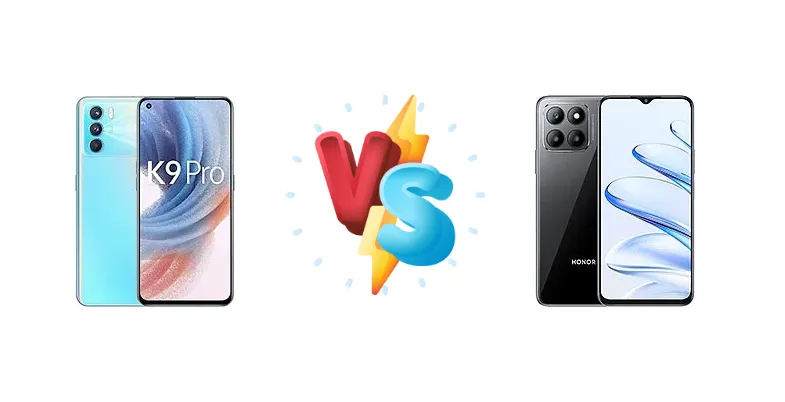
The Oppo K9 Pro and Honor 70 Lite represent distinct approaches to the mid-range 5G smartphone market. The K9 Pro, leveraging the more powerful Mediatek Dimensity 1200, aims for performance, while the Honor 70 Lite focuses on affordability with the Qualcomm Snapdragon 480+ 5G. This comparison dissects their key differences to help you determine which device best suits your priorities.
🏆 Quick Verdict
For users prioritizing performance and faster charging, the Oppo K9 Pro is the clear winner. Its Dimensity 1200 chipset offers significantly more processing power, making it ideal for gaming and demanding applications. However, the Honor 70 Lite provides a compelling value proposition for those seeking a basic 5G experience on a tighter budget.
| Network |
|---|
| 2G bands | GSM 850 / 900 / 1800 / 1900 | GSM 850 / 900 / 1800 / 1900 |
| 3G bands | HSDPA 800 / 850 / 900 / 1700(AWS) / 1900 / 2100 | HSDPA 850 / 900 / 1900 / 2100 |
| 4G bands | 1, 2, 3, 4, 5, 7, 8, 28, 34, 38, 39, 40, 41 | LTE |
| 5G bands | 1, 28, 41, 77, 78 SA/NSA | SA/NSA |
| Speed | HSPA, LTE, 5G | HSPA, LTE, 5G |
| Technology | GSM / CDMA / HSPA / CDMA2000 / LTE / 5G | GSM / HSPA / LTE / 5G |
| | CDMA2000 1x | - |
| Launch |
|---|
| Announced | 2021, September 26 | 2023, March 20 |
| Status | Available. Released 2021, October 20 | Available. Released 2023, March 31 |
| Body |
|---|
| Dimensions | 158.7 x 73.5 x 8.5 mm (6.25 x 2.89 x 0.33 in) | 163.7 x 75.1 x 8.7 mm (6.44 x 2.96 x 0.34 in) |
| SIM | Nano-SIM + Nano-SIM | Nano-SIM + Nano-SIM |
| Weight | 180 g (6.35 oz) | 194 g (6.84 oz) |
| Display |
|---|
| Resolution | 1080 x 2400 pixels, 20:9 ratio (~409 ppi density) | 720 x 1600 pixels, 20:9 ratio (~270 ppi density) |
| Size | 6.43 inches, 99.8 cm2 (~85.6% screen-to-body ratio) | 6.5 inches, 102.0 cm2 (~83.0% screen-to-body ratio) |
| Type | AMOLED, 120Hz, HDR10, 430 nits (typ), 800 nits (peak) | TFT LCD, 90Hz |
| Platform |
|---|
| CPU | Octa-core (1x3.0 GHz Cortex-A78 & 3x2.6 GHz Cortex-A78 & 4x2.0 GHz Cortex-A55) | Octa-core (2x2.2 GHz Kryo 460 & 6x1.9 GHz Kryo 460) |
| Chipset | Mediatek Dimensity 1200 (6 nm) | Qualcomm SM4350-AC Snapdragon 480+ 5G (8 nm) |
| GPU | Mali-G77 MC9 | Adreno 619 |
| OS | Android 11, ColorOS 11.3 | Android 12, upgradable to Android 14, Magic UI 8 |
| Memory |
|---|
| Card slot | No | Unspecified |
| Internal | 128GB 8GB RAM, 256GB 12GB RAM, 256GB 8GB RAM | 128GB 4GB RAM |
| | UFS 3.1 | - |
| Main Camera |
|---|
| Features | Dual-LED dual-tone flash, HDR, panorama | LED flash, HDR, panorama |
| Single | 16 MP, f/2.4, (wide) | 8 MP, f/2.0, (wide) |
| Triple | 64 MP, f/1.7, 26mm (wide), PDAF
8 MP, f/2.2, 119˚ (ultrawide)
2 MP (macro) | 50 MP, f/1.8, (wide), PDAF
2 MP (macro)
Auxiliary lens |
| Video | 4K@30fps, 1080p@30/60/120fps; gyro-EIS | 1080p@30fps |
| Selfie camera |
|---|
| Single | 16 MP, f/2.4, (wide) | 8 MP, f/2.0, (wide) |
| Video | 1080p@30fps, gyro-EIS | 1080p@30fps |
| Sound |
|---|
| 3.5mm jack | Yes | Yes |
| 35mm jack | Yes | Yes |
| Loudspeaker | Yes, with stereo speakers | Yes |
| Comms |
|---|
| Bluetooth | 5.2, A2DP, LE, aptX HD | 5.1, A2DP, LE |
| NFC | Yes | Yes |
| Positioning | GPS, GLONASS, GALILEO, BDS, QZSS | GPS, GLONASS, GALILEO, BDS |
| Radio | No | Unspecified |
| USB | USB Type-C 2.0, OTG | USB Type-C 2.0, OTG |
| WLAN | Wi-Fi 802.11 a/b/g/n/ac/6, dual-band, Wi-Fi Direct | Wi-Fi 802.11 a/b/g/n/ac, dual-band, Wi-Fi Direct |
| Features |
|---|
| Sensors | Fingerprint (under display, optical), accelerometer, gyro, proximity, compass | Fingerprint (side-mounted), accelerometer, proximity |
| | - | 24-bit/192kHz audio |
| Battery |
|---|
| Charging | 60W wired, 50% in 16 min | 22.5W wired |
| Type | Li-Po 4500 mAh | Li-Po 5000 mAh |
| Misc |
|---|
| Colors | Black, Aurora | Ocean Blue, Titanium Silver, Midnight Black |
| Models | PEYM00 | RBN-NX1 |
| Price | About 360 EUR | About 120 EUR |
Oppo K9 Pro
- Significantly faster processor (Dimensity 1200)
- Much faster 60W charging
- Likely better camera performance
- Potentially higher price
- May generate more heat under sustained load
Honor 70 Lite
- More affordable price point
- Decent 5G connectivity
- Potentially better battery life (depending on capacity)
- Slower processor (Snapdragon 480+)
- Significantly slower 22.5W charging
- Likely less capable camera
Display Comparison
Neither device's display specifications are provided, so a direct comparison is limited. However, given the K9 Pro's focus on performance, it likely features a higher refresh rate panel (potentially 120Hz) for smoother visuals. The Honor 70 Lite, targeting a lower price point, likely utilizes a standard 60Hz panel. Bezels are expected to be comparable, typical of this price bracket. Color accuracy will depend on panel calibration, a detail not available in the provided data.
Camera Comparison
Without specific camera sensor details, analysis is limited. However, the K9 Pro, positioned as a performance-focused device, likely incorporates a more capable primary sensor and potentially features Optical Image Stabilization (OIS). The Honor 70 Lite will likely rely on software processing to compensate for a less advanced sensor. The presence of a 2MP macro camera on the Honor 70 Lite is a common, but often underwhelming, feature in this segment; its utility is limited by the low resolution and lack of OIS. The K9 Pro is more likely to deliver better image quality, especially in low-light conditions.
Performance
The core difference lies in the chipsets. The Oppo K9 Pro’s Mediatek Dimensity 1200 (6nm) boasts a significantly more powerful CPU configuration – a 1x3.0 GHz Cortex-A78, 3x2.6 GHz Cortex-A78, and 4x2.0 GHz Cortex-A55 – compared to the Honor 70 Lite’s Qualcomm Snapdragon 480+ 5G (8nm) with its 2x2.2 GHz Kryo 460 and 6x1.9 GHz Kryo 460. The Dimensity 1200’s higher clock speeds and more advanced core architecture translate to substantially faster processing speeds and improved graphics performance. The 8nm process of the Snapdragon 480+ offers better efficiency than older nodes, but it can't match the raw power of the Dimensity 1200. This difference will be most noticeable in gaming and resource-intensive applications.
Battery Life
Battery capacity isn't specified for either device. However, the charging speeds are a key differentiator. The Oppo K9 Pro’s 60W wired charging is significantly faster than the Honor 70 Lite’s 22.5W charging. Oppo claims a 50% charge in just 16 minutes, offering a substantial convenience advantage. While a larger battery capacity on the Honor 70 Lite could partially offset the slower charging, the K9 Pro’s rapid charging will likely result in less downtime.
Buying Guide
Buy the Oppo K9 Pro if you need a phone capable of handling demanding games, multitasking, and benefit from significantly faster 60W charging. This is the choice for power users and mobile gamers. Buy the Honor 70 Lite if you prioritize affordability and a simple, reliable 5G experience for everyday tasks like browsing, social media, and light communication. It's a practical choice for budget-conscious users.
Frequently Asked Questions
❓ Will the Dimensity 1200 in the Oppo K9 Pro overheat during prolonged gaming sessions?
The Dimensity 1200 is a powerful chip, and while it's built on a 6nm process, it can generate heat under sustained load. Oppo likely incorporates thermal management solutions, but extended gaming at maximum settings may lead to some throttling to prevent overheating. The Honor 70 Lite's Snapdragon 480+ will likely run cooler, but at the cost of performance.
❓ Is the 5G connectivity on the Honor 70 Lite sufficient for streaming video and online gaming?
The Snapdragon 480+ 5G provides adequate 5G connectivity for typical use cases like streaming video and online gaming. However, the experience may be less consistent than on the Oppo K9 Pro, especially in areas with weaker 5G signals, due to the Dimensity 1200's more advanced modem. Expect some lag or buffering in demanding scenarios.
❓ How much faster is the 60W charging on the Oppo K9 Pro compared to the 22.5W charging on the Honor 70 Lite in real-world use?
The 60W charging on the K9 Pro is a game-changer. Oppo claims 50% charge in 16 minutes. The Honor 70 Lite's 22.5W charging will take considerably longer – likely over an hour to reach a similar charge level. This difference is significant for users who frequently need to top up their battery quickly.