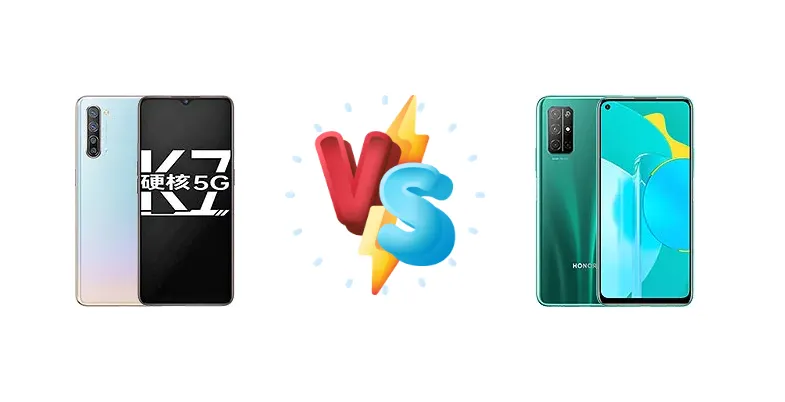
The Oppo K7 5G and Honor 30S represent compelling options in the increasingly competitive mid-range 5G smartphone market. Both devices aim to deliver a balance of performance, features, and affordability, but they achieve this through different approaches – Qualcomm’s Snapdragon 765G versus Huawei’s Kirin 820. This comparison dissects their key differences to determine which phone best suits your needs.
🏆 Quick Verdict
For the average user prioritizing consistent performance and a more established software ecosystem, the Oppo K7 5G emerges as the slightly better choice. While the Honor 30S boasts faster charging, the Snapdragon 765G’s efficiency and broader compatibility give the K7 5G a slight edge in overall usability.
| Network |
|---|
| 2G bands | GSM 850 / 900 / 1800 / 1900 | GSM 850 / 900 / 1800 / 1900 |
| 3G bands | HSDPA 800 / 850 / 900 / 1700(AWS) / 1900 / 2100 | HSDPA 800 / 850 / 900 / 1700(AWS) / 1900 / 2100 |
| 4G bands | LTE | 1, 2, 3, 4, 5, 6, 8, 18, 19, 26, 34, 38, 39, 40, 41 |
| 5G bands | SA/NSA | 1, 3, 41, 78, 79 SA/NSA |
| EDGE | No | - |
| GPRS | No | - |
| Speed | HSPA, LTE, 5G (1.9 Gbps DL) | HSPA, LTE, 5G |
| Technology | GSM / CDMA / HSPA / EVDO / LTE / 5G | GSM / CDMA / HSPA / LTE / 5G |
| | CDMA2000 1xEV-DO | CDMA 800 & TD-SCDMA |
| Launch |
|---|
| Announced | 2020, August 04. Released 2020, August 11 | 2020, March 30. Released 2020, April 07 |
| Status | Discontinued | Discontinued |
| Body |
|---|
| Build | Glass front (Gorilla Glass 5), glass back (Gorilla Glass 5), aluminum frame | Glass front (Aluminosilicate glass), glass back, aluminum frame |
| Dimensions | 160.3 x 74.3 x 8 mm (6.31 x 2.93 x 0.31 in) | 162.3 x 75 x 8.6 mm (6.39 x 2.95 x 0.34 in) |
| SIM | Nano-SIM + Nano-SIM | Nano-SIM + Nano-SIM |
| Weight | 180 g (6.35 oz) | 190 g (6.70 oz) |
| Display |
|---|
| Protection | Corning Gorilla Glass 5 | Aluminosilicate glass |
| Resolution | 1080 x 2400 pixels, 20:9 ratio (~411 ppi density) | 1080 x 2400 pixels, 20:9 ratio (~405 ppi density) |
| Size | 6.4 inches, 98.9 cm2 (~83.0% screen-to-body ratio) | 6.5 inches, 102.0 cm2 (~83.8% screen-to-body ratio) |
| Type | AMOLED, 430 nits (typ) | IPS LCD, HDR10 |
| Platform |
|---|
| CPU | Octa-core (1x2.4 GHz Kryo 475 Prime & 1x2.2 GHz Kryo 475 Gold & 6x1.8 GHz Kryo 475 Silver) | Octa-core (1x2.36 GHz Cortex-A76 & 3x2.22 GHz Cortex-A76 & 4x1.84 GHz Cortex-A55) |
| Chipset | Qualcomm SM7250 Snapdragon 765G 5G (7 nm) | Kirin 820 5G (7 nm) |
| GPU | Adreno 620 | Mali-G57 6 |
| OS | Android 10, ColorOS 7 | Android 10, Magic UI 3, no Google Play Services |
| Memory |
|---|
| Card slot | No | Nano Memory (uses shared SIM slot) |
| Internal | 128GB 8GB RAM, 256GB 8GB RAM | 128GB 6GB RAM, 128GB 8GB RAM, 256GB 8GB RAM |
| | UFS 2.1 | UFS 2.1 |
| Main Camera |
|---|
| Features | LED flash, HDR, panorama | LED flash, HDR, panorama |
| Quad | 48 MP, f/1.7, 26mm (wide), 1/2.0", 0.8µm, PDAF
8 MP, f/2.2, 13mm (ultrawide), 1/4.0", 1.12µm
2 MP B/W, f/2.4, 1/5.0", 1.75µm
Auxiliary lens | 64 MP, f/1.8, 26mm (wide), 1/1.73", 0.8µm, PDAF
8 MP, f/2.4, 80mm (telephoto), AF, 3x optical zoom
8 MP, f/2.4, 17mm (ultrawide)
Auxiliary lens |
| Video | 4K@30fps, 1080p@30/60fps; gyro-EIS | 4K@30fps, 1080p@30fps, 720p@960fps, gyro-EIS |
| Selfie camera |
|---|
| Features | HDR | HDR |
| Single | 32 MP, f/2.0, 26mm (wide), 1/2.8", 0.8µm | 16 MP, f/2.0, (wide) |
| Video | 1080p@30fps | 1080p@30fps |
| Sound |
|---|
| 3.5mm jack | Yes | Yes |
| 35mm jack | Yes | Yes |
| Loudspeaker | Yes | Yes |
| | - | 32-bit/192kHz audio |
| Comms |
|---|
| Bluetooth | 5.1, A2DP, LE | 5.1, A2DP, LE |
| NFC | Yes | No |
| Positioning | GPS (L1+L5), GLONASS (G1), BDS (B1I+B2a), GALILEO (E1+E5a), QZSS (L1+L5) | GPS, GLONASS, BDS |
| Radio | No | No |
| USB | USB Type-C 2.0, OTG | USB Type-C 2.0, OTG |
| WLAN | Wi-Fi 802.11 a/b/g/n/ac/6, dual-band, Wi-Fi Direct | Wi-Fi 802.11 a/b/g/n/ac, dual-band, Wi-Fi Direct |
| Features |
|---|
| Sensors | Fingerprint (under display, optical), accelerometer, gyro, proximity, compass | Fingerprint (side-mounted), accelerometer, gyro, proximity, compass |
| Battery |
|---|
| Charging | 30W wired, 50% in 20 min | 40W wired, 70% in 30 min |
| Type | Li-Po 4025 mAh | Li-Po 4000 mAh |
| Misc |
|---|
| Colors | Moonlight Black, Pearl White, Blue, Blue/Red | Black, Blue, Green, Gradient, Butterfly Feather Red |
| Models | A1554 | CDY-AN90, CDY-AN95, CDY-TN90 |
| Price | About 240 EUR | About 310 EUR |
Oppo K7 5G
- Qualcomm Snapdragon 765G offers strong gaming performance.
- Generally better software optimization and app compatibility.
- Potentially better battery efficiency due to Snapdragon chipset.
- Slower charging speed compared to Honor 30S.
- Display specs are unknown and likely average.
Honor 30S
- 40W fast charging provides significantly quicker top-ups.
- Huawei’s ISP often delivers vibrant image processing.
- Kirin 820 offers competitive performance in everyday tasks.
- Potential software limitations due to Huawei’s restrictions.
- Mali-G56 GPU may struggle in demanding games.
Display Comparison
Neither Oppo nor Honor provided display specs beyond the existence of a display. Assuming typical mid-range panels for the time, we can infer both likely utilize IPS LCD technology. The lack of high refresh rates or advanced features like LTPO suggests a focus on cost optimization. The real difference will likely come down to color calibration and peak brightness, areas where Oppo historically performs well. Without specific data, it's difficult to declare a clear winner.
Camera Comparison
Detailed camera specs are missing, but we can infer some differences. Both phones likely feature multi-camera setups, but the image processing philosophies differ. Huawei’s Kirin chipsets are known for their strong image signal processing (ISP), often resulting in vibrant, sometimes oversaturated, photos. Oppo typically aims for a more natural look. Without knowing sensor sizes and aperture values, it’s difficult to assess low-light performance. The presence of OIS on the main sensor would be a significant advantage for either device, but this information is unavailable.
Performance
The core of the difference lies in the chipsets. The Oppo K7 5G’s Snapdragon 765G (7nm) features an octa-core CPU with a 2.4 GHz Kryo 475 Prime core, alongside a 2.2 GHz Kryo 475 Gold core and six 1.8 GHz Kryo 475 Silver cores. The Honor 30S counters with the Kirin 820 5G (7nm), utilizing an octa-core configuration with a 2.36 GHz Cortex-A76, three 2.22 GHz Cortex-A76 cores, and four 1.84 GHz Cortex-A55 cores. While clock speeds are similar, the Snapdragon benefits from Qualcomm’s optimized CPU architecture and Adreno 620 GPU, generally providing a smoother gaming experience and better sustained performance. The Kirin 820’s Mali-G56 MP4 GPU is capable, but often falls behind the Adreno in demanding titles. The Snapdragon 765G also benefits from wider software optimization, ensuring better compatibility with popular apps and games.
Battery Life
The Honor 30S takes a clear lead in charging speed with its 40W wired charging, capable of reaching 70% charge in 30 minutes. The Oppo K7 5G offers 30W charging, reaching 50% in 20 minutes. While the K7 5G is faster initially, the 30S ultimately charges to full capacity quicker. Battery capacity is unknown for both devices, but the faster charging of the Honor 30S mitigates the impact of a potentially smaller battery. The Snapdragon 765G’s efficiency may contribute to slightly better battery life on the K7 5G during typical usage, but the 30S’s charging advantage is significant.
Buying Guide
Buy the Oppo K7 5G if you need a reliable all-rounder with a focus on gaming and a smoother software experience, benefiting from Qualcomm’s optimized drivers. Buy the Honor 30S if you prioritize the fastest possible charging speeds and are comfortable with Huawei’s EMUI software, potentially accepting some limitations in app availability and long-term software support.
Frequently Asked Questions
❓ Will the Kirin 820 in the Honor 30S overheat during prolonged gaming sessions?
The Kirin 820 is known to exhibit some thermal throttling under sustained load. While it can handle moderate gaming, extended sessions with graphically intensive titles may lead to performance drops as the chip attempts to manage heat. The Snapdragon 765G in the Oppo K7 5G generally handles heat more efficiently.
❓ Does the Oppo K7 5G support popular gaming titles like PUBG Mobile at high frame rates?
The Snapdragon 765G is capable of running PUBG Mobile at high frame rates (60fps) with optimized settings. However, achieving consistently smooth performance will depend on the specific game settings and the phone’s thermal management. The Adreno 620 GPU provides a solid foundation for mobile gaming.
❓ What are the potential software limitations of the Honor 30S due to the Huawei situation?
The Honor 30S runs on Huawei’s EMUI, which lacks full Google Mobile Services (GMS) support. This means users may need to rely on Huawei’s AppGallery and alternative methods for installing popular apps like Google Maps and YouTube. While workarounds exist, they can be less convenient.