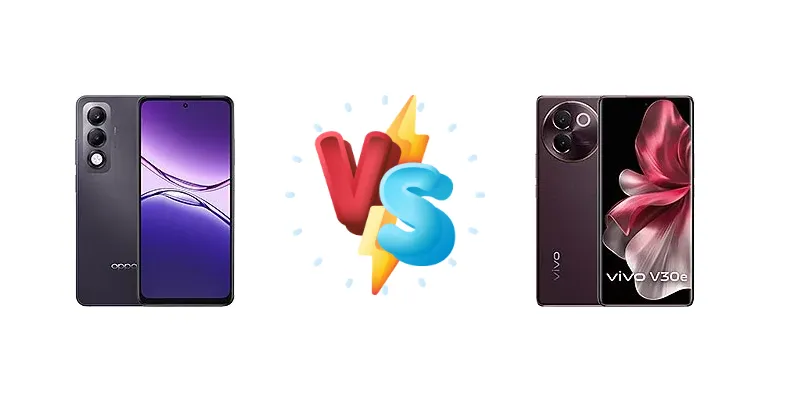
The Oppo K13x and vivo V30e represent compelling options in the increasingly competitive mid-range smartphone market. While both aim for affordability, they diverge in their core processing power – the K13x utilizing Mediatek’s Dimensity 6300 and the V30e opting for Qualcomm’s Snapdragon 6 Gen 1. This comparison will dissect these key differences, alongside their charging capabilities, to determine which device delivers the best value.
🏆 Quick Verdict
For the average user prioritizing sustained performance and efficiency, the vivo V30e edges out the Oppo K13x. The Snapdragon 6 Gen 1’s 4nm process provides a thermal advantage, translating to more consistent frame rates during extended gaming or demanding tasks, despite the K13x's slightly faster clock speeds.
| Network |
|---|
| 2G bands | GSM 850 / 900 / 1800 / 1900 | GSM 850 / 900 / 1800 / 1900 |
| 3G bands | HSDPA 900 / 2100 - K13x | HSDPA 850 / 900 / 1700(AWS) / 1900 / 2100 - Malaysia |
| 4G bands | 1, 3, 5, 8, 28, 40, 41 - K13x | 1, 2, 3, 4, 5, 7, 8, 18, 19, 20, 26, 28, 38, 39, 40, 41 - Malaysia |
| 5G bands | 1, 3, 5, 8, 28, 40, 41, 77, 78 SA/NSA - K13x | 1, 3, 5, 7, 8, 20, 28, 38, 40, 41, 77, 78 SA/NSA - Malaysia |
| Speed | HSPA, LTE, 5G | HSPA, LTE, 5G |
| Technology | GSM / HSPA / LTE / 5G | GSM / HSPA / LTE / 5G |
| Launch |
|---|
| Announced | 2025, June 23 | 2024, May 02 |
| Status | Available. Released 2025, June 27 | Available. Released 2024, May 09 |
| Body |
|---|
| Build | - | Glass front, plastic frame, glass back or plastic back |
| Dimensions | 165.7 x 76.2 x 7.9 mm (6.52 x 3.00 x 0.31 in) | 164.4 x 74.8 x 7.7 mm (6.47 x 2.94 x 0.30 in) |
| SIM | Nano-SIM + Nano-SIM | Nano-SIM + Nano-SIM |
| Weight | 194 g (6.84 oz) | 179 g or 188 g (6.31 oz) |
| Display |
|---|
| Protection | Corning Gorilla Glass 7i (Oppo A5i Pro only) | Schott Xensation |
| Resolution | 720 x 1604 pixels, 20:9 ratio (~264 ppi density) | 1080 x 2400 pixels, 20:9 ratio (~388 ppi density) |
| Size | 6.67 inches, 107.2 cm2 (~84.9% screen-to-body ratio) | 6.78 inches, 111.0 cm2 (~90.3% screen-to-body ratio) |
| Type | IPS LCD, 120Hz, 850 nits (typ), 1000 nits (HBM) | AMOLED, 1B colors, 120Hz, 1300 nits (peak) |
| Platform |
|---|
| CPU | Octa-core (2x2.4 GHz Cortex-A76 & 6x2.0 GHz Cortex-A55) | Octa-core (4x2.2 GHz Cortex-A78 & 4x1.8 GHz Cortex-A55) |
| Chipset | Mediatek Dimensity 6300 (6 nm) | Qualcomm SM6450 Snapdragon 6 Gen 1 (4 nm) |
| GPU | Mali-G57 MC2 | Adreno 710 |
| OS | Android 15, ColorOS 15 | Android 14, Funtouch 14 |
| Memory |
|---|
| Card slot | microSDXC | microSDXC (uses shared SIM slot) |
| Internal | 128GB 4GB RAM, 128GB 6GB RAM, 128GB 8GB RAM, 256GB 8GB RAM | 128GB 8GB RAM, 256GB 8GB RAM, 256GB 12GB RAM |
| Main Camera |
|---|
| Dual | 50 MP, f/1.8, 27mm (wide), 1/2.88", 0.61µm, PDAF
2 MP, f/2.4, (wide) | 50 MP, f/1.8, 26mm (wide), 1/1.95", 0.8µm, PDAF, OIS (India only)
8 MP, f/2.2, 120˚ (ultrawide), 1/4.0", 1.12µm |
| Features | LED flash, HDR, panorama | Ring-LED flash, panorama, HDR |
| Video | 1080p@30/60fps | 4K@30fps, 1080p@30fps |
| Selfie camera |
|---|
| Features | Panorama | - |
| Single | 8 MP, f/2.0, 25mm (wide), 1/4.0", 1.12µm | 50 MP, f/2.5, 25mm (wide), AF - India
32 MP, f/2.0, 24mm (wide) - Malaysia |
| Video | 1080p@30fps | 4K@30fps (India only), 1080p@30fps |
| Sound |
|---|
| 35mm jack | Yes | No |
| Loudspeaker | Yes | Yes |
| Comms |
|---|
| Bluetooth | 5.4, A2DP, LE, aptX HD | 5.1, A2DP, LE |
| NFC | Yes (only A5i Pro) | Yes (market/region dependent) |
| Positioning | GPS, GALILEO, GLONASS, BDS, QZSS | GPS, GLONASS, GALILEO, BDS, QZSS, NavIC |
| Radio | Unspecified | No |
| USB | USB Type-C 2.0, OTG | USB Type-C 2.0, OTG |
| WLAN | Wi-Fi 802.11 a/b/g/n/ac, dual-band | Wi-Fi 802.11 a/b/g/n/ac, dual-band |
| Features |
|---|
| Sensors | Fingerprint (side-mounted), accelerometer, proximity, compass | Fingerprint (under display, optical), accelerometer, gyro, proximity, compass |
| Battery |
|---|
| Charging | 45W wired, 33W PPS, 13.5W PD, 50% in 37 min | 44W wired, PD
Reverse wired |
| Type | 6000 mAh | Li-Ion 5500 mAh |
| Misc |
|---|
| Colors | Sunset Peach, Midnight Violet (Midnight Purple), Breeze Blue | Velvet Red (Coco Brown), Silk Blue, Sky Mirror |
| Models | CPH2753, CPH2821 | V2339 |
| Price | ₹ 10,798 | ₹ 23,999 |
| SAR | 1.18 W/kg (head) 1.05 W/kg (body) | - |
Oppo K13x
- Faster 45W charging with PPS and PD support
- Potentially higher peak CPU performance
- Likely more affordable price point
- Less efficient 6nm chipset
- Potential for thermal throttling under sustained load
- Older CPU core architecture (A76)
vivo V30e
- More efficient 4nm Snapdragon 6 Gen 1 chipset
- Better thermal management for sustained performance
- Newer CPU core architecture (A78)
- Reverse wired charging
- Slightly slower charging speed (44W)
- Potentially higher price point
- Lower peak CPU clock speeds
Display Comparison
Display specifications are not provided, so a direct comparison is limited. However, given the price bracket, both are likely to feature 6.6-6.7 inch LCD panels with FHD+ resolution. The absence of LTPO technology suggests neither will offer adaptive refresh rates. Bezels are expected to be similar, and color accuracy will likely be tuned for vibrant, rather than color-accurate, visuals. The user experience will likely be similar in terms of visual fidelity.
Camera Comparison
Camera details are unavailable beyond the existence of cameras. Assuming typical configurations for this price point, both phones will likely feature a primary camera, an ultrawide, and potentially a macro lens. The Snapdragon 6 Gen 1’s ISP (Image Signal Processor) is generally more advanced, potentially leading to better image processing, especially in low-light conditions. Without sensor size or aperture information, it’s difficult to definitively declare a winner, but Qualcomm’s image processing algorithms give the V30e a slight edge.
Performance
The core difference lies in the chipsets. The Oppo K13x’s Dimensity 6300 (6nm) features a 2x2.4 GHz Cortex-A76 and 6x2.0 GHz Cortex-A55 configuration. The vivo V30e’s Snapdragon 6 Gen 1 (4nm) employs a 4x2.2 GHz Cortex-A78 and 4x1.8 GHz Cortex-A55 setup. While the K13x boasts higher peak clock speeds on its prime cores, the Snapdragon 6 Gen 1’s 4nm process offers superior power efficiency and thermal management. This means the V30e is less likely to throttle under sustained load, providing more consistent performance in games and demanding applications. The Snapdragon's newer Cortex-A78 cores also offer a performance uplift over the K13x's A76 cores. Both devices likely utilize LPDDR4X RAM, limiting memory bandwidth.
Battery Life
Battery capacity is not specified. However, the charging speeds are a key differentiator. The Oppo K13x supports 45W wired charging with PPS and PD, claiming a 50% charge in 37 minutes. The vivo V30e offers 44W wired charging with PD and reverse wired charging. While the wattage is similar, the inclusion of PPS on the K13x suggests more efficient charging with compatible chargers. The reverse wired charging on the V30e is a convenient feature for topping up accessories. The actual 0-100% charge time will depend on battery capacity, but the K13x’s slightly higher wattage and PPS support likely translate to a faster overall charge.
Buying Guide
Buy the Oppo K13x if you need rapid charging and prioritize peak CPU performance for short bursts, like app loading and quick tasks. Its 45W charging with PPS and PD support offers faster top-ups. Buy the vivo V30e if you prefer a more efficient chipset for longer gaming sessions and all-day use, benefiting from the Snapdragon 6 Gen 1’s 4nm fabrication and optimized power management.
Frequently Asked Questions
❓ Will the Dimensity 6300 in the Oppo K13x struggle with graphically intensive games like Genshin Impact?
While the Dimensity 6300 can run Genshin Impact, expect to play at lower graphics settings to maintain a stable frame rate. The 6nm process and potential for thermal throttling may limit sustained performance compared to the Snapdragon 6 Gen 1 in the vivo V30e, which is better equipped for longer gaming sessions.
❓ Does the vivo V30e's reverse wired charging work with any device, or is it limited to vivo accessories?
The vivo V30e's reverse wired charging utilizes the PD standard, meaning it should work with any device that supports PD charging, including smartphones, earbuds, and other compatible accessories. However, charging speeds may vary depending on the device's power requirements.
❓ Is the difference in CPU clock speeds between the Dimensity 6300 and Snapdragon 6 Gen 1 noticeable in everyday tasks?
For typical everyday tasks like browsing, social media, and messaging, the difference in CPU clock speeds is unlikely to be noticeable. The Snapdragon 6 Gen 1’s efficiency and newer core architecture provide a smoother overall experience, especially when multitasking, but the K13x will feel responsive for basic usage.