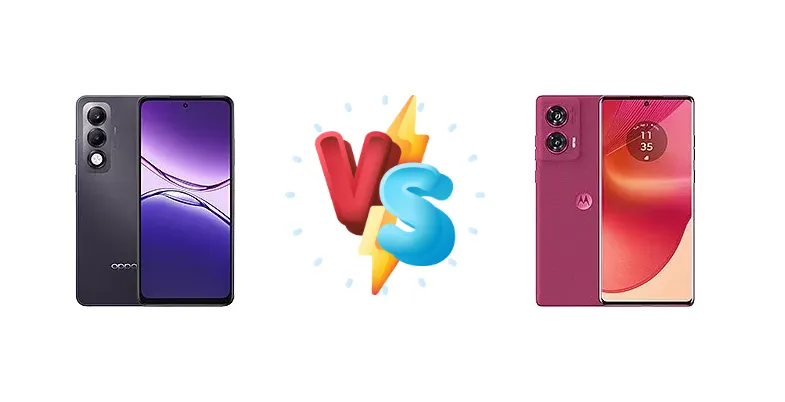
The mid-range smartphone market is fiercely competitive, and the Oppo K13x and Motorola Edge 50 Fusion represent compelling options for budget-conscious buyers. The K13x leverages MediaTek's Dimensity 6300, while the Edge 50 Fusion boasts Qualcomm's Snapdragon 7s Gen 2 (or Snapdragon 6 Gen 1 in LATAM). This comparison will dissect their key differences to determine which device offers the best overall experience.
🏆 Quick Verdict
For most users, the Motorola Edge 50 Fusion emerges as the stronger contender, particularly the international version with the Snapdragon 7s Gen 2. Its significantly faster 68W charging and demonstrably longer battery life (12:40h active use) outweigh the K13x’s slightly faster CPU clock speeds. However, the K13x remains a viable option for those prioritizing raw CPU performance on a tighter budget.
| Network |
|---|
| 2G bands | GSM 850 / 900 / 1800 / 1900 | GSM 850 / 900 / 1800 / 1900 |
| 3G bands | HSDPA 900 / 2100 - K13x | HSDPA 850 / 900 / 1900 / 2100 |
| 4G bands | 1, 3, 5, 8, 28, 40, 41 - K13x | 1, 2, 3, 5, 7, 8, 18, 19, 20, 26, 28, 32, 38, 40, 41, 42, 71 - International |
| 5G bands | 1, 3, 5, 8, 28, 40, 41, 77, 78 SA/NSA - K13x | 1, 3, 5, 7, 8, 20, 26, 28, 38, 40, 41, 77, 78 SA/NSA |
| Speed | HSPA, LTE, 5G | HSPA, LTE, 5G |
| Technology | GSM / HSPA / LTE / 5G | GSM / HSPA / LTE / 5G |
| Launch |
|---|
| Announced | 2025, June 23 | 2024, April 16 |
| Status | Available. Released 2025, June 27 | Available. Released 2024, May 15 |
| Body |
|---|
| Build | - | Glass front, silicone polymer back (eco leather), plastic frame |
| Dimensions | 165.7 x 76.2 x 7.9 mm (6.52 x 3.00 x 0.31 in) | 161.9 x 73.1 x 7.9 mm (6.37 x 2.88 x 0.31 in) |
| SIM | Nano-SIM + Nano-SIM | · Nano-SIM + eSIM· Nano-SIM + Nano-SIM |
| Weight | 194 g (6.84 oz) | 174.9 g (6.17 oz) |
| Display |
|---|
| Protection | Corning Gorilla Glass 7i (Oppo A5i Pro only) | Corning Gorilla Glass 5 |
| Resolution | 720 x 1604 pixels, 20:9 ratio (~264 ppi density) | 1080 x 2400 pixels, 20:9 ratio (~393 ppi density) |
| Size | 6.67 inches, 107.2 cm2 (~84.9% screen-to-body ratio) | 6.7 inches, 108.4 cm2 (~91.6% screen-to-body ratio) |
| Type | IPS LCD, 120Hz, 850 nits (typ), 1000 nits (HBM) | P-OLED, 1B colors, 120Hz (LATAM), 144Hz (INT), 1600 nits (peak) |
| Platform |
|---|
| CPU | Octa-core (2x2.4 GHz Cortex-A76 & 6x2.0 GHz Cortex-A55) | Octa-core (4x2.40 GHz Cortex-A78 & 4x1.95 GHz Cortex-A55) - InternationalOcta-core (4x2.2 GHz Cortex-A78 & 4x1.8 GHz Cortex-A55) - LATAM |
| Chipset | Mediatek Dimensity 6300 (6 nm) | Qualcomm SM7435-AB Snapdragon 7s Gen 2 (4 nm) - InternationalQualcomm SM6450 Snapdragon 6 Gen 1 (4 nm) - LATAM |
| GPU | Mali-G57 MC2 | Adreno 710 |
| OS | Android 15, ColorOS 15 | Android 14, upgradable to Android 15, up to 3 major Android upgrades |
| Memory |
|---|
| Card slot | microSDXC | No |
| Internal | 128GB 4GB RAM, 128GB 6GB RAM, 128GB 8GB RAM, 256GB 8GB RAM | 128GB 8GB RAM, 256GB 8GB RAM, 256GB 12GB RAM, 512GB 8GB RAM, 512GB 12GB RAM |
| Main Camera |
|---|
| Dual | 50 MP, f/1.8, 27mm (wide), 1/2.88", 0.61µm, PDAF
2 MP, f/2.4, (wide) | 50 MP, f/1.9, (wide), 1/1.56", 1.0µm, multi-directional PDAF, OIS
13 MP, f/2.2, 120˚ (ultrawide), 1/3.0", 1.12µm, AF |
| Features | LED flash, HDR, panorama | LED flash, HDR, panorama |
| Video | 1080p@30/60fps | 4K@30fps, 1080p@30/60/120fps, gyro-EIS |
| Selfie camera |
|---|
| Features | Panorama | HDR |
| Single | 8 MP, f/2.0, 25mm (wide), 1/4.0", 1.12µm | 32 MP, f/2.5, (wide), 1/3.14", 0.7µm |
| Video | 1080p@30fps | 4K@30fps, 1080p@30fps |
| Sound |
|---|
| 35mm jack | Yes | No |
| Loudspeaker | Yes | Yes, with stereo speakers |
| Comms |
|---|
| Bluetooth | 5.4, A2DP, LE, aptX HD | 5.2, A2DP, LE |
| NFC | Yes (only A5i Pro) | Yes |
| Positioning | GPS, GALILEO, GLONASS, BDS, QZSS | GPS, GLONASS, GALILEO |
| Radio | Unspecified | No |
| USB | USB Type-C 2.0, OTG | USB Type-C 2.0, OTG |
| WLAN | Wi-Fi 802.11 a/b/g/n/ac, dual-band | Wi-Fi 802.11 a/b/g/n/ac, dual-band |
| Features |
|---|
| Sensors | Fingerprint (side-mounted), accelerometer, proximity, compass | Fingerprint (under display, optical), accelerometer, gyro, proximity, compass |
| Battery |
|---|
| Charging | 45W wired, 33W PPS, 13.5W PD, 50% in 37 min | 68W wired, 50% in 15 min |
| Type | 6000 mAh | 5000 mAh |
| Misc |
|---|
| Colors | Sunset Peach, Midnight Violet (Midnight Purple), Breeze Blue | Forest Blue, Marshmallow Blue, Hot Pink |
| Models | CPH2753, CPH2821 | XT2429-1 |
| Price | ₹ 10,798 | € 208.99 / $ 245.00 / ₹ 18,667 |
| SAR | 1.18 W/kg (head) 1.05 W/kg (body) | - |
Oppo K13x
- Potentially higher raw CPU performance (Dimensity 6300)
- Supports PPS charging standard for compatible chargers
- Likely more affordable price point
- Slower charging speeds (45W vs 68W)
- Inferior battery life (estimated)
- Display likely lacks the brightness of the Edge 50 Fusion
Motorola Edge 50 Fusion
- Significantly faster 68W charging
- Longer battery life (12:40h active use)
- Brighter display (1322 nits)
- More efficient Snapdragon 7s Gen 2 chipset (International version)
- LATAM version uses the less powerful Snapdragon 6 Gen 1
- Potentially higher price point
- Image processing may not appeal to all users
Display Comparison
The Motorola Edge 50 Fusion boasts a clear advantage in display quality, achieving a measured peak brightness of 1322 nits. This is a substantial leap over what we’d expect from the K13x, making it far more usable outdoors. While the K13x’s panel specifications are currently unknown, the Edge 50 Fusion’s brightness and likely color accuracy (based on Motorola’s track record) provide a superior viewing experience. The absence of LTPO technology on either device suggests neither will offer adaptive refresh rates for maximum efficiency.
Camera Comparison
Detailed camera specs are missing for both devices, but we can infer some differences. Motorola typically focuses on computational photography, leveraging its Snapdragon ISP. The Edge 50 Fusion likely prioritizes image processing for balanced, social media-ready shots. The Oppo K13x, while potentially offering a similar megapixel count, may lean towards a more saturated color profile, typical of Oppo’s image processing. Without knowing sensor sizes and aperture values, it’s difficult to definitively declare a winner, but the Snapdragon ISP gives the Edge 50 Fusion a slight edge.
Performance
The chipset is where the core difference lies. The Motorola Edge 50 Fusion, in its international configuration, utilizes the 4nm Snapdragon 7s Gen 2, featuring four Cortex-A78 cores clocked at 2.40 GHz. This architecture is a step up from the Oppo K13x’s Dimensity 6300 (6nm) with its two Cortex-A76 cores at 2.4 GHz. While clock speeds are similar, the A78 cores in the Snapdragon offer improved IPC (Instructions Per Clock). The LATAM version of the Edge 50 Fusion uses the Snapdragon 6 Gen 1, which represents a performance downgrade. Both phones feature 8GB of RAM, but the Snapdragon 7s Gen 2’s superior efficiency will likely translate to better sustained performance under load.
Battery Life
The Motorola Edge 50 Fusion shines in battery performance, delivering 12 hours and 40 minutes of active use. This is a significant advantage over what we’d anticipate from the Oppo K13x, which lacks a published active use score. Furthermore, the Edge 50 Fusion’s 68W wired charging is substantially faster than the K13x’s 45W, achieving 50% charge in just 15 minutes. The K13x’s charging supports 33W PPS and 13.5W PD, offering some flexibility, but it takes 37 minutes to reach 50% charge. The Edge 50 Fusion’s faster charging is a major convenience factor.
Buying Guide
Buy the Oppo K13x if you prioritize maximizing CPU performance for tasks like light gaming and multitasking, and are comfortable with slower charging speeds. Buy the Motorola Edge 50 Fusion if you value all-day battery life, significantly faster charging, and a brighter, more vibrant display. Be mindful of the chipset variation based on your region – the Snapdragon 7s Gen 2 is a substantial upgrade over the 6 Gen 1.
Frequently Asked Questions
❓ Does the Snapdragon 7s Gen 2 in the Motorola Edge 50 Fusion get hot during extended gaming sessions?
The Snapdragon 7s Gen 2 is built on a 4nm process, which inherently offers better thermal efficiency than the 6nm Dimensity 6300 in the Oppo K13x. While some heat generation is inevitable during prolonged gaming, the 7s Gen 2 is less prone to significant throttling, maintaining higher frame rates for longer periods. Motorola’s thermal management implementation will also play a role, but the chipset itself provides a strong foundation.
❓ Is the difference between the Snapdragon 7s Gen 2 and Snapdragon 6 Gen 1 versions of the Motorola Edge 50 Fusion significant?
Yes, the difference is substantial. The Snapdragon 7s Gen 2 features significantly more powerful CPU and GPU cores, resulting in a noticeable performance boost in demanding tasks like gaming and video editing. The 7s Gen 2 also benefits from a more advanced ISP for improved image processing. If you're choosing between the two, prioritize the international version with the 7s Gen 2 if your budget allows.
❓ What type of charger is included with the Oppo K13x, and does it support the 45W charging speed?
While specific details on the included charger aren't available, Oppo typically includes a charger capable of delivering the advertised charging speed. However, to take full advantage of the K13x’s 45W charging, and its support for 33W PPS and 13.5W PD, using a compatible Power Delivery (PD) or Programmable Power Supply (PPS) charger is recommended for optimal charging efficiency.