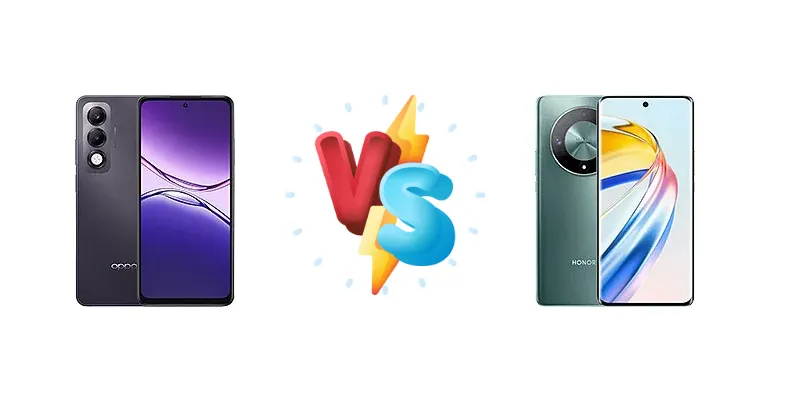
The Oppo K13x and Honor X9b represent compelling options in the increasingly competitive mid-range smartphone market. The K13x leverages MediaTek’s Dimensity 6300, while the X9b opts for Qualcomm’s Snapdragon 6 Gen 1. This comparison will dissect their key differences, focusing on performance, charging speeds, and overall value to help you determine which device best suits your needs.
🏆 Quick Verdict
For the average user prioritizing sustained performance and efficient power usage, the Honor X9b emerges as the stronger contender. Its 4nm Snapdragon 6 Gen 1 offers a more refined architecture and better thermal characteristics than the Oppo K13x’s 6nm Dimensity 6300, despite a slightly lower peak CPU clock speed.
| Network |
|---|
| 2G bands | GSM 850 / 900 / 1800 / 1900 | GSM 850 / 900 / 1800 / 1900 |
| 3G bands | HSDPA 900 / 2100 - K13x | HSDPA 850 / 900 / 1900 / 2100 |
| 4G bands | 1, 3, 5, 8, 28, 40, 41 - K13x | 1, 2, 3, 4, 5, 7, 8, 20, 28, 32, 38, 40, 41 |
| 5G bands | 1, 3, 5, 8, 28, 40, 41, 77, 78 SA/NSA - K13x | 1, 3, 7, 8, 20, 28, 38, 40, 41, 77, 78 SA/NSA |
| Speed | HSPA, LTE, 5G | HSPA, LTE, 5G |
| Technology | GSM / HSPA / LTE / 5G | GSM / HSPA / LTE / 5G |
| Launch |
|---|
| Announced | 2025, June 23 | 2023, October 18 |
| Status | Available. Released 2025, June 27 | Available. Released 2023, October |
| Body |
|---|
| Dimensions | 165.7 x 76.2 x 7.9 mm (6.52 x 3.00 x 0.31 in) | 163.6 x 75.5 x 8 mm (6.44 x 2.97 x 0.31 in) |
| SIM | Nano-SIM + Nano-SIM | Nano-SIM + Nano-SIM |
| Weight | 194 g (6.84 oz) | 185 g (6.53 oz) |
| Display |
|---|
| Protection | Corning Gorilla Glass 7i (Oppo A5i Pro only) | - |
| Resolution | 720 x 1604 pixels, 20:9 ratio (~264 ppi density) | 1220 x 2652 pixels, 19.5:9 ratio (~431 ppi density) |
| Size | 6.67 inches, 107.2 cm2 (~84.9% screen-to-body ratio) | 6.78 inches, 112.6 cm2 (~91.2% screen-to-body ratio) |
| Type | IPS LCD, 120Hz, 850 nits (typ), 1000 nits (HBM) | AMOLED, 1B colors, 120Hz, 1200 nits (peak) |
| Platform |
|---|
| CPU | Octa-core (2x2.4 GHz Cortex-A76 & 6x2.0 GHz Cortex-A55) | Octa-core (4x2.2 GHz Cortex-A78 & 4x1.8 GHz Cortex-A55) |
| Chipset | Mediatek Dimensity 6300 (6 nm) | Qualcomm SM6450 Snapdragon 6 Gen 1 (4 nm) |
| GPU | Mali-G57 MC2 | Adreno 710 |
| OS | Android 15, ColorOS 15 | Android 13, Magic OS 7.2 |
| Memory |
|---|
| Card slot | microSDXC | No |
| Internal | 128GB 4GB RAM, 128GB 6GB RAM, 128GB 8GB RAM, 256GB 8GB RAM | 256GB 8GB RAM, 256GB 12GB RAM, 512GB 8GB RAM, 512GB 12GB RAM |
| Main Camera |
|---|
| Dual | 50 MP, f/1.8, 27mm (wide), 1/2.88", 0.61µm, PDAF
2 MP, f/2.4, (wide) | - |
| Features | LED flash, HDR, panorama | LED flash, panorama, HDR |
| Triple | - | 108 MP, f/1.8, (wide), 1/1.67", PDAF
5 MP, f/2.2, (ultrawide)
2 MP (macro) |
| Video | 1080p@30/60fps | 4K@30fps, 1080p@30fps |
| Selfie camera |
|---|
| Features | Panorama | - |
| Single | 8 MP, f/2.0, 25mm (wide), 1/4.0", 1.12µm | 16 MP, f/2.5, (wide) |
| Video | 1080p@30fps | 1080p@30fps |
| Sound |
|---|
| 35mm jack | Yes | No |
| Loudspeaker | Yes | Yes |
| Comms |
|---|
| Bluetooth | 5.4, A2DP, LE, aptX HD | 5.1, A2DP, LE |
| Infrared port | - | Yes |
| NFC | Yes (only A5i Pro) | Yes (market/region dependent) |
| Positioning | GPS, GALILEO, GLONASS, BDS, QZSS | GPS, GLONASS, GALILEO, BDS |
| Radio | Unspecified | No |
| USB | USB Type-C 2.0, OTG | USB Type-C 2.0, OTG |
| WLAN | Wi-Fi 802.11 a/b/g/n/ac, dual-band | Wi-Fi 802.11 a/b/g/n/ac, dual-band, Wi-Fi Direct |
| Features |
|---|
| Sensors | Fingerprint (side-mounted), accelerometer, proximity, compass | Fingerprint (under display, optical), accelerometer, gyro, proximity, compass |
| Battery |
|---|
| Charging | 45W wired, 33W PPS, 13.5W PD, 50% in 37 min | 35W wired
Reverse wired |
| Type | 6000 mAh | Li-Po 5800 mAh |
| Misc |
|---|
| Colors | Sunset Peach, Midnight Violet (Midnight Purple), Breeze Blue | Sunrise Orange, Midnight Black, Emerald Green |
| Models | CPH2753, CPH2821 | ALI-NX1 |
| Price | ₹ 10,798 | About 970 EUR |
| SAR | 1.18 W/kg (head) 1.05 W/kg (body) | - |
Oppo K13x
- Faster 45W wired charging with PPS and PD support
- Potentially higher peak CPU clock speeds
- Likely more aggressive software optimizations for quick app launches
- 6nm process node leads to higher heat generation
- Dimensity 6300 may throttle under sustained load
- No reverse wired charging
Honor X9b
- More efficient 4nm Snapdragon 6 Gen 1 chipset
- Better sustained performance and thermal management
- Reverse wired charging capability
- Slower 35W wired charging
- Lower peak CPU clock speeds
- Potentially less aggressive software optimizations
Display Comparison
Neither device’s display specifications are provided, so a direct comparison is limited. However, given the price bracket, we can assume both utilize LCD panels. The absence of LTPO technology suggests neither will offer adaptive refresh rates for power saving. Bezels are likely comparable, and color accuracy will depend on software calibration. The key differentiator, if any, will be peak brightness, which is currently unknown.
Camera Comparison
Without specific camera sensor details, a detailed comparison is impossible. However, it’s reasonable to assume both phones will feature a multi-camera setup with a primary sensor, ultrawide, and potentially a macro lens. The absence of information regarding OIS (Optical Image Stabilization) suggests neither phone likely includes it. Image processing will be a key differentiator, with Oppo typically favoring vibrant, saturated colors and Honor leaning towards more natural tones. The quality of the main sensor will be the most significant factor in image quality.
Performance
The core of the difference lies in the chipsets. The Honor X9b’s Snapdragon 6 Gen 1 (4nm) utilizes a more modern fabrication process than the Oppo K13x’s Dimensity 6300 (6nm). While the Dimensity 6300 boasts higher clock speeds on its prime Cortex-A76 cores (2.4 GHz vs 2.2 GHz on the X9b’s Cortex-A78 cores), the Snapdragon 6 Gen 1’s architecture and process node provide superior efficiency and sustained performance. The Cortex-A78 cores in the Snapdragon are generally more efficient than the A76, and the 4nm process reduces heat generation. This translates to less throttling during demanding tasks. The K13x’s CPU configuration (2x2.4 GHz A76 & 6x2.0 GHz A55) is paired with the Dimensity 6300, while the X9b uses 4x2.2 GHz A78 & 4x1.8 GHz A55. The X9b’s configuration is better suited for multi-threaded workloads.
Battery Life
The Oppo K13x’s 45W wired charging is a clear advantage over the Honor X9b’s 35W charging. The K13x also supports 33W PPS and 13.5W PD, offering broader compatibility with chargers. The K13x claims a 50% charge in 37 minutes, a substantial benefit for users who need a quick top-up. While battery capacity isn’t specified, the Snapdragon 6 Gen 1’s superior efficiency in the X9b may offset a potentially smaller battery size, resulting in comparable real-world battery life. The X9b also offers reverse wired charging, a feature absent on the K13x.
Buying Guide
Buy the Oppo K13x if you prioritize faster wired charging and are frequently topping up your battery throughout the day. Its 45W charging, with PPS and PD support, provides a significant advantage. Buy the Honor X9b if you value consistent performance during extended use, such as gaming or multitasking, and appreciate the efficiency benefits of a 4nm process node. The X9b is the better choice for users who want a phone that won’t throttle as quickly under load.
Frequently Asked Questions
❓ Will the Dimensity 6300 in the Oppo K13x struggle with graphically demanding games like Genshin Impact?
While the Dimensity 6300 can run Genshin Impact, expect to lower graphics settings to maintain a stable frame rate. The 6nm process and potential for thermal throttling may limit sustained performance during extended gaming sessions. The Snapdragon 6 Gen 1 in the Honor X9b is better equipped to handle demanding games with more consistent frame rates due to its 4nm process and more efficient architecture.
❓ How much faster is the 45W charging on the Oppo K13x compared to the 35W charging on the Honor X9b in real-world use?
The Oppo K13x’s 45W charging will noticeably reduce charging times. While a full 0-100% time isn’t specified, the claimed 50% charge in 37 minutes indicates a significantly faster charging speed. The Honor X9b’s 35W charging will still be adequate, but will take longer to fully replenish the battery. The K13x’s support for PPS and PD also offers greater charger compatibility.
❓ Does the Snapdragon 6 Gen 1 in the Honor X9b support 5G connectivity?
Yes, the Qualcomm Snapdragon 6 Gen 1 inherently supports 5G connectivity. However, 5G availability also depends on carrier support and regional infrastructure. The Oppo K13x’s 5G capabilities are not explicitly stated, but given its chipset, it likely also supports 5G.