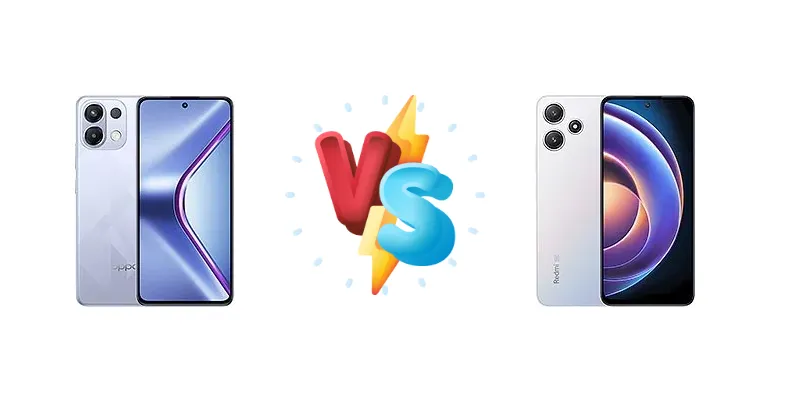
The Oppo K13 and Xiaomi Redmi Note 12R represent compelling options in the increasingly competitive budget smartphone market. While both devices leverage Qualcomm's 4nm process technology, they target slightly different user priorities. The K13 prioritizes processing power with the newer Snapdragon 6 Gen 4, while the Note 12R aims for affordability with the Snapdragon 4 Gen 2. This comparison dissects the key differences to help you choose the right device.
🏆 Quick Verdict
For users prioritizing performance and faster charging, the Oppo K13 is the clear winner. Its Snapdragon 6 Gen 4 chipset delivers a noticeable upgrade over the Redmi Note 12R's Snapdragon 4 Gen 2. However, the Redmi Note 12R remains a strong contender for budget-conscious buyers who value simplicity and efficiency.
| Network |
|---|
| 2G bands | GSM 850 / 900 / 1800 / 1900 | GSM 850 / 900 / 1800 / 1900 |
| 3G bands | HSDPA 850 / 900 / 2100 | HSDPA 850 / 900 / 2100 |
| 4G bands | 1, 3, 5, 8, 28, 34, 38, 39, 40, 41, 42, 48 - China | 1, 3, 5, 8, 34, 38, 39, 40, 41 |
| 5G bands | 1, 5, 8, 28, 41, 77, 78 SA/NSA - China | 1, 5, 8, 28, 41, 78 SA/NSA |
| Speed | HSPA, LTE, 5G | HSPA, LTE, 5G |
| Technology | GSM / HSPA / LTE / 5G | GSM / CDMA / HSPA / EVDO / LTE / 5G |
| Launch |
|---|
| Announced | 2025, April 21 | 2023, June 28 |
| Status | Available. Released 2025, April 25 | Available. Released 2023, June 28 |
| Body |
|---|
| Build | - | Glass front, plastic frame, glass back |
| Dimensions | 163.2 x 76.1 x 8.5 mm (6.43 x 3.00 x 0.33 in) | 168.6 x 76.3 x 8.2 mm (6.64 x 3.00 x 0.32 in) |
| SIM | Nano-SIM + Nano-SIM | Nano-SIM + Nano-SIM |
| Weight | 208 g (7.34 oz) | 199 g (7.02 oz) |
| Display |
|---|
| Resolution | 1080 x 2400 pixels, 20:9 ratio (~395 ppi density) | 1080 x 2460 pixels (~396 ppi density) |
| Size | 6.67 inches, 107.4 cm2 (~86.5% screen-to-body ratio) | 6.79 inches, 109.5 cm2 (~85.1% screen-to-body ratio) |
| Type | AMOLED, 120Hz, 1920Hz PWM, 600 nits (typ), 1200 nits (peak) | IPS LCD, 90Hz, 550 nits |
| Platform |
|---|
| CPU | Octa-core (1x2.3 GHz Cortex-A720s & 3x2.2 GHz Cortex-A720s & 4x1.8 GHz Cortex-A520s) | Octa-core (2x2.2 GHz Cortex-A78 & 6x1.95 GHz Cortex-A55) |
| Chipset | Qualcomm Snapdragon 6 Gen 4 (4 nm) | Qualcomm SM4450 Snapdragon 4 Gen 2 (4 nm) |
| GPU | Adreno 810 | Adreno 613 |
| OS | Android 15, up to 2 major Android upgrades, ColorOS 15 | Android 13, MIUI 14 |
| Memory |
|---|
| Card slot | No | microSDXC (uses shared SIM slot) |
| Internal | 128GB 8GB RAM, 256GB 8GB RAM, 256GB 12GB RAM, 512GB 12GB RAM | 128GB 4GB RAM, 128GB 6GB RAM, 128GB 8GB RAM, 256GB 8GB RAM |
| Main Camera |
|---|
| Dual | 50 MP, f/1.9, 27mm (wide), 1/2.88", PDAF
Auxiliary lens | 50 MP, f/1.8, (wide), PDAF
2 MP (macro) |
| Features | LED flash, HDR, panorama | LED flash, HDR |
| Video | 4K@30fps, 1080p@30/60/120fps, gyro-EIS | 1080p@30fps |
| Selfie camera |
|---|
| Features | - | HDR |
| Single | 16 MP, f/2.5, 23mm (wide), 1/3.0", 1.0µm | 5 MP, f/2.2, (wide), 1/5.0", 1.12µm |
| Video | 1080p@30fps, gyro-EIS | 1080p@30fps |
| Sound |
|---|
| 35mm jack | No | Yes |
| Loudspeaker | Yes, with stereo speakers | Yes |
| Comms |
|---|
| Bluetooth | 5.2, A2DP, LE, aptX HD | 5.3, A2DP, LE |
| Infrared port | Yes | Yes |
| NFC | NFC (China only) | Yes (market/region dependent) |
| Positioning | GPS, GALILEO, GLONASS, BDS, QZSS | GPS, GLONASS, GALILEO, BDS |
| Radio | No | No |
| USB | USB Type-C 2.0, OTG | USB Type-C |
| WLAN | Wi-Fi 802.11 a/b/g/n/ac/6, dual-band | Wi-Fi 802.11 a/b/g/n/ac, dual-band |
| Features |
|---|
| Sensors | Fingerprint (under display, optical), accelerometer, gyro, proximity, compass | Fingerprint (side-mounted), accelerometer, compass |
| Battery |
|---|
| Charging | 80W wired, 33W PPS, PD, QC, 62% in 30 min, 100% in 56 min | 18W wired, PD |
| Type | Si/C Li-Ion 7000 mAh | Li-Po 5000 mAh |
| Misc |
|---|
| Colors | Icy Purple, Prism Black, White | Black, Blue, Silver |
| Models | CPH2729, PLD110 | 23076RA4BC |
| Price | About 190 EUR | About 150 EUR |
Oppo K13
- Significantly faster charging (80W)
- More powerful Snapdragon 6 Gen 4 chipset
- Potentially smoother display with higher refresh rate
- Likely higher price point
- May have less battery capacity to offset charging speed
Xiaomi Redmi Note 12R
- More affordable price
- Efficient Snapdragon 4 Gen 2 chipset for basic tasks
- Simple and user-friendly experience
- Slow charging speed (18W)
- Less powerful chipset for demanding applications
Display Comparison
Neither device's display specifications are provided, so a direct comparison is limited. However, given the K13's positioning, it's reasonable to expect a higher refresh rate panel (90Hz or 120Hz) compared to the Note 12R, potentially offering smoother scrolling and animations. The K13's slightly higher price point suggests a potentially brighter display with better color accuracy, though this remains speculative without further data. Bezels are likely comparable, focusing on maximizing screen real estate within their respective price brackets.
Camera Comparison
Without detailed camera specifications, a comprehensive comparison is difficult. However, it's likely the Oppo K13 will feature a more sophisticated camera system, potentially with a larger main sensor and more advanced image processing algorithms. The K13's higher price point allows for investment in better optics and software. The Redmi Note 12R will likely focus on providing adequate image quality for everyday use, but may struggle in low-light conditions or with dynamic range. The presence of a 2MP macro camera on either device is unlikely to significantly impact image quality, serving primarily as a marketing feature.
Performance
The core difference lies in the chipsets. The Oppo K13's Snapdragon 6 Gen 4, built on a 4nm process, features an octa-core configuration with a prime Cortex-A720s core clocked at 2.3 GHz. This architecture represents a significant step up from the Redmi Note 12R's Snapdragon 4 Gen 2, which utilizes a Cortex-A78 based configuration. The A720s cores in the K13 offer improved single-core performance, crucial for responsive app launches and general usability. The Note 12R's A78 cores are still capable, but will exhibit more noticeable slowdowns under heavy load. The K13's CPU configuration (1x2.3GHz + 3x2.2GHz + 4x1.8GHz) also suggests a more balanced approach to performance and efficiency than the Note 12R's (2x2.2GHz + 6x1.95GHz).
Battery Life
The Oppo K13 boasts a substantial advantage in charging speed with its 80W wired charging, capable of reaching 62% in 30 minutes and 100% in 56 minutes. This is a game-changer for users who frequently need to top up their battery quickly. The Redmi Note 12R's 18W wired charging is considerably slower, requiring significantly more time to reach a full charge. While battery capacity isn't specified, the K13's faster charging mitigates the impact of a potentially smaller battery, offering a more convenient user experience. The K13 also supports PPS, PD, and QC charging standards, offering broader compatibility.
Buying Guide
Buy the Oppo K13 if you need a phone capable of handling demanding apps, multitasking, and light gaming with greater ease. Its 80W charging is a significant time-saver. Buy the Xiaomi Redmi Note 12R if you prefer a more affordable device for basic tasks like calling, texting, social media, and casual browsing, and aren't concerned with rapid charging speeds.
Frequently Asked Questions
❓ Will the Snapdragon 6 Gen 4 in the Oppo K13 handle demanding games like Genshin Impact?
While the Snapdragon 6 Gen 4 is a significant upgrade, Genshin Impact may require reduced graphics settings for a consistently smooth experience. It's capable of running the game, but don't expect maximum settings at high frame rates. The Redmi Note 12R would struggle significantly with this title.
❓ How much slower is the 18W charging on the Redmi Note 12R compared to the Oppo K13's 80W?
The difference is substantial. The Redmi Note 12R will take over two hours to fully charge from 0%, while the Oppo K13 can achieve a full charge in under an hour. This makes the K13 ideal for users who need a quick power boost.
❓ Does the Oppo K13 support 5G connectivity?
This information isn't provided. However, given the Snapdragon 6 Gen 4's capabilities and the K13's positioning, 5G support is highly probable. The Redmi Note 12R's 5G support is also likely, but confirmation is needed.
❓ Is the difference in CPU architecture (Cortex-A720s vs A78) noticeable in everyday use?
Yes, the Cortex-A720s cores in the K13 offer a performance advantage in single-core tasks, resulting in snappier app launches and smoother multitasking. While the A78 cores in the Note 12R are competent, the K13 will feel more responsive, especially when switching between apps.