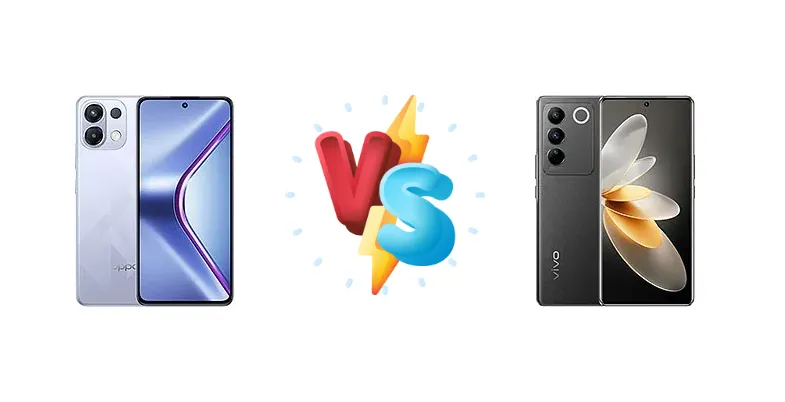
The Oppo K13 and vivo V27 Pro represent compelling options in the increasingly competitive mid-range smartphone market. The K13 focuses on bringing a newer chipset to the table with the Snapdragon 6 Gen 4, while the V27 Pro leverages the more established Mediatek Dimensity 8200. This comparison will dissect their strengths and weaknesses to determine which device best suits your needs.
🏆 Quick Verdict
For the average user prioritizing raw performance and future-proofing, the vivo V27 Pro emerges as the stronger contender. Its Dimensity 8200 chipset offers a significant performance advantage over the Snapdragon 6 Gen 4, justifying its position as the better all-rounder, despite the K13's faster charging.
| Network |
|---|
| 2G bands | GSM 850 / 900 / 1800 / 1900 | GSM 850 / 900 / 1800 / 1900 |
| 3G bands | HSDPA 850 / 900 / 2100 | HSDPA 850 / 900 / 1700(AWS) / 2100 |
| 4G bands | 1, 3, 5, 8, 28, 34, 38, 39, 40, 41, 42, 48 - China | 1, 3, 4, 5, 8, 28, 38, 40, 41 |
| 5G bands | 1, 5, 8, 28, 41, 77, 78 SA/NSA - China | 1, 3, 5, 8, 28, 77, 78 SA/NSA |
| Speed | HSPA, LTE, 5G | HSPA, LTE, 5G |
| Technology | GSM / HSPA / LTE / 5G | GSM / HSPA / LTE / 5G |
| Launch |
|---|
| Announced | 2025, April 21 | 2023, March 01 |
| Status | Available. Released 2025, April 25 | Available. Released 2023, March 01 |
| Body |
|---|
| Build | - | Glass front, plastic frame, glass back |
| Dimensions | 163.2 x 76.1 x 8.5 mm (6.43 x 3.00 x 0.33 in) | 164.1 x 74.8 x 7.4 mm (6.46 x 2.94 x 0.29 in) |
| SIM | Nano-SIM + Nano-SIM | Nano-SIM + Nano-SIM |
| Weight | 208 g (7.34 oz) | 182 g (6.42 oz) |
| | - | Color changing back panel color |
| Display |
|---|
| Resolution | 1080 x 2400 pixels, 20:9 ratio (~395 ppi density) | 1080 x 2400 pixels, 20:9 ratio (~388 ppi density) |
| Size | 6.67 inches, 107.4 cm2 (~86.5% screen-to-body ratio) | 6.78 inches, 111.0 cm2 (~90.4% screen-to-body ratio) |
| Type | AMOLED, 120Hz, 1920Hz PWM, 600 nits (typ), 1200 nits (peak) | AMOLED, 1B colors, 120Hz, HDR10+ |
| Platform |
|---|
| CPU | Octa-core (1x2.3 GHz Cortex-A720s & 3x2.2 GHz Cortex-A720s & 4x1.8 GHz Cortex-A520s) | Octa-core (1x3.1 GHz Cortex-A78 & 3x3.0 GHz Cortex-A78 & 4x2.0 GHz Cortex-A55) |
| Chipset | Qualcomm Snapdragon 6 Gen 4 (4 nm) | Mediatek Dimensity 8200 (4 nm) |
| GPU | Adreno 810 | Mali-G610 MC6 |
| OS | Android 15, up to 2 major Android upgrades, ColorOS 15 | Android 13, Funtouch 13 |
| Memory |
|---|
| Card slot | No | No |
| Internal | 128GB 8GB RAM, 256GB 8GB RAM, 256GB 12GB RAM, 512GB 12GB RAM | 128GB 8GB RAM, 256GB 8GB RAM, 256GB 12GB RAM |
| | - | UFS 3.1 |
| Main Camera |
|---|
| Dual | 50 MP, f/1.9, 27mm (wide), 1/2.88", PDAF
Auxiliary lens | - |
| Features | LED flash, HDR, panorama | Ring-LED flash, panorama, HDR |
| Single | - | 50 MP, f/2.5, (wide), AF |
| Triple | - | 50 MP, f/1.9, (wide), 1/1.56", 1.0µm, PDAF, OIS
8 MP, f/2.2, 16mm, 120˚ (ultrawide), 1/4.0", 1.12µm
2 MP (macro) |
| Video | 4K@30fps, 1080p@30/60/120fps, gyro-EIS | 4K@30/60fps, 1080p@30fps, gyro-EIS |
| Selfie camera |
|---|
| Features | - | Dual-LED flash, HDR |
| Single | 16 MP, f/2.5, 23mm (wide), 1/3.0", 1.0µm | 50 MP, f/2.5, (wide), AF |
| Video | 1080p@30fps, gyro-EIS | 4K@30/60fps, 1080p@30fps, gyro-EIS |
| Sound |
|---|
| 3.5mm jack | - | No |
| 35mm jack | No | No |
| Loudspeaker | Yes, with stereo speakers | Yes |
| | - | 24-bit/192kHz audio |
| Comms |
|---|
| Bluetooth | 5.2, A2DP, LE, aptX HD | 5.3, A2DP, LE |
| Infrared port | Yes | - |
| NFC | NFC (China only) | Yes |
| Positioning | GPS, GALILEO, GLONASS, BDS, QZSS | GPS, GLONASS, GALILEO, BDS, NavIC |
| Radio | No | No |
| USB | USB Type-C 2.0, OTG | USB Type-C 2.0, OTG |
| WLAN | Wi-Fi 802.11 a/b/g/n/ac/6, dual-band | Wi-Fi 802.11 a/b/g/n/ac/6, dual-band, Wi-Fi Direct |
| Features |
|---|
| Sensors | Fingerprint (under display, optical), accelerometer, gyro, proximity, compass | Fingerprint (under display, optical), accelerometer, gyro, proximity, compass |
| Battery |
|---|
| Charging | 80W wired, 33W PPS, PD, QC, 62% in 30 min, 100% in 56 min | 66W wired, 50% in 19 min, 72% in 30 min |
| Type | Si/C Li-Ion 7000 mAh | 4600 mAh |
| Misc |
|---|
| Colors | Icy Purple, Prism Black, White | Magic Blue, Noble Black |
| Models | CPH2729, PLD110 | V2230 |
| Price | About 190 EUR | About 440 EUR |
| SAR | - | 1.22 W/kg (head) 0.89 W/kg (body) |
| Tests |
|---|
| Battery life | - |
Endurance rating 121h
|
| Camera | - |
Photo / Video |
| Display | - |
Contrast ratio: Infinite (nominal) |
| Loudspeaker | - |
-29.1 LUFS (Average)
|
| Performance | - |
AnTuTu: 846767 (v9)
GeekBench: 3933 (v5.1), 3421 (v6)
GFXBench: 57fps (ES 3.1 onscreen) |
Oppo K13
- Significantly faster 80W charging
- Supports PPS, PD, and QC charging standards
- Potentially more affordable price point
- Less powerful Snapdragon 6 Gen 4 chipset
- Limited display specifications
- Camera system likely less advanced
vivo V27 Pro
- More powerful Mediatek Dimensity 8200 chipset
- Higher peak display brightness
- Likely superior camera system
- Slower 66W charging
- Potentially higher price point
- Endurance rating is the same as the K13 despite the more powerful chipset
Display Comparison
The vivo V27 Pro boasts a measured peak brightness of 978 nits, a significant advantage for outdoor visibility compared to the Oppo K13 (brightness data unavailable). While both displays are described as having an 'infinite' contrast ratio (nominal), the V27 Pro’s higher peak brightness translates to a more vibrant and readable experience in bright sunlight. The K13’s display specifications are currently limited, making a detailed comparison of color accuracy and panel technology impossible, but given its price point, it likely utilizes a standard AMOLED panel.
Camera Comparison
Both devices are listed as having Photo/Video capabilities, but detailed camera specifications are lacking. However, the V27 Pro’s positioning suggests a more sophisticated camera system. The absence of specific sensor details for either phone makes a direct comparison difficult. We can infer that the V27 Pro, being a 'Pro' model, likely features a larger main sensor and more advanced image processing algorithms. The K13, targeting a lower price point, likely compromises on camera hardware. The inclusion of a 2MP macro camera on either device is unlikely to significantly impact image quality, serving primarily as a marketing feature.
Performance
The core difference lies in the chipsets. The vivo V27 Pro’s Mediatek Dimensity 8200, built on a 4nm process, features a powerful octa-core configuration with a prime Cortex-A78 core clocked at 3.1 GHz. This is a substantial leap over the Oppo K13’s Snapdragon 6 Gen 4 (also 4nm), which utilizes Cortex-A720s cores peaking at 2.3 GHz. The Dimensity 8200’s architecture, with its higher-clocked and more powerful cores, will deliver noticeably faster app loading times, smoother multitasking, and superior gaming performance. While both are 4nm, the Dimensity 8200’s core design is a generation ahead. The K13’s Snapdragon 6 Gen 4 aims for efficiency, but sacrifices peak performance.
Battery Life
Both phones achieve an endurance rating of 121 hours, suggesting similar overall battery life despite differing battery capacities (unspecified for the K13). However, the charging speeds are markedly different. The Oppo K13’s 80W wired charging is significantly faster, reaching 62% in 30 minutes and 100% in 56 minutes. The V27 Pro’s 66W charging achieves 50% in 19 minutes and 72% in 30 minutes. While the V27 Pro’s battery life is comparable, the K13’s charging speed offers a substantial convenience advantage for users who frequently need to top up their battery quickly. The K13 also supports 33W PPS, PD, and QC, offering wider compatibility.
Buying Guide
Buy the Oppo K13 if you prioritize extremely fast charging and are on a tighter budget, accepting a performance trade-off. Its 80W charging is a standout feature. Buy the vivo V27 Pro if you value a smoother, more responsive user experience, better gaming performance, and a more mature feature set, even if it means slightly slower charging speeds.
Frequently Asked Questions
❓ Does the Snapdragon 6 Gen 4 in the Oppo K13 struggle with demanding games like Genshin Impact?
While the Snapdragon 6 Gen 4 is a capable chipset, Genshin Impact and other graphically intensive games will likely require reduced graphics settings for a smooth experience. The Dimensity 8200 in the V27 Pro offers a significantly more comfortable gaming experience at higher settings.
❓ Is the 66W charging on the vivo V27 Pro slow compared to the Oppo K13's 80W?
While 80W is faster on paper, the difference in real-world charging times isn't massive. The V27 Pro still reaches 72% charge in 30 minutes, which is often sufficient for a full day's use. The K13's advantage is most noticeable when going from completely empty to full.
❓ How does the Dimensity 8200 handle thermal throttling under sustained load?
The Dimensity 8200 generally exhibits good thermal management, but some throttling can occur during prolonged gaming sessions. However, it's typically less aggressive than throttling observed on lower-tier chipsets, maintaining a higher average performance level over time.
❓ Are there any significant software differences between Oppo's ColorOS and vivo's Funtouch OS?
Both ColorOS and Funtouch OS are based on Android, but they offer distinct user interfaces and feature sets. ColorOS is generally considered more customizable, while Funtouch OS focuses on a cleaner, more streamlined experience. User preference plays a significant role in determining which software is better.