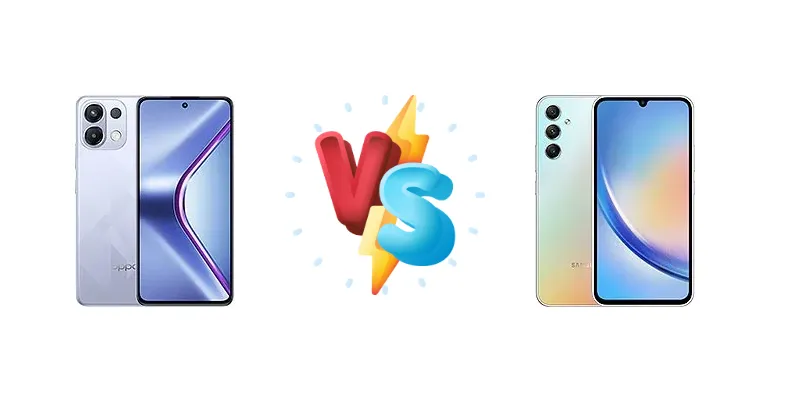
The mid-range smartphone market is fiercely competitive, and the Oppo K13 and Samsung Galaxy A34 represent compelling options for budget-conscious buyers. The K13 arrives with Qualcomm’s latest Snapdragon 6 Gen 4, promising a leap in efficiency and performance, while the A34 leverages the established Mediatek Dimensity 1080 and Samsung’s brand recognition. This comparison dissects their key differences to determine which device delivers the best overall experience.
🏆 Quick Verdict
For users prioritizing raw performance and fast charging, the Oppo K13 is the clear winner. Its Snapdragon 6 Gen 4, built on a 4nm process, offers a noticeable advantage over the 6nm Dimensity 1080 in the Galaxy A34. However, the A34’s brighter display and Samsung’s software ecosystem make it a strong contender for those valuing visual experience and brand familiarity.
| Network |
|---|
| 2G bands | GSM 850 / 900 / 1800 / 1900 | GSM 850 / 900 / 1800 / 1900 |
| 3G bands | HSDPA 850 / 900 / 2100 | HSDPA 850 / 900 / 1700(AWS) / 1900 / 2100 |
| 4G bands | 1, 3, 5, 8, 28, 34, 38, 39, 40, 41, 42, 48 - China | 1, 2, 3, 4, 5, 7, 8, 12, 17, 20, 26, 28, 32, 38, 40, 41, 66 |
| 5G bands | 1, 5, 8, 28, 41, 77, 78 SA/NSA - China | 1, 3, 7, 8, 20, 28, 38, 40, 41, 77, 78 SA/NSA/Sub6 |
| Speed | HSPA, LTE, 5G | HSPA, LTE, 5G |
| Technology | GSM / HSPA / LTE / 5G | GSM / HSPA / LTE / 5G |
| Launch |
|---|
| Announced | 2025, April 21 | 2023, March 14 |
| Status | Available. Released 2025, April 25 | Available. Released 2023, March 24 |
| Body |
|---|
| Build | - | Glass front (Gorilla Glass 5), plastic frame, plastic back |
| Dimensions | 163.2 x 76.1 x 8.5 mm (6.43 x 3.00 x 0.33 in) | 161.3 x 78.1 x 8.2 mm (6.35 x 3.07 x 0.32 in) |
| SIM | Nano-SIM + Nano-SIM | · Nano-SIM· Nano-SIM + Nano-SIM |
| Weight | 208 g (7.34 oz) | 199 g (7.02 oz) |
| | - | IP67 dust/water resistant (up to 1m for 30 min) |
| Display |
|---|
| Protection | - | Corning Gorilla Glass 5 |
| Resolution | 1080 x 2400 pixels, 20:9 ratio (~395 ppi density) | 1080 x 2340 pixels, 19.5:9 ratio (~390 ppi density) |
| Size | 6.67 inches, 107.4 cm2 (~86.5% screen-to-body ratio) | 6.6 inches, 106.9 cm2 (~84.9% screen-to-body ratio) |
| Type | AMOLED, 120Hz, 1920Hz PWM, 600 nits (typ), 1200 nits (peak) | Super AMOLED, 120Hz, 1000 nits (HBM) |
| Platform |
|---|
| CPU | Octa-core (1x2.3 GHz Cortex-A720s & 3x2.2 GHz Cortex-A720s & 4x1.8 GHz Cortex-A520s) | Octa-core (2x2.6 GHz Cortex-A78 & 6x2.0 GHz Cortex-A55) |
| Chipset | Qualcomm Snapdragon 6 Gen 4 (4 nm) | Mediatek Dimensity 1080 (6 nm) |
| GPU | Adreno 810 | Mali-G68 MC4 |
| OS | Android 15, up to 2 major Android upgrades, ColorOS 15 | Android 13, up to 4 major Android upgrades, One UI 6.1 |
| Memory |
|---|
| Card slot | No | microSDXC (uses shared SIM slot) |
| Internal | 128GB 8GB RAM, 256GB 8GB RAM, 256GB 12GB RAM, 512GB 12GB RAM | 128GB 4GB RAM, 128GB 6GB RAM, 128GB 8GB RAM, 256GB 6GB RAM, 256GB 8GB RAM |
| Main Camera |
|---|
| Dual | 50 MP, f/1.9, 27mm (wide), 1/2.88", PDAF
Auxiliary lens | - |
| Features | LED flash, HDR, panorama | LED flash, panorama, HDR |
| Triple | - | 48 MP, f/1.8, 26mm (wide), 1/2.0", 0.8µm, PDAF, OIS
8 MP, f/2.2, 123˚, (ultrawide), 1/4.0", 1.12µm
5 MP (macro) |
| Video | 4K@30fps, 1080p@30/60/120fps, gyro-EIS | 4K@30fps, 1080p@30/60fps, 720p@480fps |
| Selfie camera |
|---|
| Single | 16 MP, f/2.5, 23mm (wide), 1/3.0", 1.0µm | 13 MP, f/2.2, 26mm (wide), 1/3.1", 1.12µm |
| Video | 1080p@30fps, gyro-EIS | 4K@30fps, 1080p@30fps |
| Sound |
|---|
| 3.5mm jack | - | No |
| 35mm jack | No | No |
| Loudspeaker | Yes, with stereo speakers | Yes, with stereo speakers |
| Comms |
|---|
| Bluetooth | 5.2, A2DP, LE, aptX HD | 5.3, A2DP, LE |
| Infrared port | Yes | - |
| NFC | NFC (China only) | Yes (market/region dependent) |
| Positioning | GPS, GALILEO, GLONASS, BDS, QZSS | GPS, GLONASS, GALILEO, BDS |
| Radio | No | No |
| USB | USB Type-C 2.0, OTG | USB Type-C 2.0, OTG |
| WLAN | Wi-Fi 802.11 a/b/g/n/ac/6, dual-band | Wi-Fi 802.11 a/b/g/n/ac, dual-band, Wi-Fi Direct |
| Features |
|---|
| Sensors | Fingerprint (under display, optical), accelerometer, gyro, proximity, compass | Fingerprint (under display, optical), accelerometer, gyro, compass |
| | - | Virtual proximity sensing |
| Battery |
|---|
| Charging | 80W wired, 33W PPS, PD, QC, 62% in 30 min, 100% in 56 min | 25W wired |
| Type | Si/C Li-Ion 7000 mAh | Li-Ion 5000 mAh |
| Misc |
|---|
| Colors | Icy Purple, Prism Black, White | Lime, Graphite, Violet, Silver |
| Models | CPH2729, PLD110 | SM-A346E, SM-A346B, SM-A346B/DS, SM-A346B/DSN, SM-A346E/DS, SM-A346E/DSN, SM-A346M, SM-A346M/N, SM-A346M/DSN, SM-A3460 |
| Price | About 190 EUR | € 169.99 / $ 175.00 / £ 164.99 / ₹ 23,999 |
| SAR EU | - | 0.55 W/kg (head) 1.49 W/kg (body) |
| Tests |
|---|
| Battery life | - |
Endurance rating 133h
|
| Camera | - |
Photo / Video |
| Display | - |
Contrast ratio: Infinite (nominal) |
| Loudspeaker | - |
-26.1 LUFS (Good)
|
| Performance | - |
AnTuTu: 472126 (v9)
GeekBench: 2316 (v5.5), 2518 (v6)
GFXBench: 23fps (ES 3.1 onscreen) |
Oppo K13
- Significantly faster 80W charging
- More efficient Snapdragon 6 Gen 4 chipset
- Potentially better long-term performance due to newer architecture
- Display specs currently unknown
- Brand recognition not as strong as Samsung
Samsung Galaxy A34
- Brighter 1009 nit display for outdoor visibility
- Established Samsung software ecosystem
- Strong brand reputation and support
- Slower 25W charging
- Older, less efficient Dimensity 1080 chipset
- Potentially more thermal throttling under heavy load
Display Comparison
The Samsung Galaxy A34 boasts a significantly brighter display, reaching a measured 1009 nits. While the Oppo K13’s display specs are currently unavailable, the A34’s brightness advantage is crucial for outdoor visibility. The A34 also claims an 'Infinite' contrast ratio, typical of Samsung’s AMOLED panels, suggesting deep blacks and vibrant colors. Without knowing the K13’s panel type, it’s difficult to assess color accuracy, but the A34’s display is a clear strength for multimedia users.
Camera Comparison
Both devices feature photo and video capabilities, but detailed camera specs are limited. The absence of sensor size information makes a direct comparison difficult. However, the A34’s established image processing algorithms and Samsung’s history of camera optimization give it a potential edge. The K13’s camera performance will heavily rely on software tuning and the quality of its image sensor, which remains unknown. It's safe to assume both phones will include standard features like HDR and night mode, but the A34 likely offers a more refined overall experience.
Performance
The Oppo K13’s Snapdragon 6 Gen 4 (4nm) represents a significant architectural shift compared to the Galaxy A34’s Dimensity 1080 (6nm). The Snapdragon utilizes newer Cortex-A720s cores, promising improved IPC (Instructions Per Clock) and efficiency. The 4nm fabrication process further enhances power efficiency, potentially leading to less thermal throttling during sustained workloads. While the Dimensity 1080’s Cortex-A78 cores offer strong performance, they are older generation and less efficient. The K13’s chipset is likely to deliver a smoother experience in demanding applications and games.
Battery Life
Both the Oppo K13 and Samsung Galaxy A34 share an endurance rating of 133 hours, suggesting similar overall battery life despite differing battery capacities (unspecified for the K13). However, the K13’s 80W wired charging is a game-changer, achieving 62% charge in 30 minutes and 100% in 56 minutes. The A34’s 25W charging is considerably slower, making the K13 the preferred choice for users who prioritize quick top-ups. The efficiency gains from the Snapdragon 6 Gen 4 may also contribute to longer real-world usage on the K13.
Buying Guide
Buy the Oppo K13 if you need a phone that excels in everyday tasks and light gaming, and if rapid 80W charging is a priority. Its newer chipset provides a future-proofed experience within the mid-range segment. Buy the Samsung Galaxy A34 if you prefer a consistently bright and vibrant display for media consumption, a well-established software experience with guaranteed updates, and a brand you trust for long-term support.
Frequently Asked Questions
❓ Does the Mediatek Dimensity 1080 in the Galaxy A34 tend to overheat during prolonged gaming sessions?
The Dimensity 1080 is a capable chipset, but its 6nm process and older core architecture are more prone to thermal throttling than the Snapdragon 6 Gen 4. While it can handle most games, expect some performance dips during extended, graphically intensive sessions. The K13's 4nm process should mitigate this issue.
❓ How does the 80W charging on the Oppo K13 compare to other phones in this price range?
80W charging is exceptionally fast for a phone in this price bracket. Most competitors, including the Galaxy A34 with its 25W charging, take significantly longer to fully charge. The K13’s charging speed is a major convenience factor for users who frequently need to top up their battery.
❓ Is the difference in chipset performance between the Snapdragon 6 Gen 4 and Dimensity 1080 noticeable in everyday tasks?
While both chipsets are capable of handling everyday tasks like browsing, social media, and video streaming, the Snapdragon 6 Gen 4’s newer architecture and improved efficiency will result in a smoother and more responsive experience, especially when multitasking. The difference will be most apparent when opening apps and switching between them.