
Oppo K13 vs OnePlus Nord CE 3 Lite: A Deep Dive into Mid-Range Performance
| Phones Images | |||||
|---|---|---|---|---|---|
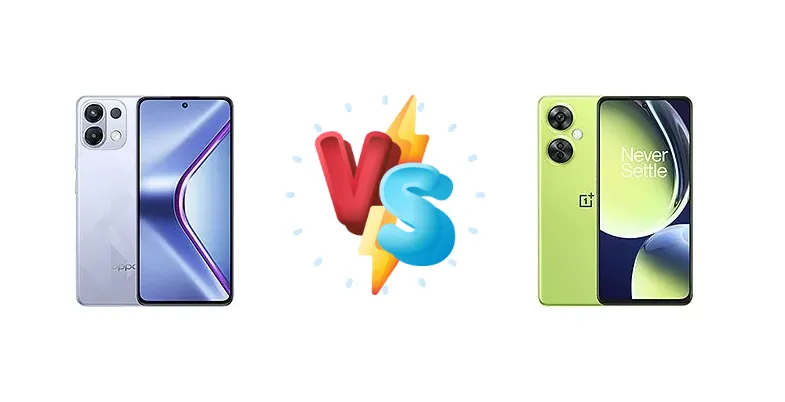
|
🏆 Quick Verdict
For most users, the Oppo K13 emerges as the stronger choice. Its Snapdragon 6 Gen 4, built on a more efficient 4nm process, provides a noticeable performance uplift over the Nord CE 3 Lite’s 6nm Snapdragon 695. While the Nord CE 3 Lite’s 67W charging is respectable, the K13’s 80W charging, coupled with PPS support, offers a faster and more versatile charging experience.
| PHONES | ||
|---|---|---|
| Phone Names | Oppo K13 | OnePlus Nord CE 3 Lite |
| Network | ||
|---|---|---|
| 2G bands | GSM 850 / 900 / 1800 / 1900 | GSM 850 / 900 / 1800 / 1900 |
| 3G bands | HSDPA 850 / 900 / 2100 | HSDPA 800 / 850 / 900 / 1700(AWS) / 1900 / 2100 - International |
| 4G bands | 1, 3, 5, 8, 28, 34, 38, 39, 40, 41, 42, 48 - China | 1, 2, 3, 4, 5, 7, 8, 12, 13, 17, 18, 19, 20, 26, 28, 32, 38, 39, 40, 41, 66 - International |
| 5G bands | 1, 5, 8, 28, 41, 77, 78 SA/NSA - China | 1, 3, 5, 7, 8, 20, 28, 38, 40, 41, 66, 77, 78 SA/NSA - International |
| Speed | HSPA, LTE, 5G | HSPA, LTE, 5G |
| Technology | GSM / HSPA / LTE / 5G | GSM / HSPA / LTE / 5G |
| - | 1, 3, 5, 8, 28, 40, 41, 77, 78 SA/NSA - India | |
| Launch | ||
|---|---|---|
| Announced | 2025, April 21 | 2023, April 04 |
| Status | Available. Released 2025, April 25 | Available. Released 2023, April 11 |
| Body | ||
|---|---|---|
| Build | - | Glass front, plastic frame, plastic back |
| Dimensions | 163.2 x 76.1 x 8.5 mm (6.43 x 3.00 x 0.33 in) | 165.5 x 76 x 8.3 mm (6.52 x 2.99 x 0.33 in) |
| SIM | Nano-SIM + Nano-SIM | Nano-SIM + Nano-SIM |
| Weight | 208 g (7.34 oz) | 195 g (6.88 oz) |
| Display | ||
|---|---|---|
| Protection | - | Corning Gorilla Glass |
| Resolution | 1080 x 2400 pixels, 20:9 ratio (~395 ppi density) | 1080 x 2400 pixels, 20:9 ratio (~391 ppi density) |
| Size | 6.67 inches, 107.4 cm2 (~86.5% screen-to-body ratio) | 6.72 inches, 109.6 cm2 (~87.1% screen-to-body ratio) |
| Type | AMOLED, 120Hz, 1920Hz PWM, 600 nits (typ), 1200 nits (peak) | IPS LCD, 120Hz, 550 nits (typ), 680 nits (peak) |
| Platform | ||
|---|---|---|
| CPU | Octa-core (1x2.3 GHz Cortex-A720s & 3x2.2 GHz Cortex-A720s & 4x1.8 GHz Cortex-A520s) | Octa-core (2x2.2 GHz Kryo 660 Gold & 6x1.7 GHz Kryo 660 Silver) |
| Chipset | Qualcomm Snapdragon 6 Gen 4 (4 nm) | Qualcomm SM6375 Snapdragon 695 5G (6 nm) |
| GPU | Adreno 810 | Adreno 619 |
| OS | Android 15, up to 2 major Android upgrades, ColorOS 15 | Android 13, OxygenOS 13.1 |
| Memory | ||
|---|---|---|
| Card slot | No | microSDXC (uses shared SIM slot) |
| Internal | 128GB 8GB RAM, 256GB 8GB RAM, 256GB 12GB RAM, 512GB 12GB RAM | 128GB 8GB RAM, 256GB 8GB RAM |
| - | UFS 2.2 | |
| Main Camera | ||
|---|---|---|
| Dual | 50 MP, f/1.9, 27mm (wide), 1/2.88", PDAF Auxiliary lens | - |
| Features | LED flash, HDR, panorama | LED flash, HDR, panorama |
| Triple | - | 108 MP, f/1.8, (wide), 1/1.67", 0.64µm, PDAF 2 MP (macro) Auxiliary lens |
| Video | 4K@30fps, 1080p@30/60/120fps, gyro-EIS | 1080p@30fps |
| Selfie camera | ||
|---|---|---|
| Features | - | HDR, panorama |
| Single | 16 MP, f/2.5, 23mm (wide), 1/3.0", 1.0µm | 16 MP, f/2.4, (wide), 1.0µm |
| Video | 1080p@30fps, gyro-EIS | 1080p@30fps |
| Sound | ||
|---|---|---|
| 3.5mm jack | - | Yes |
| 35mm jack | No | Yes |
| Loudspeaker | Yes, with stereo speakers | Yes, with stereo speakers |
| Comms | ||
|---|---|---|
| Bluetooth | 5.2, A2DP, LE, aptX HD | 5.1, A2DP, LE, aptX HD |
| Infrared port | Yes | - |
| NFC | NFC (China only) | Yes (market/region dependent) |
| Positioning | GPS, GALILEO, GLONASS, BDS, QZSS | GPS, GALILEO, GLONASS, BDS, QZSS |
| Radio | No | No |
| USB | USB Type-C 2.0, OTG | USB Type-C 2.0, OTG |
| WLAN | Wi-Fi 802.11 a/b/g/n/ac/6, dual-band | Wi-Fi 802.11 a/b/g/n/ac, dual-band |
| Features | ||
|---|---|---|
| Sensors | Fingerprint (under display, optical), accelerometer, gyro, proximity, compass | Fingerprint (side-mounted), accelerometer, gyro, proximity, compass |
| Battery | ||
|---|---|---|
| Charging | 80W wired, 33W PPS, PD, QC, 62% in 30 min, 100% in 56 min | 67W wired, 80% in 30 min |
| Type | Si/C Li-Ion 7000 mAh | Li-Po 5000 mAh |
| Misc | ||
|---|---|---|
| Colors | Icy Purple, Prism Black, White | Pastel Lime, Chromatic Gray |
| Models | CPH2729, PLD110 | CPH2467, CPH2465 |
| Price | About 190 EUR | £ 169.98 / € 209.99 |
| SAR | - | 1.17 W/kg (head) 0.70 W/kg (body) |
| Tests | ||
|---|---|---|
| Performance | - | AnTuTu: 412006 (v9) GeekBench: 2052 (v5) GFXBench: 17fps (ES 3.1 onscreen) |
Oppo K13
- Superior performance with Snapdragon 6 Gen 4
- More efficient 4nm process for better battery life
- Faster 80W charging with PPS, PD, and QC support
- Potential for higher price compared to Nord CE 3 Lite
- Display specifications are unknown
OnePlus Nord CE 3 Lite
- Competitive 67W charging
- Potentially lower price point
- Established Snapdragon 695 platform
- Older Snapdragon 695 chipset with less performance
- Less efficient 6nm process
- Charging lacks PPS support
Display Comparison
Neither device's display specifications are provided, so a direct comparison is limited. However, given the price points, we can anticipate both utilizing LCD panels. The absence of LTPO technology suggests neither will offer adaptive refresh rates for power saving. Bezels are likely comparable, and color accuracy will depend on software calibration. The user experience will likely be similar, with the display being a secondary consideration.
Camera Comparison
Without detailed camera specifications, a comprehensive comparison is impossible. However, the focus should be on the main sensor resolution and aperture. Assuming both devices feature similar sensor sizes, the image processing capabilities of the Snapdragon 6 Gen 4 ISP in the K13 may offer slightly better dynamic range and noise reduction. The absence of information regarding OIS (Optical Image Stabilization) makes it difficult to assess low-light performance. It's likely both devices will include standard features like portrait mode and night mode, but the K13’s newer ISP could provide a more refined experience.
Performance
The Oppo K13’s Snapdragon 6 Gen 4 (4nm) represents a significant architectural leap over the OnePlus Nord CE 3 Lite’s Snapdragon 695 (6nm). The 6 Gen 4 features newer Cortex-A720s cores, offering improved IPC (Instructions Per Clock) and efficiency. The 4nm fabrication process further enhances efficiency, leading to less heat generation and potentially sustained performance during demanding tasks. The Nord CE 3 Lite’s Kryo 660 Gold & Silver cores, while competent, are based on older architecture. This translates to a tangible advantage for the K13 in CPU-intensive applications and gaming. The K13's CPU configuration (1x2.3 GHz Cortex-A720s & 3x2.2 GHz Cortex-A720s & 4x1.8 GHz Cortex-A520s) is more balanced than the Nord CE 3 Lite's (2x2.2 GHz Kryo 660 Gold & 6x1.7 GHz Kryo 660 Silver), suggesting better multi-tasking capabilities.
Battery Life
The Oppo K13’s 80W wired charging is a clear advantage, achieving 62% charge in 30 minutes and 100% in 56 minutes. The OnePlus Nord CE 3 Lite’s 67W charging reaches 80% in 30 minutes, but lacks the full charge time data. The K13 also supports 33W PPS, PD, and QC, offering broader compatibility with chargers. While battery capacity isn't specified, the Snapdragon 6 Gen 4’s 4nm process should contribute to better power efficiency, potentially offsetting any capacity differences. The K13’s faster charging and wider compatibility make it more convenient for users who frequently need to top up their battery.
Buying Guide
Buy the Oppo K13 if you prioritize performance for everyday tasks and light gaming, and value a more future-proof chipset with better power efficiency. Buy the OnePlus Nord CE 3 Lite if you prioritize a slightly faster charging experience and are comfortable with a chipset that, while capable, is a generation behind. The Nord CE 3 Lite is a solid option for users on a tighter budget who don't demand the latest processing power.