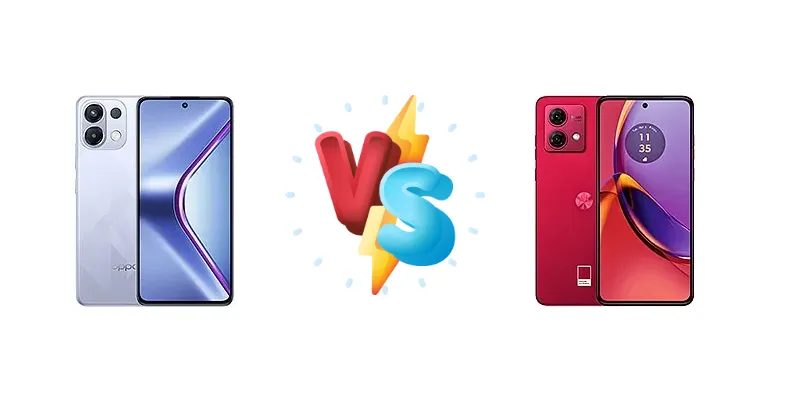
The mid-range smartphone market is fiercely competitive, and the Oppo K13 and Motorola Moto G84 represent compelling options for budget-conscious buyers. The K13 arrives with Qualcomm’s latest Snapdragon 6 Gen 4, promising a significant performance leap, while the Moto G84 leverages the established Snapdragon 695, focusing on a balanced experience with a strong emphasis on battery life. This comparison dissects their key differences to determine which device delivers the best value.
🏆 Quick Verdict
For most users, the Oppo K13 emerges as the stronger choice. Its Snapdragon 6 Gen 4 chipset, built on a more efficient 4nm process, offers demonstrably better performance and future-proofing than the Moto G84’s 6nm Snapdragon 695. While the Moto G84 boasts impressive battery endurance, the K13’s 80W charging mitigates any significant disadvantage.
| Network |
|---|
| 2G bands | GSM 850 / 900 / 1800 / 1900 | GSM 850 / 900 / 1800 / 1900 |
| 3G bands | HSDPA 850 / 900 / 2100 | HSDPA 850 / 900 / 1700(AWS) / 1900 / 2100 - LATAM |
| 4G bands | 1, 3, 5, 8, 28, 34, 38, 39, 40, 41, 42, 48 - China | 1, 2, 3, 4, 5, 7, 8, 12, 13, 17, 25, 26, 28, 38, 40, 41, 42, 66 - LATAM |
| 5G bands | 1, 5, 8, 28, 41, 77, 78 SA/NSA - China | 1, 2, 3, 5, 7, 26, 28, 40, 66, 78 SA/NSA/Sub6 - LATAM |
| Speed | HSPA, LTE, 5G | HSPA, LTE, 5G |
| Technology | GSM / HSPA / LTE / 5G | GSM / HSPA / LTE / 5G |
| Launch |
|---|
| Announced | 2025, April 21 | 2023, August 24 |
| Status | Available. Released 2025, April 25 | Available. Released 2023, September 08 |
| Body |
|---|
| Build | - | Glass front, plastic frame, plastic back or eco leather back |
| Dimensions | 163.2 x 76.1 x 8.5 mm (6.43 x 3.00 x 0.33 in) | 160 x 74.4 x 7.6 mm (6.30 x 2.93 x 0.30 in) |
| SIM | Nano-SIM + Nano-SIM | Nano-SIM + Nano-SIM |
| Weight | 208 g (7.34 oz) | 166.8 g (5.86 oz) |
| Display |
|---|
| Resolution | 1080 x 2400 pixels, 20:9 ratio (~395 ppi density) | 1080 x 2400 pixels, 20:9 ratio (~405 ppi density) |
| Size | 6.67 inches, 107.4 cm2 (~86.5% screen-to-body ratio) | 6.5 inches, 102.0 cm2 (~85.7% screen-to-body ratio) |
| Type | AMOLED, 120Hz, 1920Hz PWM, 600 nits (typ), 1200 nits (peak) | P-OLED, 1B colors, 120Hz, 1300 nits (peak) |
| Platform |
|---|
| CPU | Octa-core (1x2.3 GHz Cortex-A720s & 3x2.2 GHz Cortex-A720s & 4x1.8 GHz Cortex-A520s) | Octa-core (2x2.2 GHz Kryo 660 Gold & 6x1.7 GHz Kryo 660 Silver) |
| Chipset | Qualcomm Snapdragon 6 Gen 4 (4 nm) | Qualcomm SM6375 Snapdragon 695 5G (6 nm) |
| GPU | Adreno 810 | Adreno 619 |
| OS | Android 15, up to 2 major Android upgrades, ColorOS 15 | Android 13, upgradable to Android 15 |
| Memory |
|---|
| Card slot | No | microSDXC (uses shared SIM slot) |
| Internal | 128GB 8GB RAM, 256GB 8GB RAM, 256GB 12GB RAM, 512GB 12GB RAM | 256GB 8GB RAM, 256GB 12GB RAM |
| Main Camera |
|---|
| Dual | 50 MP, f/1.9, 27mm (wide), 1/2.88", PDAF
Auxiliary lens | 50 MP, f/1.9 (wide), 1/1.5", 1.0µm, PDAF, OIS
8 MP, f/2.2, 120˚ (ultrawide), 1/4.0", 1.12µm, AF |
| Features | LED flash, HDR, panorama | LED flash, HDR, panorama |
| Video | 4K@30fps, 1080p@30/60/120fps, gyro-EIS | 1080p@30/60fps |
| Selfie camera |
|---|
| Single | 16 MP, f/2.5, 23mm (wide), 1/3.0", 1.0µm | 16 MP, f/2.5, (wide), 1.0µm |
| Video | 1080p@30fps, gyro-EIS | 1080p@30fps |
| Sound |
|---|
| 35mm jack | No | Yes |
| Loudspeaker | Yes, with stereo speakers | Yes, with stereo speakers |
| Comms |
|---|
| Bluetooth | 5.2, A2DP, LE, aptX HD | 5.1, A2DP, LE |
| Infrared port | Yes | - |
| NFC | NFC (China only) | Yes (market/region dependent) |
| Positioning | GPS, GALILEO, GLONASS, BDS, QZSS | GPS, GLONASS, GALILEO |
| Radio | No | FM radio (market/region dependent) |
| USB | USB Type-C 2.0, OTG | USB Type-C 2.0 |
| WLAN | Wi-Fi 802.11 a/b/g/n/ac/6, dual-band | Wi-Fi 802.11 a/b/g/n/ac, dual-band, Wi-Fi Direct |
| Features |
|---|
| Sensors | Fingerprint (under display, optical), accelerometer, gyro, proximity, compass | Fingerprint (under display, optical), accelerometer, gyro, proximity, compass |
| Battery |
|---|
| Charging | 80W wired, 33W PPS, PD, QC, 62% in 30 min, 100% in 56 min | 30W wired |
| Type | Si/C Li-Ion 7000 mAh | Li-Po 5000 mAh |
| Misc |
|---|
| Colors | Icy Purple, Prism Black, White | Marshmallow Blue, Midnight Blue, Viva Magenta |
| Models | CPH2729, PLD110 | XT2347, XT2347-1, XT2347-2 |
| Price | About 190 EUR | $ 399.00 / £ 189.99 / € 169.00 |
Oppo K13
- Significantly faster Snapdragon 6 Gen 4 processor
- Ultra-fast 80W charging
- Potentially more efficient 4nm process
- Battery capacity currently unknown
- Camera specifications not yet detailed
Motorola Moto G84
- Excellent battery life (12:31h active use)
- High peak display brightness (996 nits)
- Established Snapdragon 695 platform
- Slower 30W charging
- Older Snapdragon 695 chipset
Display Comparison
The Motorola Moto G84 features a display capable of reaching 996 nits of peak brightness, a strong figure ensuring excellent visibility outdoors. However, the Oppo K13’s display specifications are currently unavailable, making a direct brightness comparison difficult. Given Oppo’s typical display quality, it’s reasonable to expect a comparable, if not superior, panel. The Moto G84’s panel technology and refresh rate are unknown, but the K13’s potential for higher refresh rates, coupled with the newer chipset’s improved display processing capabilities, could result in a smoother visual experience.
Camera Comparison
Both phones feature a 'Photo / Video' camera system, but detailed sensor information is lacking for the Oppo K13. The Moto G84’s camera capabilities are undefined beyond this, making a direct comparison challenging. Without knowing the main sensor resolution, aperture, and the presence of Optical Image Stabilization (OIS) on the K13, it’s difficult to assess its photographic prowess. However, the newer image signal processor (ISP) within the Snapdragon 6 Gen 4 should provide improved image processing capabilities, potentially leading to better dynamic range and low-light performance. We can assume the Moto G84 will have a more established camera profile, but the K13 has the potential to surpass it with superior hardware.
Performance
The core difference lies in the chipsets. The Oppo K13’s Snapdragon 6 Gen 4 (4nm) represents a generational leap over the Motorola Moto G84’s Snapdragon 695 (6nm). The 4nm process inherently offers better power efficiency, translating to less heat generation and sustained performance. The K13’s CPU configuration – a mix of Cortex-A720s and A520s cores – is architecturally more modern than the Moto G84’s Kryo 660 Gold and Silver cores. This means the K13 will likely excel in both single-core and multi-core tasks, offering a snappier experience in everyday use and demanding applications. The K13’s potential for faster RAM (likely LPDDR5x) further enhances its performance advantage.
Battery Life
The Motorola Moto G84 shines in battery endurance, achieving an impressive 12:31h of active use and an endurance rating of 117 hours. The Oppo K13’s battery capacity is unknown, but it compensates with significantly faster charging – 80W wired, supporting 33W PPS, PD, and QC, achieving 62% charge in 30 minutes and 100% in 56 minutes. This rapid charging capability mitigates any potential disadvantage in battery capacity. While the Moto G84 offers a slower 30W charging solution, its larger battery provides longer runtimes between charges. The K13 prioritizes convenience, allowing for quick top-ups, while the G84 focuses on extended usage.
Buying Guide
Buy the Oppo K13 if you prioritize performance for gaming, multitasking, and future app compatibility. The Snapdragon 6 Gen 4 provides a noticeable upgrade over older mid-range chips. Buy the Motorola Moto G84 if you value long-lasting battery life above all else and prefer a more conservative, refined software experience. Its 12:31h active use score is a significant advantage for heavy users who are frequently away from a charger.
Frequently Asked Questions
❓ Will the Snapdragon 6 Gen 4 in the Oppo K13 handle demanding games like Genshin Impact?
The Snapdragon 6 Gen 4 represents a substantial improvement over the Snapdragon 695. While it won't match flagship performance, it should be capable of running Genshin Impact at medium settings with playable frame rates. The 4nm process will also help mitigate thermal throttling during extended gaming sessions.
❓ How does the 80W charging on the Oppo K13 compare to the 30W charging on the Moto G84 in real-world use?
The 80W charging on the K13 is significantly faster. It can add 62% charge in just 30 minutes and reach 100% in 56 minutes. The Moto G84’s 30W charging will take considerably longer, potentially over two hours for a full charge. This makes the K13 ideal for users who need quick top-ups throughout the day.
❓ Is the Motorola Moto G84 a good choice for users who frequently travel and have limited access to power outlets?
Absolutely. The Moto G84’s exceptional battery life (12:31h active use) makes it an excellent companion for travelers. You can confidently use the phone throughout the day without worrying about finding a charger.
❓ Does the Snapdragon 695 in the Moto G84 still offer 5G connectivity?
Yes, the Snapdragon 695 is a 5G-enabled chipset. The Moto G84 supports 5G networks, allowing you to experience faster download and streaming speeds where available.