
Oppo K13 Turbo vs Xiaomi Redmi K70 Ultra: Which Dimensity Powerhouse Reigns Supreme?
| Phones Images | |||||
|---|---|---|---|---|---|
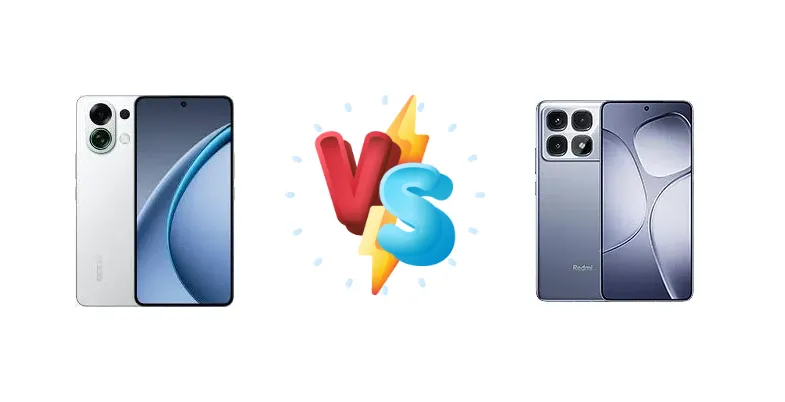
|
🏆 Quick Verdict
For most users, the Xiaomi Redmi K70 Ultra is the superior choice. The Dimensity 9300+ provides a noticeable performance uplift, particularly in demanding tasks and gaming, and the 120W charging significantly reduces downtime. While the K13 Turbo offers a compelling value proposition, the K70 Ultra’s raw power justifies the price difference.
| PHONES | ||
|---|---|---|
| Phone Names | Oppo K13 Turbo | Xiaomi Redmi K70 Ultra |
| Network | ||
|---|---|---|
| 2G bands | GSM 850 / 900 / 1800 / 1900 | GSM 850 / 900 / 1800 / 1900 |
| 3G bands | HSDPA 850 / 1700 / 2100 | HSDPA 800 / 850 / 900 / 1700(AWS) / 2100 |
| 4G bands | 1, 3, 5, 6, 8, 19, 28, 34, 38, 39, 40, 41, 42, 48 | 1, 3, 4, 5, 7, 8, 18, 19, 26, 28, 34, 38, 39, 40, 41, 42, 48, 66 |
| 5G bands | 1, 3, 5, 8, 28, 38, 40, 41, 48, 77, 78 SA/NSA | 1, 3, 5, 7, 8, 28, 66, 38, 40, 41, 48, 77, 78 SA/NSA |
| Speed | HSPA, LTE, 5G | HSPA, LTE, 5G |
| Technology | GSM / CDMA / HSPA / LTE / 5G | GSM / CDMA / HSPA / CDMA2000 / LTE / 5G |
| Launch | ||
|---|---|---|
| Announced | 2025, July 21 | 2024, July 19 |
| Status | Available. Released 2025, July 25 | Available. Released 2024, July 19 |
| Body | ||
|---|---|---|
| Build | - | Glass front, aluminum frame |
| Dimensions | 162.8 x 77.2 x 7.3 mm (6.41 x 3.04 x 0.29 in) | 160.4 x 75.1 x 8.4 mm (6.31 x 2.96 x 0.33 in) |
| SIM | Nano-SIM + Nano-SIM | Nano-SIM + Nano-SIM |
| Weight | 207 g (7.30 oz) | 211 g (7.44 oz) |
| Display | ||
|---|---|---|
| Protection | - | Scratch/drop-resistant glass |
| Resolution | 1280 x 2800 pixels, 19.5:9 ratio (~453 ppi density) | 1220 x 2712 pixels, 20:9 ratio (~446 ppi density) |
| Size | 6.8 inches, 112.8 cm2 (~89.8% screen-to-body ratio) | 6.67 inches, 107.4 cm2 (~89.1% screen-to-body ratio) |
| Type | AMOLED, 1B colors, 120Hz, 1600 nits (peak) | OLED, 68B colors, 144Hz, Dolby Vision, HDR10+, 1600 nits (HBM), 4000 nits (peak) |
| Platform | ||
|---|---|---|
| CPU | Octa-core (1x3.25 GHz Cortex-A725 & 3x3.0 GHz Cortex-A725 & 4x2.1 GHz Cortex-A725) | Octa-core (1x3.25 GHz Cortex-X4 & 3x2.85 GHz Cortex-X4 & 4x2.0 GHz Cortex-A720) |
| Chipset | Mediatek Dimensity 8450 (4 nm) | Mediatek Dimensity 9300+ (4 nm) |
| GPU | Mali-G720 MC7 | Immortalis-G720 MC12 |
| OS | Android 15, ColorOS 15 | Android 14, HyperOS |
| Memory | ||
|---|---|---|
| Card slot | No | No |
| Internal | 128GB 8GB RAM, 256GB 8GB RAM, 256GB 12GB RAM, 256GB 16GB RAM, 512GB 12GB RAM | 256GB 12GB RAM, 512GB 12GB RAM, 512GB 16GB RAM, 1TB 16GB RAM, 1TB 24GB RAM |
| Main Camera | ||
|---|---|---|
| Dual | 50 MP, f/1.8, 27mm (wide), PDAF 2 MP | - |
| Features | LED flash, HDR, panorama | Color spectrum sensor, Dual-LED dual-tone flash, HDR, panorama |
| Triple | - | 50 MP, f/1.7, 23mm (wide), 1/1.56", 1.0µm, PDAF, OIS 8 MP, 119˚ (ultrawide), 1/4.0", 1.12µm 2 MP (macro) |
| Video | 4K@30/60fps, 1080p@30fps | 8K@24/30fps, 4K@24/30/60fps, 1080p@30/60/120/240/960fps, gyro-EIS |
| Selfie camera | ||
|---|---|---|
| Features | 1080p@30fps | HDR |
| Single | 16 MP, f/2.4, 22mm (wide) | 20 MP, (wide), 1/2.0", 0.8µm |
| Video | Yes | 1080p@30fps |
| Sound | ||
|---|---|---|
| 35mm jack | No | No |
| Loudspeaker | Yes, with stereo speakers | Yes, with stereo speakers |
| Comms | ||
|---|---|---|
| Bluetooth | 5.4, A2DP, LE, aptX HD, LHDC 5 | 5.4, A2DP, LE, LHDC 5 |
| Infrared port | Yes | Yes |
| NFC | Yes | Yes |
| Positioning | GPS, GLONASS, GALILEO, BDS, QZSS | GPS (L1+L5), BDS (B1I+B1C+B2a+B2b), GALILEO (E1+E5a+E5b), QZSS (L1+L5), NavIC (L5), GLONASS |
| Radio | No | Unspecified |
| USB | USB Type-C 2.0, OTG | USB Type-C |
| WLAN | Wi-Fi 802.11 a/b/g/n/ac/6, dual-band | Wi-Fi 802.11 a/b/g/n/ac/6/7, dual-band, Wi-Fi Direct |
| Features | ||
|---|---|---|
| Sensors | Fingerprint (under display, optical), accelerometer, gyro, proximity, compass | Fingerprint (under display, optical), accelerometer, gyro, proximity, compass |
| Battery | ||
|---|---|---|
| Charging | 80W wired, 13.5W PD, 44W UFCS, 33W PPS Reverse wired | 120W wired, PD3.0, 100% in 24 min |
| Type | 7000 mAh | Li-Po 5500 mAh |
| Misc | ||
|---|---|---|
| Colors | Purple Phantom, Midnight Maverick, White Knight | Black, White, Violet, Green Championship Edition, Orange Championship Edition |
| Models | PLM110 | 2407FRK8EC |
| Price | ₹ 23,795 | About 330 EUR |
Oppo K13 Turbo
- More affordable price point
- Versatile charging support (80W wired + multiple PD/PPS standards)
- Good overall performance for everyday tasks
- Dimensity 8450 is outperformed by the 9300+
- Slower charging speed compared to the K70 Ultra
Xiaomi Redmi K70 Ultra
- Significantly faster Dimensity 9300+ processor
- Ultra-fast 120W wired charging
- Superior graphics performance for gaming
- Higher price tag
- May run slightly warmer under sustained load
Display Comparison
While both devices likely feature high-refresh-rate AMOLED displays (data not provided), the core difference lies in the processing power driving them. The chipset impacts the smoothness of animations and responsiveness. The K70 Ultra’s superior GPU, stemming from the Dimensity 9300+, will translate to higher, more stable frame rates in games. Without specific display specs, we can assume both will offer vibrant colors and good viewing angles, but the K70 Ultra has the headroom to push higher resolutions and refresh rates if the panel allows.
Camera Comparison
Without detailed camera specifications, it’s difficult to make a definitive judgment. However, the processing capabilities of the Dimensity 9300+ in the K70 Ultra will likely contribute to better image processing, particularly in low-light conditions. The K70 Ultra’s ISP (Image Signal Processor) is more advanced, enabling faster and more accurate noise reduction and dynamic range optimization. We can assume both phones will offer capable camera systems, but the K70 Ultra has the potential for superior image quality due to its more powerful chipset.
Performance
The Dimensity 9300+ in the Redmi K70 Ultra is the clear winner here. Its Cortex-X4 prime core, clocked at 3.25 GHz, represents a significant architectural upgrade over the Cortex-A725 cores found in the K13 Turbo’s Dimensity 8450. The K70 Ultra’s CPU configuration (1x3.25 GHz X4 + 3x2.85 GHz X4 + 4x2.0 GHz A720) offers both higher peak performance and improved sustained performance due to the more efficient X4 cores. This translates to faster app loading times, smoother multitasking, and a more responsive user experience. The K70 Ultra’s GPU will also deliver substantially higher graphics performance.
Battery Life
The Redmi K70 Ultra’s 120W wired charging is a game-changer. Claimed 100% charge in 24 minutes is significantly faster than the Oppo K13 Turbo’s 80W charging. While the K13 Turbo supports multiple charging standards (80W wired, 13.5W PD, 44W UFCS, 33W PPS, reverse wired), the sheer speed of the K70 Ultra’s charging is a major convenience factor. Battery capacity is not specified, but the faster charging mitigates any potential disadvantage if the K70 Ultra has a slightly smaller battery.
Buying Guide
Buy the Oppo K13 Turbo if you prioritize value and a balanced experience. It’s ideal for everyday users, social media enthusiasts, and those who enjoy mobile gaming at moderate settings. Buy the Xiaomi Redmi K70 Ultra if you demand the highest possible performance, need rapid charging, and frequently engage in graphically intensive gaming or content creation. It’s the choice for power users and those who want a future-proofed device.