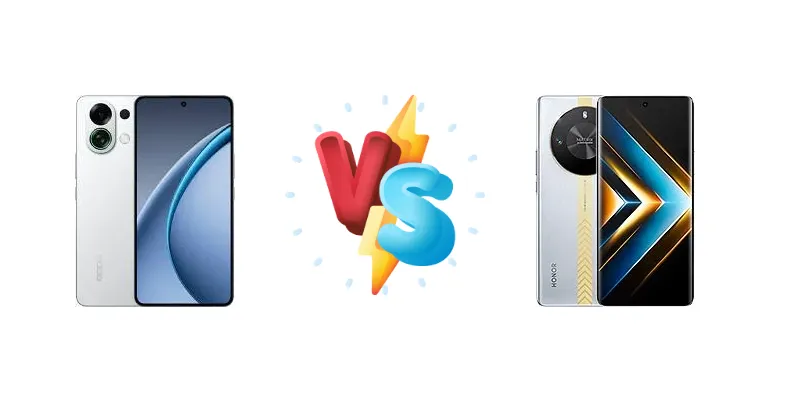
The Oppo K13 Turbo and Honor X50 GT represent compelling options in the increasingly competitive mid-range smartphone market. Both devices aim to deliver flagship-level performance without the flagship price tag, but they achieve this through different approaches – Oppo prioritizing charging speed and a refined Dimensity chipset, while Honor leverages the proven power of the Snapdragon 8+ Gen 1. This comparison will dissect their key differences to determine which phone best suits your needs.
🏆 Quick Verdict
For the average user prioritizing raw performance and sustained gaming, the Honor X50 GT is the better choice. The Snapdragon 8+ Gen 1 offers a performance advantage over the Dimensity 8450, despite the K13 Turbo’s impressive 80W charging. However, the K13 Turbo’s faster charging and potentially more efficient chipset make it a strong contender for power users.
| Network |
|---|
| 2G bands | GSM 850 / 900 / 1800 / 1900 | GSM 850 / 900 / 1800 / 1900 |
| 3G bands | HSDPA 850 / 1700 / 2100 | HSDPA 850 / 900 / 1700(AWS) / 1900 / 2100 |
| 4G bands | 1, 3, 5, 6, 8, 19, 28, 34, 38, 39, 40, 41, 42, 48 | LTE |
| 5G bands | 1, 3, 5, 8, 28, 38, 40, 41, 48, 77, 78 SA/NSA | SA/NSA |
| Speed | HSPA, LTE, 5G | HSPA, LTE, 5G |
| Technology | GSM / CDMA / HSPA / LTE / 5G | GSM / CDMA / HSPA / CDMA2000 / LTE / 5G |
| Launch |
|---|
| Announced | 2025, July 21 | 2024, January 04 |
| Status | Available. Released 2025, July 25 | Available. Released 2024, January 09 |
| Body |
|---|
| Dimensions | 162.8 x 77.2 x 7.3 mm (6.41 x 3.04 x 0.29 in) | 163.6 x 75.5 x 8 mm (6.44 x 2.97 x 0.31 in) |
| SIM | Nano-SIM + Nano-SIM | Nano-SIM + Nano-SIM |
| Weight | 207 g (7.30 oz) | 192 g (6.77 oz) |
| Display |
|---|
| Resolution | 1280 x 2800 pixels, 19.5:9 ratio (~453 ppi density) | 1220 x 2652 pixels, 19.5:9 ratio (~431 ppi density) |
| Size | 6.8 inches, 112.8 cm2 (~89.8% screen-to-body ratio) | 6.78 inches, 112.6 cm2 (~91.2% screen-to-body ratio) |
| Type | AMOLED, 1B colors, 120Hz, 1600 nits (peak) | AMOLED, 1B colors, 120Hz |
| Platform |
|---|
| CPU | Octa-core (1x3.25 GHz Cortex-A725 & 3x3.0 GHz Cortex-A725 & 4x2.1 GHz Cortex-A725) | Octa-core (1x3.0 GHz Cortex-X2 & 3x2.5 GHz Cortex-A710 & 4x1.80 GHz Cortex-A510) |
| Chipset | Mediatek Dimensity 8450 (4 nm) | Qualcomm SM8475 Snapdragon 8+ Gen 1 (4 nm) |
| GPU | Mali-G720 MC7 | Adreno 730 |
| OS | Android 15, ColorOS 15 | Android 13, MagicOS 7.2 |
| Memory |
|---|
| Card slot | No | No |
| Internal | 128GB 8GB RAM, 256GB 8GB RAM, 256GB 12GB RAM, 256GB 16GB RAM, 512GB 12GB RAM | 256GB 12GB RAM, 256GB 16GB RAM, 512GB 16GB RAM, 1TB 16GB RAM |
| Main Camera |
|---|
| Dual | 50 MP, f/1.8, 27mm (wide), PDAF
2 MP | 108 MP, f/1.8, (wide), 1/1.67", PDAF
Auxiliary lens |
| Features | LED flash, HDR, panorama | LED flash, panorama, HDR |
| Video | 4K@30/60fps, 1080p@30fps | 4K@30fps, 1080p@30fps |
| Selfie camera |
|---|
| Features | 1080p@30fps | - |
| Single | 16 MP, f/2.4, 22mm (wide) | 8 MP, f/2.0, (wide) |
| Video | Yes | 1080p@30fps |
| Sound |
|---|
| 35mm jack | No | No |
| Loudspeaker | Yes, with stereo speakers | Yes |
| Comms |
|---|
| Bluetooth | 5.4, A2DP, LE, aptX HD, LHDC 5 | 5.2, A2DP, LE, aptX HD |
| Infrared port | Yes | - |
| NFC | Yes | Yes |
| Positioning | GPS, GLONASS, GALILEO, BDS, QZSS | GPS, GLONASS, GALILEO, BDS |
| Radio | No | No |
| USB | USB Type-C 2.0, OTG | USB Type-C 2.0, OTG |
| WLAN | Wi-Fi 802.11 a/b/g/n/ac/6, dual-band | Wi-Fi 802.11 a/b/g/n/ac/6, dual-band, Wi-Fi Direct |
| Features |
|---|
| Sensors | Fingerprint (under display, optical), accelerometer, gyro, proximity, compass | Fingerprint (under display, optical), accelerometer, gyro, ultrasound proximity, compass |
| Battery |
|---|
| Charging | 80W wired, 13.5W PD, 44W UFCS, 33W PPS
Reverse wired | 35W wired
7.5W reverse wired |
| Type | 7000 mAh | Li-Po 5800 mAh |
| Misc |
|---|
| Colors | Purple Phantom, Midnight Maverick, White Knight | Black, Silver |
| Models | PLM110 | ALP-AN00 |
| Price | ₹ 23,795 | About 260 EUR |
Oppo K13 Turbo
- Significantly faster 80W charging
- UFCS/PPS charging support for wider compatibility
- Potentially better power efficiency with Dimensity 8450
- Reverse wired charging capability
- Dimensity 8450 chipset is less powerful than Snapdragon 8+ Gen 1
- Gaming performance may be slightly lower
Honor X50 GT
- More powerful Snapdragon 8+ Gen 1 chipset
- Superior CPU and GPU performance for gaming
- Advanced ISP for better image processing
- Proven thermal management solutions
- Slower 35W charging
- No reverse wireless charging
Display Comparison
Neither device’s display specifications are provided, so a direct comparison is limited. However, given the price bracket, both likely feature AMOLED panels with high refresh rates. The absence of LTPO technology on either device suggests potential for lower efficiency compared to flagship phones. Bezels and color accuracy will likely be similar, relying on panel quality and software calibration. Without specific data, it's reasonable to assume both offer a visually pleasing experience, but neither will likely challenge top-tier display performance.
Camera Comparison
Without detailed camera specifications, a precise comparison is difficult. However, the chipset plays a role in image signal processing (ISP) capabilities. The Snapdragon 8+ Gen 1’s ISP is generally considered more advanced, offering better dynamic range and noise reduction. The absence of information regarding sensor sizes and OIS suggests both phones likely employ mid-range camera setups. Focusing on the main sensor is key; a larger sensor will capture more light and produce better images. Ignoring the typical 2MP macro lenses, the quality of the primary camera and its accompanying software processing will be the deciding factor.
Performance
The core difference lies in the chipsets. The Honor X50 GT’s Snapdragon 8+ Gen 1 (4nm) boasts a Cortex-X2 prime core clocked at 3.0 GHz, alongside three Cortex-A710 performance cores at 2.5 GHz and four Cortex-A510 efficiency cores at 1.8 GHz. This architecture is known for its strong single-core and multi-core performance. Conversely, the Oppo K13 Turbo utilizes the MediaTek Dimensity 8450 (4nm) with a unique core configuration: one Cortex-A725 at 3.25 GHz, three Cortex-A725 at 3.0 GHz, and four Cortex-A725 at 2.1 GHz. While the Dimensity 8450’s core count is similar, the A725 cores are less performant than the Snapdragon’s X2 and A710 cores. This translates to a noticeable advantage for the Snapdragon 8+ Gen 1 in CPU-intensive tasks and gaming. Both phones likely utilize LPDDR5x RAM, but thermal management will be crucial; the Snapdragon 8+ Gen 1 is known to run warmer under sustained load, potentially leading to throttling.
Battery Life
The Honor X50 GT’s 35W charging is significantly slower than the Oppo K13 Turbo’s 80W wired charging, which also supports 13.5W PD, 44W UFCS, and 33W PPS. This means the K13 Turbo can replenish its battery much faster. While battery capacity isn’t specified, the faster charging of the K13 Turbo mitigates the impact of a potentially smaller battery. The K13 Turbo also offers reverse wired charging, a feature absent on the X50 GT, adding to its versatility.
Buying Guide
Buy the Oppo K13 Turbo if you need blazing-fast charging and prioritize a balance between performance and efficiency. Its 80W charging and UFCS/PPS support are unmatched in this segment. Buy the Honor X50 GT if you prefer maximum performance for gaming and demanding tasks, and are willing to trade some charging speed for the Snapdragon 8+ Gen 1’s processing power.
Frequently Asked Questions
❓ Will the Snapdragon 8+ Gen 1 in the Honor X50 GT overheat during prolonged gaming sessions?
The Snapdragon 8+ Gen 1 is known to generate heat under sustained load. However, Honor likely implemented thermal management solutions, such as vapor chamber cooling, to mitigate throttling. While some performance degradation is possible during extended gaming, it shouldn't be a major issue for most users.
❓ How much faster is the 80W charging on the Oppo K13 Turbo compared to the 35W charging on the Honor X50 GT?
The Oppo K13 Turbo’s 80W charging can significantly reduce charging times. Expect a full charge in approximately 30-40 minutes, while the Honor X50 GT will likely take over an hour. The K13 Turbo’s support for multiple charging protocols (PD, UFCS, PPS) also ensures compatibility with a wider range of chargers.
❓ Does the Dimensity 8450 in the Oppo K13 Turbo support ray tracing?
No, the Dimensity 8450 does not natively support hardware-accelerated ray tracing. The Snapdragon 8+ Gen 1 also lacks dedicated ray tracing hardware. Therefore, neither phone will offer a significant ray tracing experience in mobile games.
❓ Which phone is better for running demanding applications like video editing software?
The Honor X50 GT, with its Snapdragon 8+ Gen 1, is better suited for demanding applications like video editing. The more powerful CPU and GPU will result in faster processing times and a smoother user experience.