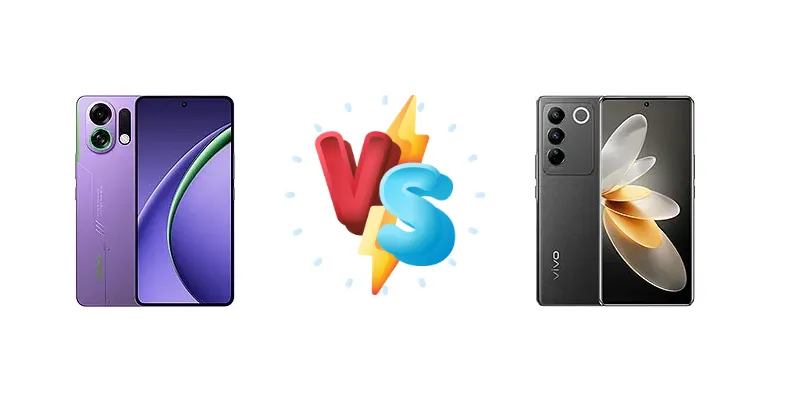
The Oppo K13 Turbo Pro and vivo V27 Pro represent compelling options in the increasingly competitive mid-range smartphone market. The K13 Turbo Pro arrives with the newer Qualcomm Snapdragon 8s Gen 4, aiming for raw performance, while the V27 Pro leverages the established Mediatek Dimensity 8200 and focuses on a well-rounded experience. This comparison dissects their key differences to help you choose the right device.
🏆 Quick Verdict
For users prioritizing raw processing power and gaming performance, the Oppo K13 Turbo Pro is the clear winner. Its Snapdragon 8s Gen 4 chipset offers a significant advantage. However, the vivo V27 Pro provides a solid all-around experience with comparable battery life and a potentially more refined software experience.
| Network |
|---|
| 2G bands | GSM 850 / 900 / 1800 / 1900 | GSM 850 / 900 / 1800 / 1900 |
| 3G bands | HSDPA 850 / 1700 / 2100 | HSDPA 850 / 900 / 1700(AWS) / 2100 |
| 4G bands | 1, 3, 5, 8, 19, 28, 34, 38, 39, 40, 41, 42, 48 | 1, 3, 4, 5, 8, 28, 38, 40, 41 |
| 5G bands | 1, 3, 5, 8, 28, 38, 40, 41, 77, 78 SA/NSA | 1, 3, 5, 8, 28, 77, 78 SA/NSA |
| Speed | HSPA, LTE, 5G | HSPA, LTE, 5G |
| Technology | GSM / CDMA / HSPA / LTE / 5G | GSM / HSPA / LTE / 5G |
| Launch |
|---|
| Announced | 2025, July 21 | 2023, March 01 |
| Status | Available. Released 2025, July 25 | Available. Released 2023, March 01 |
| Body |
|---|
| Build | - | Glass front, plastic frame, glass back |
| Dimensions | 162.8 x 77.2 x 7.3 mm (6.41 x 3.04 x 0.29 in) | 164.1 x 74.8 x 7.4 mm (6.46 x 2.94 x 0.29 in) |
| SIM | Nano-SIM + Nano-SIM | Nano-SIM + Nano-SIM |
| Weight | 208 g (7.34 oz) | 182 g (6.42 oz) |
| | - | Color changing back panel color |
| Display |
|---|
| Resolution | 1280 x 2800 pixels, 19.5:9 ratio (~453 ppi density) | 1080 x 2400 pixels, 20:9 ratio (~388 ppi density) |
| Size | 6.8 inches, 112.8 cm2 (~89.8% screen-to-body ratio) | 6.78 inches, 111.0 cm2 (~90.4% screen-to-body ratio) |
| Type | AMOLED, 1B colors, 120Hz, 1600 nits (peak) | AMOLED, 1B colors, 120Hz, HDR10+ |
| Platform |
|---|
| CPU | Octa-core (1x3.21 GHz Cortex-X4 & 3x3.0 GHz Cortex-A720 & 2x2.8 GHz Cortex-A720 & 2x2.0 GHz Cortex-A720) | Octa-core (1x3.1 GHz Cortex-A78 & 3x3.0 GHz Cortex-A78 & 4x2.0 GHz Cortex-A55) |
| Chipset | Qualcomm SM8735 Snapdragon 8s Gen 4 (4 nm) | Mediatek Dimensity 8200 (4 nm) |
| GPU | Adreno 825 | Mali-G610 MC6 |
| OS | Android 15, ColorOS 15 | Android 13, Funtouch 13 |
| Memory |
|---|
| Card slot | No | No |
| Internal | 256GB 8GB RAM, 256GB 12GB RAM, 256GB 16GB RAM, 512GB 12GB RAM, 512GB 16GB RAM | 128GB 8GB RAM, 256GB 8GB RAM, 256GB 12GB RAM |
| | - | UFS 3.1 |
| Main Camera |
|---|
| Dual | 50 MP, f/1.8, 27mm (wide), PDAF, OIS
2 MP | - |
| Features | LED flash, HDR, panorama | Ring-LED flash, panorama, HDR |
| Single | - | 50 MP, f/2.5, (wide), AF |
| Triple | - | 50 MP, f/1.9, (wide), 1/1.56", 1.0µm, PDAF, OIS
8 MP, f/2.2, 16mm, 120˚ (ultrawide), 1/4.0", 1.12µm
2 MP (macro) |
| Video | 4K@30/60fps, 1080p@30fps | 4K@30/60fps, 1080p@30fps, gyro-EIS |
| Selfie camera |
|---|
| Features | 1080p@30fps | Dual-LED flash, HDR |
| Single | 16 MP, f/2.4, 22mm (wide) | 50 MP, f/2.5, (wide), AF |
| Video | Yes | 4K@30/60fps, 1080p@30fps, gyro-EIS |
| Sound |
|---|
| 3.5mm jack | - | No |
| 35mm jack | No | No |
| Loudspeaker | Yes, with stereo speakers | Yes |
| | - | 24-bit/192kHz audio |
| Comms |
|---|
| Bluetooth | 5.4, A2DP, LE, aptX HD, LHDC 5 | 5.3, A2DP, LE |
| Infrared port | Yes | - |
| NFC | Yes | Yes |
| Positioning | GPS, GLONASS, GALILEO, BDS, QZSS | GPS, GLONASS, GALILEO, BDS, NavIC |
| Radio | No | No |
| USB | USB Type-C 2.0, OTG | USB Type-C 2.0, OTG |
| WLAN | Wi-Fi 802.11 a/b/g/n/ac/6/7, dual-band | Wi-Fi 802.11 a/b/g/n/ac/6, dual-band, Wi-Fi Direct |
| Features |
|---|
| Sensors | Fingerprint (under display, optical), accelerometer, gyro, proximity, compass | Fingerprint (under display, optical), accelerometer, gyro, proximity, compass |
| Battery |
|---|
| Charging | 80W wired, 13.5W PD, 44W UFCS, 33W PPS
Reverse wired | 66W wired, 50% in 19 min, 72% in 30 min |
| Type | 7000 mAh | 4600 mAh |
| Misc |
|---|
| Colors | Silver Knight, Purple Phantom, Midnight Maverick | Magic Blue, Noble Black |
| Models | PLE110 | V2230 |
| Price | About 340 EUR | About 440 EUR |
| SAR | - | 1.22 W/kg (head) 0.89 W/kg (body) |
| Tests |
|---|
| Battery life | - |
Endurance rating 121h
|
| Camera | - |
Photo / Video |
| Display | - |
Contrast ratio: Infinite (nominal) |
| Loudspeaker | - |
-29.1 LUFS (Average)
|
| Performance | - |
AnTuTu: 846767 (v9)
GeekBench: 3933 (v5.1), 3421 (v6)
GFXBench: 57fps (ES 3.1 onscreen) |
Oppo K13 Turbo Pro
- Superior processing power with Snapdragon 8s Gen 4
- Faster and more versatile charging options
- Potentially better thermal management for gaming
- Display specifications currently unknown
- Camera details are lacking
vivo V27 Pro
- Bright display with 978 nits peak brightness
- Balanced performance for everyday tasks
- Potentially refined software experience
- Less powerful chipset compared to Snapdragon 8s Gen 4
- Slower charging speed
Display Comparison
The vivo V27 Pro boasts a measured peak brightness of 978 nits, a respectable figure for outdoor visibility. While the Oppo K13 Turbo Pro’s display specifications are currently unavailable, it’s likely to be competitive within its price bracket. Both devices feature an 'Infinite' (nominal) contrast ratio, typical of OLED panels. Without knowing the K13 Turbo Pro’s panel technology (LTPO vs standard OLED), it’s difficult to assess potential advantages in refresh rate adaptability and power efficiency. The V27 Pro’s brightness gives it a slight edge for users who frequently use their phones in direct sunlight.
Camera Comparison
Both phones are described as having 'Photo / Video' capabilities, lacking specific details. Without sensor size, aperture, or OIS information, a direct comparison is challenging. However, the market positioning suggests the V27 Pro may prioritize camera features more heavily, potentially offering more advanced image processing algorithms. The presence of a 2MP macro camera on the V27 Pro is unlikely to significantly impact image quality, serving primarily as a marketing feature. A detailed analysis requires sample images and camera spec sheets.
Performance
The core difference lies in the chipsets. The Oppo K13 Turbo Pro’s Qualcomm Snapdragon 8s Gen 4 (4nm) features a unique CPU configuration: 1x3.21 GHz Cortex-X4, 3x3.0 GHz Cortex-A720, 2x2.8 GHz Cortex-A720, and 2x2.0 GHz Cortex-A720. This architecture prioritizes peak performance with the Cortex-X4 prime core. The vivo V27 Pro utilizes the Mediatek Dimensity 8200 (4nm) with an octa-core setup of 1x3.1 GHz Cortex-A78, 3x3.0 GHz Cortex-A78, and 4x2.0 GHz Cortex-A55. While the Dimensity 8200 is a capable chip, the Snapdragon 8s Gen 4’s newer architecture and higher clock speeds on its prime core translate to superior CPU and GPU performance, particularly in sustained workloads. The K13 Turbo Pro will likely exhibit less thermal throttling during extended gaming sessions.
Battery Life
Both devices share an endurance rating of 121 hours, suggesting similar real-world battery life despite potentially different battery capacities (not specified). The Oppo K13 Turbo Pro offers significantly faster charging with 80W wired, 13.5W PD, 44W UFCS, and 33W PPS, alongside reverse wired charging. The vivo V27 Pro is limited to 66W wired charging, reaching 50% in 19 minutes and 72% in 30 minutes. The K13 Turbo Pro’s broader charging protocol support (PD, UFCS, PPS) provides greater compatibility with various chargers and accessories. The faster charging speed is a substantial advantage for users who prioritize quick top-ups.
Buying Guide
Buy the Oppo K13 Turbo Pro if you need a phone for demanding tasks like mobile gaming, video editing, or running resource-intensive applications. Its Snapdragon 8s Gen 4 provides a noticeable performance boost. Buy the vivo V27 Pro if you prefer a balanced smartphone experience with a focus on camera versatility, consistent performance for everyday tasks, and a potentially more polished user interface.
Frequently Asked Questions
❓ Will the Snapdragon 8s Gen 4 in the Oppo K13 Turbo Pro overheat during prolonged gaming sessions?
The Snapdragon 8s Gen 4's 4nm process and optimized architecture are designed to mitigate thermal throttling. While some heat generation is inevitable, it's expected to perform better than older generation chips under sustained load, offering a more consistent gaming experience compared to the Dimensity 8200.
❓ Does the vivo V27 Pro's camera perform well in low-light conditions?
Without specific details on the camera sensor and aperture, it's difficult to definitively answer. However, vivo typically employs strong image processing algorithms to enhance low-light performance. Reviewing independent camera samples is crucial to assess its capabilities in challenging lighting scenarios.
❓ What charging protocols does the Oppo K13 Turbo Pro support beyond 80W wired?
The Oppo K13 Turbo Pro supports 13.5W PD (Power Delivery), 44W UFCS (Universal Fast Charge Standard), and 33W PPS (Programmable Power Supply), offering broad compatibility with various chargers and accessories. This is a significant advantage over the vivo V27 Pro's solely 66W wired charging.