
Oppo K13 Turbo Pro vs Nothing Phone (2): A Detailed Performance and Value Showdown
| Phones Images | |||||
|---|---|---|---|---|---|
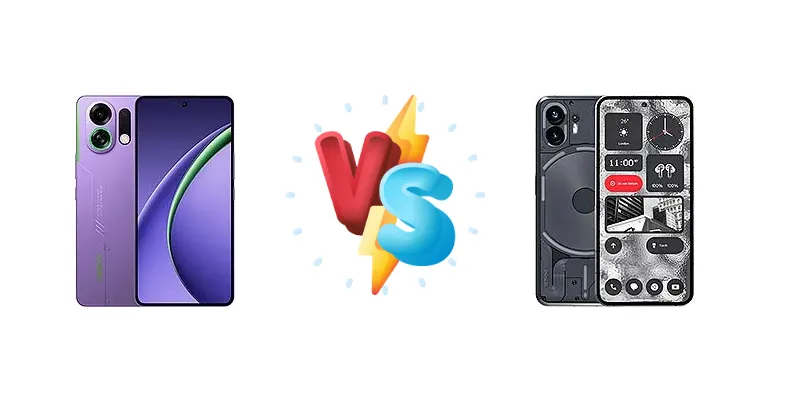
|
🏆 Quick Verdict
For most users, the Oppo K13 Turbo Pro emerges as the stronger contender. Its Snapdragon 8s Gen 4 chipset delivers demonstrably superior CPU and GPU performance, and its 80W charging significantly outpaces the Nothing Phone (2)'s 45W. While the Nothing Phone (2) offers a more refined software experience and wireless charging, the K13 Turbo Pro’s performance advantage is hard to ignore.
| PHONES | ||
|---|---|---|
| Phone Names | Oppo K13 Turbo Pro | Nothing Phone (2) |
| Network | ||
|---|---|---|
| 2G bands | GSM 850 / 900 / 1800 / 1900 | GSM 850 / 900 / 1800 / 1900 |
| 3G bands | HSDPA 850 / 1700 / 2100 | HSDPA 800 / 850 / 900 / 1700(AWS) / 1900 / 2100 |
| 4G bands | 1, 3, 5, 8, 19, 28, 34, 38, 39, 40, 41, 42, 48 | 1, 2, 3, 4, 5, 7, 8, 12, 17, 18, 19, 20, 25, 26, 28, 30, 32, 34, 38, 39, 40, 41, 42, 48, 66, 71 |
| 5G bands | 1, 3, 5, 8, 28, 38, 40, 41, 77, 78 SA/NSA | 1, 2, 3, 5, 7, 8, 12, 20, 25, 28, 30, 38, 40, 41, 66, 71, 75, 77, 78 SA/NSA |
| Speed | HSPA, LTE, 5G | HSPA, LTE, 5G |
| Technology | GSM / CDMA / HSPA / LTE / 5G | GSM / HSPA / LTE / 5G |
| Launch | ||
|---|---|---|
| Announced | 2025, July 21 | 2023, July 11 |
| Status | Available. Released 2025, July 25 | Available. Released 2023, July 17 |
| Body | ||
|---|---|---|
| Build | - | Glass front (Gorilla Glass 5), glass back (Gorilla Glass 5), aluminum frame |
| Dimensions | 162.8 x 77.2 x 7.3 mm (6.41 x 3.04 x 0.29 in) | 162.1 x 76.4 x 8.6 mm (6.38 x 3.01 x 0.34 in) |
| SIM | Nano-SIM + Nano-SIM | Nano-SIM + Nano-SIM |
| Weight | 208 g (7.34 oz) | 201.2 g (7.09 oz) |
| Display | ||
|---|---|---|
| Protection | - | Corning Gorilla Glass 5 |
| Resolution | 1280 x 2800 pixels, 19.5:9 ratio (~453 ppi density) | 1080 x 2412 pixels, 20:9 ratio (~394 ppi density) |
| Size | 6.8 inches, 112.8 cm2 (~89.8% screen-to-body ratio) | 6.7 inches, 108.0 cm2 (~87.2% screen-to-body ratio) |
| Type | AMOLED, 1B colors, 120Hz, 1600 nits (peak) | LTPO OLED, 1B colors, 120Hz, 1920Hz PWM, HDR10+, 1600 nits (HBM), 1600 nits (peak) |
| Platform | ||
|---|---|---|
| CPU | Octa-core (1x3.21 GHz Cortex-X4 & 3x3.0 GHz Cortex-A720 & 2x2.8 GHz Cortex-A720 & 2x2.0 GHz Cortex-A720) | Octa-core (1x3.0 GHz Cortex-X2 & 3x2.5 GHz Cortex-A710 & 4x1.80 GHz Cortex-A510) |
| Chipset | Qualcomm SM8735 Snapdragon 8s Gen 4 (4 nm) | Qualcomm SM8475 Snapdragon 8+ Gen 1 (4 nm) |
| GPU | Adreno 825 | Adreno 730 |
| OS | Android 15, ColorOS 15 | Android 13, upgradable to Android 15, up to 3 major Android upgrades, Nothing OS 3.0 |
| Memory | ||
|---|---|---|
| Card slot | No | No |
| Internal | 256GB 8GB RAM, 256GB 12GB RAM, 256GB 16GB RAM, 512GB 12GB RAM, 512GB 16GB RAM | 128GB 8GB RAM, 256GB 12GB RAM, 512GB 12GB RAM |
| Main Camera | ||
|---|---|---|
| Dual | 50 MP, f/1.8, 27mm (wide), PDAF, OIS 2 MP | 50 MP, f/1.9, 24mm (wide), 1/1.56", 1.0µm, PDAF, OIS 50 MP, f/2.2, 114˚ (ultrawide), 1/2.76", 0.64µm, AF |
| Features | LED flash, HDR, panorama | LED flash, panorama, HDR |
| Video | 4K@30/60fps, 1080p@30fps | 4K@30/60fps, 1080p@30/60fps, gyro-EIS, live HDR, OIS |
| Selfie camera | ||
|---|---|---|
| Features | 1080p@30fps | HDR |
| Single | 16 MP, f/2.4, 22mm (wide) | 32 MP, f/2.5, (wide), 1/2.74", 0.8µm |
| Video | Yes | 1080p@30fps |
| Sound | ||
|---|---|---|
| 35mm jack | No | No |
| Loudspeaker | Yes, with stereo speakers | Yes, with stereo speakers |
| Comms | ||
|---|---|---|
| Bluetooth | 5.4, A2DP, LE, aptX HD, LHDC 5 | 5.3, A2DP, LE, aptX HD, aptX Adaptive |
| Infrared port | Yes | - |
| NFC | Yes | Yes |
| Positioning | GPS, GLONASS, GALILEO, BDS, QZSS | GPS (L1+L5), GLONASS (L1), BDS (B1I+B1c), GALILEO (E1), QZSS (L1), NavIC |
| Radio | No | No |
| USB | USB Type-C 2.0, OTG | USB Type-C 2.0, OTG |
| WLAN | Wi-Fi 802.11 a/b/g/n/ac/6/7, dual-band | Wi-Fi 802.11 a/b/g/n/ac/6, dual-band, Wi-Fi Direct |
| Features | ||
|---|---|---|
| Sensors | Fingerprint (under display, optical), accelerometer, gyro, proximity, compass | Fingerprint (under display, optical), accelerometer, proximity, gyro, compass |
| Battery | ||
|---|---|---|
| Charging | 80W wired, 13.5W PD, 44W UFCS, 33W PPS Reverse wired | 45W wired, PD3.0, PPS, QC4, 100% in 55 min 15W wireless, 100% in 130 min 5W reverse wireless |
| Type | 7000 mAh | Li-Ion 4700 mAh |
| Misc | ||
|---|---|---|
| Colors | Silver Knight, Purple Phantom, Midnight Maverick | White, Dark Gray |
| Models | PLE110 | A065 |
| Price | About 340 EUR | $ 379.99 / £ 370.00 |
Oppo K13 Turbo Pro
- Superior CPU and GPU performance with Snapdragon 8s Gen 4
- Significantly faster 80W wired charging
- Potentially more efficient 4nm process
- Battery capacity and display specs currently unknown
- Software experience may not be as refined as Nothing OS
Nothing Phone (2)
- Unique design with Glyph Interface
- Clean and intuitive Nothing OS software
- Wireless charging and reverse wireless charging
- Older Snapdragon 8+ Gen 1 chipset
- Slower 45W wired charging
- Potentially lower peak performance in demanding tasks
Display Comparison
The Nothing Phone (2) boasts a measured peak brightness of 998 nits, a respectable figure for outdoor visibility. However, the Oppo K13 Turbo Pro’s display specifications are currently unavailable, making a direct brightness comparison difficult. Given Oppo’s history, it’s likely to be competitive. The Nothing Phone (2)'s display technology is not specified, but its smooth scrolling suggests a high refresh rate. Without knowing the panel type or refresh rate of the K13 Turbo Pro, it’s difficult to assess which offers superior color accuracy or viewing angles, but the Nothing Phone (2)'s Glyph Interface is a unique visual element.
Camera Comparison
Detailed camera analysis is hampered by a lack of specific sensor information for both devices. The Nothing Phone (2) advertises photo and video capabilities, but without knowing the megapixel count or sensor size of its main camera, it’s difficult to assess its low-light performance. The Oppo K13 Turbo Pro’s camera specs are also unknown. However, given Oppo’s strong camera reputation, it’s reasonable to expect a competitive imaging system. The absence of detailed camera specs makes a definitive comparison impossible, but the presence of OIS (Optical Image Stabilization) would be a key differentiator.
Performance
The Oppo K13 Turbo Pro’s Qualcomm SM8735 Snapdragon 8s Gen 4 (4nm) represents a significant generational leap over the Nothing Phone (2)’s Snapdragon 8+ Gen 1 (4nm). The 8s Gen 4 features a Cortex-X4 prime core clocked at 3.21 GHz, compared to the 8+ Gen 1’s Cortex-X2 at 3.0 GHz. This, combined with the newer architecture of the A720 cores in the K13 Turbo Pro, translates to faster single-core and multi-core performance. The 8s Gen 4’s improved GPU will also provide a more fluid gaming experience, especially in demanding titles. While both chips are fabricated on a 4nm process, the architectural improvements in the 8s Gen 4 offer better efficiency and sustained performance.
Battery Life
The Nothing Phone (2) delivers an impressive 14:21 hours of active use and an endurance rating of 103 hours, indicating excellent battery life. The Oppo K13 Turbo Pro’s battery capacity is unknown, but its 80W wired charging is a major advantage. This allows for significantly faster charging times compared to the Nothing Phone (2)’s 45W charging (100% in 55 minutes). The K13 Turbo Pro also supports 13.5W PD, 44W UFCS, and 33W PPS, offering greater charging flexibility. While the Nothing Phone (2) offers 15W wireless charging and 5W reverse wireless charging, the K13 Turbo Pro’s faster wired charging is a more practical benefit for most users.
Buying Guide
Buy the Oppo K13 Turbo Pro if you prioritize gaming, demanding applications, and fast charging speeds. Its Snapdragon 8s Gen 4 provides a noticeable performance uplift for power users. Buy the Nothing Phone (2) if you value a unique design aesthetic, a clean software experience (Nothing OS), and the convenience of wireless charging, even if it means sacrificing some raw processing power.