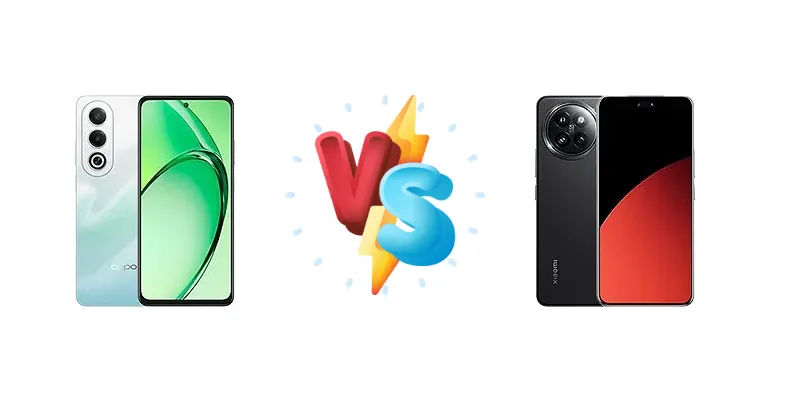
The mid-range smartphone market is fiercely competitive, and the Oppo K12x and Xiaomi Civi 4 Pro represent compelling options. The K12x aims for affordability with a Mediatek Dimensity 6300, while the Civi 4 Pro steps up with Qualcomm’s Snapdragon 8s Gen 3, promising a significant performance leap. This comparison dissects these two devices to determine which delivers the best experience for your money.
🏆 Quick Verdict
For the average user prioritizing raw performance and future-proofing, the Xiaomi Civi 4 Pro is the clear winner. Its Snapdragon 8s Gen 3 offers a substantial advantage in processing power and gaming capabilities. However, the Oppo K12x remains a strong contender for budget-conscious buyers who value efficient performance for everyday tasks.
| Network |
|---|
| 2G bands | GSM 850 / 900 / 1800 / 1900 | GSM 850 / 900 / 1800 / 1900 |
| 3G bands | HSDPA 900 / 2100 | HSDPA 800 / 850 / 900 / 1700(AWS) / 1900 / 2100 |
| 4G bands | 1, 3, 5, 8, 28, 40, 41 | 1, 3, 4, 5, 8, 18, 19, 26, 28, 34, 38, 39, 40, 41, 42, 48, 66 |
| 5G bands | 1, 3, 5, 8, 28, 40, 41, 77, 88 SA/NSA | 1, 3, 5, 8, 28, 38, 40, 41, 48, 66, 77, 78 SA/NSA |
| Speed | HSPA, LTE, 5G | HSPA, LTE, 5G |
| Technology | GSM / HSPA / LTE / 5G | GSM / CDMA / HSPA / CDMA2000 / LTE / 5G |
| Launch |
|---|
| Announced | 2024, July 29 | 2024, March 21 |
| Status | Available. Released 2024, August 02 | Available. Released 2024, March 21 |
| Body |
|---|
| Build | - | Glass front (Gorilla Glass Victus 2), glass back or silicone polymer back (eco leather), aluminum frame |
| Dimensions | 165.7 x 76 x 7.7 mm (6.52 x 2.99 x 0.30 in) | 157.2 x 72.8 x 7.5 mm or 7.8 mm |
| SIM | Nano-SIM + Nano-SIM | Nano-SIM + Nano-SIM |
| Weight | 186 g (6.56 oz) | 177.6 or 179.3 g or 180.9 g (6.28 oz) |
| Display |
|---|
| Protection | Panda glass | Corning Gorilla Glass Victus 2 |
| Resolution | 720 x 1604 pixels, 20:9 ratio (~264 ppi density) | 1236 x 2750 pixels, 20:9 ratio (~460 ppi density) |
| Size | 6.67 inches, 107.2 cm2 (~85.2% screen-to-body ratio) | 6.55 inches, 103.5 cm2 (~90.4% screen-to-body ratio) |
| Type | IPS LCD, 120Hz, 1000 nits (HBM) | AMOLED, 68B colors, 120Hz, Dolby Vision, HDR10+, 3000 nits (peak) |
| Platform |
|---|
| CPU | Octa-core (2x2.4 GHz Cortex-A76 & 6x2.0 GHz Cortex-A55) | Octa-core (1x3.0 GHz Cortex-X4 & 4x2.8 GHz Cortex-A720 & 3x2.0 GHz Cortex-A520) |
| Chipset | Mediatek Dimensity 6300 (6 nm) | Qualcomm SM8635 Snapdragon 8s Gen 3 (4 nm) |
| GPU | Mali-G57 MC2 | Adreno 735 |
| OS | Android 14, ColorOS 14 | Android 14, HyperOS |
| Memory |
|---|
| Card slot | microSDXC | No |
| Internal | 128GB 6GB RAM, 256GB 8GB RAM | 256GB 12GB RAM, 512GB 12GB RAM, 512GB 16GB RAM |
| Main Camera |
|---|
| Dual | 32 MP, f/1.8, (wide), PDAF
Auxiliary lens | - |
| Features | LED flash, HDR, panorama | Color spectrum sensor, Dual-LED flash, HDR, panorama, Leica lenses |
| Triple | - | 50 MP, f/1.6, 25mm (wide), 1/1.55", 1.0µm, PDAF, OIS
50 MP, f/2.0, 50mm (telephoto), 0.64µm, PDAF, 2x optical zoom
12 MP, f/2.2, 15mm, 120˚ (ultrawide), 1.12µm |
| Video | 1080p@30/60fps | 4K@24/30/60fps, 1080p@30/60/120/240/960fps, 720p@1920fps, HDR10+, BT.2020, 10-bit video, gyro-EIS |
| Selfie camera |
|---|
| Dual | - | 32 MP, f/2.0, 26mm (wide), 1/2.8", 0.8µm, AF
32 MP, f/2.4, 100˚ (ultrawide), 1/2.8", 0.8µm |
| Features | - | HDR, panorama |
| Single | 8 MP, f/2.0, (wide) | - |
| Video | 1080p@30fps | 4K@30fps, 1080p@30/60fps; gyro-EIS |
| Sound |
|---|
| 35mm jack | Yes | No |
| Loudspeaker | Yes | Yes, with stereo speakers |
| Comms |
|---|
| Bluetooth | 5.3, A2DP, LE, aptX HD | 5.4, A2DP, LE, LHDC |
| Infrared port | - | Yes |
| NFC | No | Yes |
| Positioning | GPS, GALILEO, GLONASS, BDS, QZSS | GPS (L1), GLONASS (G1), BDS (B1I+B1c), GALILEO (E1), QZSS (L1) |
| Radio | No | No |
| USB | USB Type-C 2.0, OTG | USB Type-C 2.0, OTG |
| WLAN | Wi-Fi 802.11 a/b/g/n/ac, dual-band | Wi-Fi 802.11 a/b/g/n/ac/6, dual-band, Wi-Fi Direct |
| Features |
|---|
| Sensors | Fingerprint (side-mounted), accelerometer, proximity, compass | Fingerprint (under display, optical), accelerometer, gyro, proximity, compass |
| Battery |
|---|
| Charging | 45W wired, PD, 50% in 30 min | 67W wired, PD3.0, 100% in 40 minutes |
| Type | 5100 mAh | Li-Po 4700 mAh |
| Misc |
|---|
| Colors | Breeze Blue, Midnight Violet | Black, Pink, Blue, Green |
| Models | CPH2667 | 24053PY09C |
| Price | ₹ 14,999 | About 380 EUR |
| SAR | 1.18 W/kg (head) 1.19 W/kg (body) | - |
Oppo K12x
- More affordable price point
- Efficient Dimensity 6300 chipset for everyday tasks
- Fast 45W charging
- Significantly less powerful than the Snapdragon 8s Gen 3
- Likely less advanced camera system
- Potentially limited long-term software support
Xiaomi Civi 4 Pro
- Powerful Snapdragon 8s Gen 3 processor
- Faster 67W charging
- Likely superior camera performance
- Higher price tag
- Potentially more heat generation under sustained load
- May require more frequent charging if battery capacity is smaller
Display Comparison
Neither device's display specifications are provided, so a direct comparison is limited. However, given the Civi 4 Pro's positioning, it likely features an AMOLED panel with a higher refresh rate and potentially LTPO technology for variable refresh rates, improving battery life. The K12x, targeting a lower price bracket, will likely utilize a standard AMOLED panel. Color accuracy and peak brightness will likely favor the Civi 4 Pro due to its higher-end components.
Camera Comparison
Without specific camera specs, we can only infer. The Civi 4 Pro, being a more premium device, likely features a larger main sensor with optical image stabilization (OIS), resulting in better low-light performance and sharper images. The K12x will likely have a competent camera setup for its price range, but will likely lack the advanced features and image processing capabilities of the Civi 4 Pro. Lens apertures will likely be wider on the Civi 4 Pro, further enhancing low-light photography.
Performance
The core difference lies in the chipsets. The Xiaomi Civi 4 Pro’s Snapdragon 8s Gen 3 (4nm) is a significant upgrade over the Oppo K12x’s Dimensity 6300 (6nm). The 4nm process node of the Snapdragon translates to better power efficiency and thermal management, allowing for sustained peak performance. The Snapdragon’s Cortex-X4 prime core, clocked at 3.0 GHz, provides a substantial single-core performance boost compared to the K12x’s Cortex-A76 cores at 2.4 GHz. This difference will be most noticeable in demanding tasks like video editing and graphically intensive games. The Civi 4 Pro will also benefit from Qualcomm’s Adreno GPU, offering superior graphics performance.
Battery Life
While battery capacities aren't specified, the Civi 4 Pro’s 67W charging is significantly faster than the K12x’s 45W charging. The Civi 4 Pro claims a full charge in 40 minutes, while the K12x reaches 50% in 30 minutes. This faster charging speed is a major convenience factor. The Snapdragon 8s Gen 3’s superior power efficiency may partially offset a potentially smaller battery capacity in the Civi 4 Pro, resulting in comparable real-world battery life.
Buying Guide
Buy the Oppo K12x if you need a reliable daily driver for social media, communication, and light gaming, and prioritize a lower price point. You'll appreciate its efficient chipset and fast charging. Buy the Xiaomi Civi 4 Pro if you prefer a smoother experience with demanding apps, enjoy mobile gaming, and are willing to invest in a more powerful processor for longer-term usability.
Frequently Asked Questions
❓ Will the Dimensity 6300 in the Oppo K12x struggle with graphically demanding games like Genshin Impact?
The Dimensity 6300 is capable of running Genshin Impact, but you'll likely need to lower the graphics settings to achieve a smooth frame rate. The Snapdragon 8s Gen 3 in the Civi 4 Pro will provide a significantly better gaming experience with higher settings and more consistent performance.
❓ How much faster is the 67W charging on the Xiaomi Civi 4 Pro compared to the 45W charging on the Oppo K12x in real-world use?
The Civi 4 Pro's 67W charging will get you from 0-100% in approximately 40 minutes, while the K12x takes longer. The difference is most noticeable in the initial stages of charging; the Civi 4 Pro will gain a substantial percentage of battery life in the first 15-20 minutes.
❓ Does the Snapdragon 8s Gen 3 in the Civi 4 Pro tend to overheat during prolonged gaming sessions?
The Snapdragon 8s Gen 3 is designed with thermal efficiency in mind. While it will generate heat during intense gaming, the 4nm process node and Qualcomm's thermal management technologies should prevent significant throttling. However, sustained peak performance may still lead to some temperature increase.