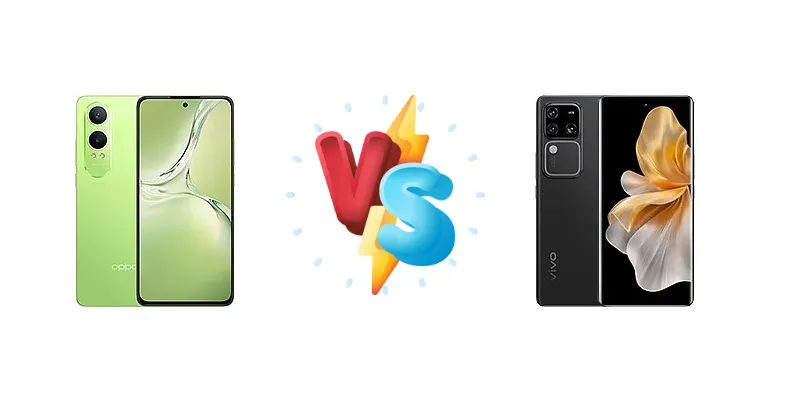
The Oppo K12x (China) and vivo S18 Pro represent distinct approaches to the mid-range smartphone market. The K12x focuses on delivering 5G connectivity and essential features at an aggressive price point, while the S18 Pro aims for a more premium experience with a flagship-level chipset. This comparison dissects the key differences to determine which device offers the best value for your money.
🏆 Quick Verdict
For the average user prioritizing performance and future-proofing, the vivo S18 Pro is the clear winner. Its Mediatek Dimensity 9200+ chipset offers a substantial performance leap over the Oppo K12x’s Snapdragon 695, making it better suited for demanding tasks and gaming. However, the K12x remains a compelling option for budget-conscious buyers.
| Network |
|---|
| 2G bands | GSM 850 / 900 / 1800 / 1900 | GSM 850 / 900 / 1800 / 1900 |
| 3G bands | HSDPA 850 / 1700(AWS) / 1900 / 2100 | HSDPA 850 / 900 / 1700(AWS) / 1900 / 2100 |
| 4G bands | 1, 3, 4, 5, 8, 28, 34, 38, 39, 40, 41 | 1, 3, 4, 5, 7, 8, 18, 19, 26, 28, 34, 38, 39, 40, 41 |
| 5G bands | 1, 5, 8, 28, 41, 77, 78 SA/NSA | 1, 3, 5, 8, 28, 38, 40, 41, 77, 78 SA/NSA |
| Speed | HSPA, LTE, 5G | HSPA, LTE, 5G |
| Technology | GSM / CDMA / HSPA / LTE / 5G | GSM / CDMA / HSPA / CDMA2000 / LTE / 5G |
| Launch |
|---|
| Announced | 2024, March 14 | 2023, December 14 |
| Status | Available. Released 2024, May 20 | Available. Released 2023, January 13 |
| Body |
|---|
| Build | Glass front, plastic frame, plastic back | Glass front, plastic frame |
| Dimensions | 162.9 x 75.6 x 8.1 mm (6.41 x 2.98 x 0.32 in) | 164.4 x 75.1 x 7.5 mm (6.47 x 2.96 x 0.30 in) |
| SIM | Nano-SIM + Nano-SIM | Nano-SIM + Nano-SIM |
| Weight | 191 g (6.74 oz) | 188 g (6.63 oz) |
| Display |
|---|
| Resolution | 1080 x 2400 pixels, 20:9 ratio (~395 ppi density) | 1260 x 2800 pixels, 20:9 ratio (~453 ppi density) |
| Size | 6.67 inches, 107.4 cm2 (~87.2% screen-to-body ratio) | 6.78 inches, 111.0 cm2 (~89.9% screen-to-body ratio) |
| Type | OLED, 120Hz, 600 nits (typ), 1200 nits (HBM), 2100 nits (peak) | AMOLED, 1B colors, 120Hz, 2800 nits (peak) |
| Platform |
|---|
| CPU | Octa-core (2x2.2 GHz Kryo 660 Gold & 6x1.7 GHz Kryo 660 Silver) | Octa-core (1x3.35 GHz Cortex-X3 & 3x3.0 GHz Cortex-A715 & 4x2.0 GHz Cortex-A510) |
| Chipset | Qualcomm SM6375 Snapdragon 695 5G (6 nm) | Mediatek Dimensity 9200+ (4 nm) |
| GPU | Adreno 619 | Immortalis-G715 MC11 |
| OS | Android 14, ColorOS 14 | Android 14, OriginOS 4 |
| Memory |
|---|
| Card slot | microSDXC (uses shared SIM slot) | No |
| Internal | 128GB 8GB RAM, 256GB 8GB RAM, 256GB 12GB RAM, 512GB 12GB RAM | 256GB 12GB RAM, 256GB 16GB RAM, 512GB 16GB RAM |
| Main Camera |
|---|
| Dual | 50 MP, f/1.8, (wide), 1/2.76", PDAF
Auxiliary lens | - |
| Features | LED flash, HDR, panorama | Ring-LED flash, panorama, HDR |
| Triple | - | 50 MP, f/1.9, (wide), 1/1.49", PDAF, OIS
12 MP, f/2.0, (telephoto), PDAF, 2x optical zoom
50 MP, f/2.0, (ultrawide), 1/2.76" |
| Video | 1080p@30fps, gyro-EIS | 4K@30fps, 1080p@30fps |
| Selfie camera |
|---|
| Features | Panorama | Dual-LED flash, HDR |
| Single | 16 MP, f/2.4, (wide) | 50 MP, f/2.0, 22mm (wide), AF |
| Video | 1080p@30fps | 4K@30fps, 1080p@30fps |
| Sound |
|---|
| 35mm jack | Yes | No |
| Loudspeaker | Yes, with stereo speakers | Yes |
| Comms |
|---|
| Bluetooth | Yes | 5.3, A2DP, LE, aptX HD |
| NFC | No | Yes |
| Positioning | GPS, GALILEO, GLONASS, BDS, QZSS | GPS (L1+L5), GLONASS, BDS (B1I+B1c+B2a), GALILEO (E1+E5a), QZSS (L1+L5), NavIC (L5) |
| Radio | No | No |
| USB | USB Type-C 2.0 | USB Type-C 2.0, OTG |
| WLAN | Wi-Fi 802.11 a/b/g/n/ac, dual-band | Wi-Fi 802.11 a/b/g/n/ac/6/7, dual-band, Wi-Fi Direct |
| Features |
|---|
| Sensors | Fingerprint (under display, optical), accelerometer, gyro, proximity, compass | Fingerprint (under display, optical), accelerometer, gyro, proximity, compass |
| Battery |
|---|
| Charging | 80W wired, PD3.0, 100% in 50 min | 80W wired, PD
Reverse wired |
| Type | 5500 mAh | 5000 mAh |
| Misc |
|---|
| Colors | Gray, Light Green | Black, Blue, Silver |
| Models | PJT110 | V2344A |
| Price | About 170 EUR | About 410 EUR |
Oppo K12x (China)
- Aggressive pricing makes it highly accessible.
- 80W fast charging provides quick top-ups.
- 5G connectivity offers future-proofed data speeds.
- Snapdragon 695 is significantly less powerful than the Dimensity 9200+.
- Likely compromises in display and camera quality.
vivo S18 Pro
- Flagship-level Dimensity 9200+ chipset delivers exceptional performance.
- Superior power efficiency for longer battery life.
- Reverse wired charging adds convenience.
- Higher price point compared to the Oppo K12x.
- May not represent the best value for users with basic needs.
Display Comparison
Neither device's display specifications are provided, so a direct comparison is limited. However, given the S18 Pro's positioning, it likely features a higher-quality panel with potentially higher peak brightness and color accuracy. The K12x, being a more budget-oriented device, will likely utilize a more cost-effective display solution. Expect the S18 Pro to have a more refined viewing experience, potentially with features like LTPO for adaptive refresh rates, though this is speculative.
Camera Comparison
Without detailed camera specifications, a precise comparison is difficult. However, the S18 Pro, positioned as a more premium device, likely incorporates a more advanced camera system with a larger sensor and improved image processing capabilities. The Oppo K12x will likely feature a more basic camera setup focused on providing acceptable image quality for everyday use. The S18 Pro’s chipset also benefits image processing, enabling faster and more sophisticated computational photography features.
Performance
The performance disparity is the most significant difference between these two phones. The vivo S18 Pro’s Mediatek Dimensity 9200+ (4nm) is a flagship-tier chipset featuring a 1x3.35 GHz Cortex-X3 prime core, 3x3.0 GHz Cortex-A715 performance cores, and 4x2.0 GHz Cortex-A510 efficiency cores. This architecture delivers significantly higher CPU and GPU performance compared to the Oppo K12x’s Qualcomm Snapdragon 695 5G (6nm), which utilizes a more modest octa-core configuration with Kryo 660 cores. The 4nm process node of the Dimensity 9200+ also contributes to better thermal efficiency, reducing the likelihood of performance throttling during sustained workloads. Users who engage in graphically intensive gaming or video editing will see a dramatic improvement with the S18 Pro.
Battery Life
Both devices support 80W wired charging, promising a quick recharge time – Oppo claims 100% in 50 minutes for the K12x. While battery capacity isn't specified, the Dimensity 9200+'s superior power efficiency in the S18 Pro could offset a potentially smaller battery compared to the K12x, resulting in comparable or even better real-world battery life. The S18 Pro also offers reverse wired charging, a feature absent in the K12x, adding to its versatility.
Buying Guide
Buy the Oppo K12x (China) if you need a reliable 5G smartphone for everyday tasks like browsing, social media, and light gaming, and prioritize affordability above all else. Buy the vivo S18 Pro if you prefer a smoother, more responsive experience for demanding applications, mobile gaming, and value a more powerful processor for long-term usability.
Frequently Asked Questions
❓ Will the Snapdragon 695 in the Oppo K12x struggle with demanding games like Genshin Impact?
Yes, the Snapdragon 695 is a mid-range chipset and will likely struggle to deliver a smooth experience in graphically intensive games like Genshin Impact, even at lower settings. Expect noticeable frame drops and potential overheating. The Dimensity 9200+ in the vivo S18 Pro is far better equipped to handle such titles.
❓ Does the vivo S18 Pro's Dimensity 9200+ chipset generate excessive heat during prolonged gaming sessions?
The Dimensity 9200+ is known for its efficiency, and while it will generate heat under heavy load, its 4nm process node and advanced thermal management features should prevent significant throttling. It's less prone to overheating compared to older flagship chipsets.
❓ Is the 80W charging on both phones compatible with all USB-PD chargers?
While both support 80W charging and USB-PD, compatibility can vary. It's best to use the charger included in the box or a USB-PD charger specifically rated for 80W output to ensure optimal charging speeds. Using a lower wattage charger will still work, but charge the phone more slowly.