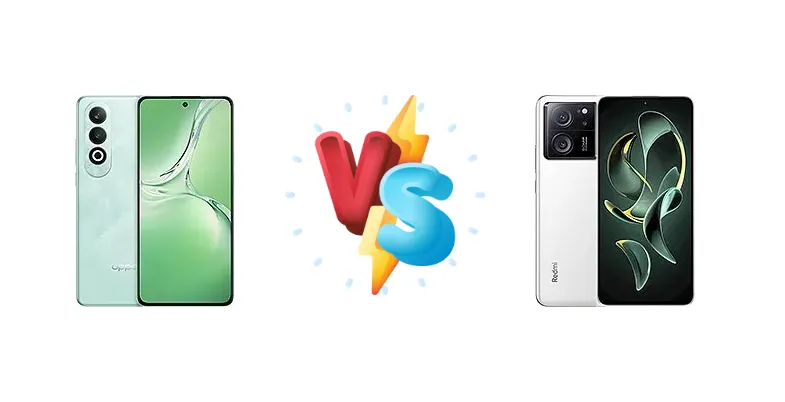
The mid-range smartphone market is fiercely competitive, and the Oppo K12 and Xiaomi Redmi K60 Ultra represent compelling options. The K12 brings Qualcomm's latest 7-series chip to the table, while the K60 Ultra boasts the older but still potent Dimensity 9200+. This comparison will dissect their strengths and weaknesses to determine which device offers the best overall package.
🏆 Quick Verdict
For most users, the Xiaomi Redmi K60 Ultra emerges as the stronger contender. Its Dimensity 9200+ chipset delivers noticeably superior CPU and GPU performance, and its 120W charging is significantly faster than the K12's 100W. While the K12 offers a competitive experience, the K60 Ultra provides a more future-proof and powerful platform.
| Network |
|---|
| 2G bands | GSM 850 / 900 / 1800 / 1900 | GSM 850 / 900 / 1800 / 1900 |
| 3G bands | HSDPA 850 / 900 / 1700(AWS) / 1900 / 2100 | HSDPA 800 / 850 / 900 / 1700(AWS) / 2100 |
| 4G bands | 1, 3, 4, 5, 8, 28, 34, 38, 39, 40, 41 | 1, 3, 4, 5, 8, 18, 19, 26, 34, 38, 39, 40, 41, 42, 66 |
| 5G bands | 1, 5, 8, 28, 41, 77, 78 SA/NSA | 1, 3, 5, 8, 28, 38, 41, 66, 77, 78 SA/NSA |
| Speed | HSPA, LTE, 5G | HSPA, LTE, 5G |
| Technology | GSM / CDMA / HSPA / LTE / 5G | GSM / CDMA / HSPA / CDMA2000 / LTE / 5G |
| Launch |
|---|
| Announced | 2024, April 24 | 2023, August 15 |
| Status | Available. Released 2024, April 29 | Available. Released 2023, August 15 |
| Body |
|---|
| Dimensions | 162.5 x 75.3 x 8.4 mm (6.40 x 2.96 x 0.33 in) | 162.2 x 75.7 x 8.5 mm (6.39 x 2.98 x 0.33 in) |
| SIM | Nano-SIM + Nano-SIM | Nano-SIM + Nano-SIM |
| Weight | 186 g (6.56 oz) | 204 g (7.20 oz) |
| Display |
|---|
| Protection | - | Unspecified |
| Resolution | 1080 x 2412 pixels, 20:9 ratio (~394 ppi density) | 1220 x 2712 pixels, 20:9 ratio (~446 ppi density) |
| Size | 6.7 inches, 108.0 cm2 (~88.3% screen-to-body ratio) | 6.67 inches, 107.4 cm2 (~87.5% screen-to-body ratio) |
| Type | AMOLED, 1B colors, 120Hz, HDR10+, 500 nits (typ), 900 nits (HBM), 1100 nits (peak) | OLED, 68B colors, 144Hz, Dolby Vision, HDR10+, 2600 nits (peak) |
| Platform |
|---|
| CPU | Octa-core (1x2.63 GHz Cortex-A715 & 4x2.4 GHz Cortex-A715 & 3x1.8 GHz Cortex-A510) | Octa-core (1x3.35 GHz Cortex-X3 & 3x3.0 GHz Cortex-A715 & 4x2.0 GHz Cortex-A510) |
| Chipset | Qualcomm SM7550-AB Snapdragon 7 Gen 3 (4 nm) | Mediatek Dimensity 9200+ (4 nm) |
| GPU | Adreno 720 | Immortalis-G715 MC11 |
| OS | Android 14, ColorOS 14 | Android 13, MIUI 14 |
| Memory |
|---|
| Card slot | microSDXC (uses shared SIM slot) | No |
| Internal | 256GB 8GB RAM, 256GB 12GB RAM, 512GB 12GB RAM | 256GB 12GB RAM, 256GB 16GB RAM, 512GB 16GB RAM, 1TB 16GB RAM, 1TB 24GB RAM |
| Main Camera |
|---|
| Dual | 50 MP, f/1.8, 26mm (wide), 1/1.95", 0.8µm, PDAF, OIS
8 MP, f/2.2, 16mm, 112˚ (ultrawide), 1/4.0", 1.12µm | - |
| Features | Dual-LED flash, HDR, panorama | Color spectrum sensor, Dual-LED dual-tone flash, HDR, panorama |
| Triple | - | 50 MP, f/1.7, (wide), 1/1.49", 1.0µm, PDAF, OIS
8 MP, 119˚ (ultrawide), 1/4.0", 1.12µm
2 MP (macro) |
| Video | 4K@30fps, 1080p@30/60/120fps, gyro-EIS, OIS | 8K@24fps, 4K@30/60fps, 1080p@30/60/120/240/960fps, gyro-EIS, HDR10+, 10-bit |
| Selfie camera |
|---|
| Features | Panorama | HDR |
| Single | 16 MP, f/2.4, 26mm (wide), 1/3.0", 1.0µm | 20 MP, (wide), 1/2.0", 0.8µm |
| Video | 1080p@30fps | 1080p@30/120fps |
| Sound |
|---|
| 35mm jack | No | No |
| Loudspeaker | Yes, with stereo speakers | Yes, with stereo speakers |
| Comms |
|---|
| Bluetooth | 5.4, A2DP, LE, aptX HD, LHDC | 5.4, A2DP, LE |
| Infrared port | Yes | Yes |
| NFC | Yes | Yes |
| Positioning | GPS, GALILEO, GLONASS, BDS, QZSS | GPS (L1+L5), GLONASS (G1), BDS (B1I+B1C+B2a+B2b), GALILEO (E1+E5a), QZSS (L1+L5), NavIC |
| Radio | No | Unspecified |
| USB | USB Type-C 2.0 | USB Type-C, OTG |
| WLAN | Wi-Fi 802.11 a/b/g/n/ac/6, dual-band | Wi-Fi 802.11 a/b/g/n/ac/6e, dual-band, Wi-Fi Direct |
| Features |
|---|
| Sensors | Fingerprint (under display, optical), accelerometer, gyro, proximity, compass | Fingerprint (under display, optical), accelerometer, gyro, proximity, compass |
| Battery |
|---|
| Charging | 100W wired, 100% in 27 min | 120W wired, PD3.0, 100% in 19 min |
| Type | 5500 mAh | Li-Po 5000 mAh |
| Misc |
|---|
| Colors | Celadon Marble, Dark Chrome | Black, White, Green |
| Models | PJR110 | 23078RKD5C |
| Price | About 250 EUR | About 330 EUR |
Oppo K12
- Newer Snapdragon 7 Gen 3 chipset
- Potentially more refined software experience
- Competitive 100W fast charging
- Less powerful CPU and GPU compared to the K60 Ultra
- Slower charging speed than the K60 Ultra
Xiaomi Redmi K60 Ultra
- Significantly more powerful Dimensity 9200+ chipset
- Ultra-fast 120W charging with PD3.0
- Likely superior display quality
- Older chipset architecture
- Potential for higher thermal throttling under sustained load
Display Comparison
Neither device's display specifications are provided, so we must infer. Given the K60 Ultra's positioning, it likely features a higher-quality AMOLED panel with a higher refresh rate (potentially 144Hz) and peak brightness compared to the K12. The K60 Ultra may also benefit from LTPO technology for adaptive refresh rates, improving battery life. Bezels are likely comparable, but the K60 Ultra's panel is expected to offer superior color accuracy and viewing angles.
Camera Comparison
Without specific camera specs, a direct comparison is difficult. However, given Xiaomi’s history, the K60 Ultra likely features a larger main sensor with optical image stabilization (OIS), offering better low-light performance and image quality. The K12 may focus on software optimization, but the hardware advantage likely resides with the K60 Ultra. We can expect similar reliance on computational photography from both brands, but the K60 Ultra’s superior processing power will allow for more complex and effective image processing.
Performance
The core difference lies in the chipsets. The Xiaomi Redmi K60 Ultra’s MediaTek Dimensity 9200+ features a Cortex-X3 prime core clocked at 3.35 GHz, significantly outpacing the Oppo K12’s Snapdragon 7 Gen 3’s Cortex-A715 prime core at 2.63 GHz. This translates to a substantial advantage in CPU-intensive tasks and gaming. The Dimensity 9200+ also boasts a more powerful GPU. While both are built on a 4nm process, the architectural advantages of the Dimensity 9200+ provide a clear performance lead. The K60 Ultra likely utilizes faster LPDDR5x RAM, further enhancing its performance capabilities. Thermal management will be crucial; the K60 Ultra's more powerful chipset will require a robust cooling solution to prevent throttling.
Battery Life
The charging speeds are a key differentiator. The Redmi K60 Ultra’s 120W charging, with a full charge in 19 minutes, is significantly faster than the Oppo K12’s 100W charging (27 minutes). While battery capacity isn't specified, the faster charging of the K60 Ultra mitigates any potential disadvantage from a slightly smaller battery. The K60 Ultra also supports PD3.0, offering wider compatibility with chargers and accessories. The K12’s 100W is still fast, but the K60 Ultra provides a more convenient and time-saving charging experience.
Buying Guide
Buy the Oppo K12 if you prioritize a newer chipset architecture and a potentially more refined software experience, and are comfortable with slightly slower charging speeds. Buy the Xiaomi Redmi K60 Ultra if you demand maximum performance for gaming and demanding tasks, and value the convenience of incredibly fast 120W charging. The K60 Ultra is the clear choice for power users.
Frequently Asked Questions
❓ Will the Dimensity 9200+ in the Redmi K60 Ultra overheat during prolonged gaming sessions?
The Dimensity 9200+ is a powerful chip, and sustained gaming will generate heat. However, Xiaomi typically implements robust cooling solutions in their 'Ultra' series. While some throttling is possible, it's unlikely to be severe enough to ruin the gaming experience, especially compared to older or less well-cooled devices.
❓ Does the Oppo K12 support features like 5G and NFC?
Given its positioning as a mid-range device, the Oppo K12 almost certainly supports 5G connectivity. NFC is also highly probable, as it's a standard feature in most modern smartphones, even in this price segment. However, specific band support for 5G will vary by region.
❓ Is the 100W charging on the Oppo K12 enough for most users, or is the 120W on the K60 Ultra a must-have?
100W charging is still very fast and will top up the K12 quickly. However, the 120W charging on the K60 Ultra is noticeably faster, reducing charging time by approximately 8 minutes. For users who frequently find themselves with low battery and need a quick boost, the K60 Ultra's charging speed is a significant convenience.