
Oppo K12 vs. Samsung Galaxy A54: A Deep Dive into Mid-Range Champions
| Phones Images | |||||
|---|---|---|---|---|---|
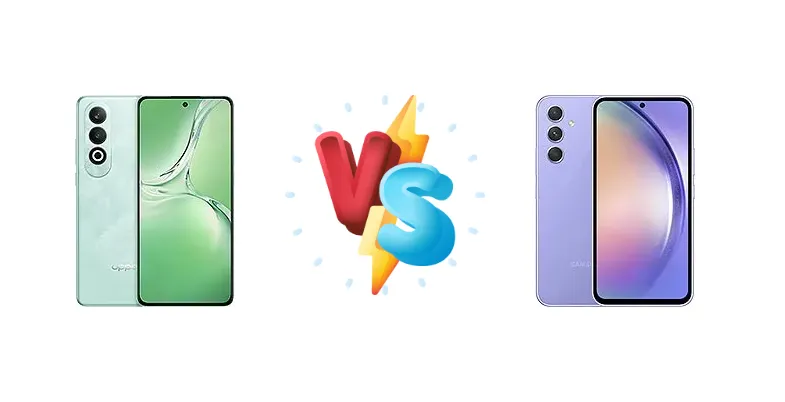
|
🏆 Quick Verdict
For users prioritizing charging speed and potentially better long-term performance, the Oppo K12 is the winner. Its 100W charging is a game-changer, and the Snapdragon 7 Gen 3 offers a more modern architecture. However, the Galaxy A54 remains a strong contender, particularly for those valuing proven battery endurance and a refined software experience.
| PHONES | ||
|---|---|---|
| Phone Names | Oppo K12 | Samsung Galaxy A54 |
| Network | ||
|---|---|---|
| 2G bands | GSM 850 / 900 / 1800 / 1900 | GSM 850 / 900 / 1800 / 1900 |
| 3G bands | HSDPA 850 / 900 / 1700(AWS) / 1900 / 2100 | HSDPA 850 / 900 / 1700(AWS) / 1900 / 2100 |
| 4G bands | 1, 3, 4, 5, 8, 28, 34, 38, 39, 40, 41 | 1, 2, 3, 4, 5, 7, 8, 12, 17, 20, 26, 28, 32, 38, 40, 41, 66 - International |
| 5G bands | 1, 5, 8, 28, 41, 77, 78 SA/NSA | 1, 3, 7, 8, 20, 28, 38, 40, 41, 77, 78 SA/NSA/Sub6 - International |
| Speed | HSPA, LTE, 5G | HSPA, LTE, 5G |
| Technology | GSM / CDMA / HSPA / LTE / 5G | GSM / HSPA / LTE / 5G |
| - | 25, 41, 66, 71 SA/NSA/Sub6/mmWave - USA | |
| Launch | ||
|---|---|---|
| Announced | 2024, April 24 | 2023, March 15 |
| Status | Available. Released 2024, April 29 | Available. Released 2023, March 24 |
| Body | ||
|---|---|---|
| Build | - | Glass front (Gorilla Glass 5), glass back (Gorilla Glass 5), plastic frame |
| Dimensions | 162.5 x 75.3 x 8.4 mm (6.40 x 2.96 x 0.33 in) | 158.2 x 76.7 x 8.2 mm (6.23 x 3.02 x 0.32 in) |
| SIM | Nano-SIM + Nano-SIM | · Nano-SIM + eSIM· Nano-SIM + Nano-SIM |
| Weight | 186 g (6.56 oz) | 202 g (7.13 oz) |
| - | IP67 dust/water resistant (up to 1m for 30 min) | |
| Display | ||
|---|---|---|
| Protection | - | Corning Gorilla Glass 5 |
| Resolution | 1080 x 2412 pixels, 20:9 ratio (~394 ppi density) | 1080 x 2340 pixels, 19.5:9 ratio (~403 ppi density) |
| Size | 6.7 inches, 108.0 cm2 (~88.3% screen-to-body ratio) | 6.4 inches, 100.5 cm2 (~82.9% screen-to-body ratio) |
| Type | AMOLED, 1B colors, 120Hz, HDR10+, 500 nits (typ), 900 nits (HBM), 1100 nits (peak) | Super AMOLED, 120Hz, HDR10+, 1000 nits (HBM) |
| Platform | ||
|---|---|---|
| CPU | Octa-core (1x2.63 GHz Cortex-A715 & 4x2.4 GHz Cortex-A715 & 3x1.8 GHz Cortex-A510) | Octa-core (4x2.4 GHz Cortex-A78 & 4x2.0 GHz Cortex-A55) |
| Chipset | Qualcomm SM7550-AB Snapdragon 7 Gen 3 (4 nm) | Exynos 1380 (5 nm) |
| GPU | Adreno 720 | Mali-G68 MP5 |
| OS | Android 14, ColorOS 14 | Android 13, up to 4 major Android upgrades, One UI 7 |
| Memory | ||
|---|---|---|
| Card slot | microSDXC (uses shared SIM slot) | microSDXC (uses shared SIM slot) |
| Internal | 256GB 8GB RAM, 256GB 12GB RAM, 512GB 12GB RAM | 128GB 4GB RAM, 128GB 6GB RAM, 128GB 8GB RAM, 256GB 6GB RAM, 256GB 8GB RAM |
| Main Camera | ||
|---|---|---|
| Dual | 50 MP, f/1.8, 26mm (wide), 1/1.95", 0.8µm, PDAF, OIS 8 MP, f/2.2, 16mm, 112˚ (ultrawide), 1/4.0", 1.12µm | - |
| Features | Dual-LED flash, HDR, panorama | LED flash, panorama, HDR |
| Single | - | 32 MP, f/2.2, 26mm (wide), 1/2.8", 0.8µm |
| Triple | - | 50 MP, f/1.8, 23mm (wide), 1/1.56", 1.0µm, PDAF, OIS 12 MP, f/2.2, 13mm, 123˚ (ultrawide), 1/3.X", 1.12µm 5 MP (macro) |
| Video | 4K@30fps, 1080p@30/60/120fps, gyro-EIS, OIS | 4K@30fps, 1080p@30/60fps, 720p@480fps, gyro-EIS |
| Selfie camera | ||
|---|---|---|
| Features | Panorama | - |
| Single | 16 MP, f/2.4, 26mm (wide), 1/3.0", 1.0µm | 32 MP, f/2.2, 26mm (wide), 1/2.8", 0.8µm |
| Video | 1080p@30fps | 4K@30fps, 1080p@30/60fps |
| Sound | ||
|---|---|---|
| 3.5mm jack | - | No |
| 35mm jack | No | No |
| Loudspeaker | Yes, with stereo speakers | Yes, with stereo speakers |
| Comms | ||
|---|---|---|
| Bluetooth | 5.4, A2DP, LE, aptX HD, LHDC | 5.3, A2DP, LE |
| Infrared port | Yes | - |
| NFC | Yes | Yes (market/region dependent) |
| Positioning | GPS, GALILEO, GLONASS, BDS, QZSS | GPS, GLONASS, GALILEO, BDS |
| Radio | No | No |
| USB | USB Type-C 2.0 | USB Type-C 2.0, OTG |
| WLAN | Wi-Fi 802.11 a/b/g/n/ac/6, dual-band | Wi-Fi 802.11 a/b/g/n/ac/6, dual-band, Wi-Fi Direct |
| Features | ||
|---|---|---|
| Sensors | Fingerprint (under display, optical), accelerometer, gyro, proximity, compass | Fingerprint (under display, optical), accelerometer, gyro, compass, barometer (USA only) |
| - | Virtual proximity sensing | |
| Battery | ||
|---|---|---|
| Charging | 100W wired, 100% in 27 min | 25W wired |
| Type | 5500 mAh | 5000 mAh |
| Misc | ||
|---|---|---|
| Colors | Celadon Marble, Dark Chrome | Lime, Graphite, Violet, White |
| Models | PJR110 | SM-A546V, SM-A546U, SM-A546U1, SM-A546B, SM-A546B/DS, SM-A546E, SM-A546E/DS, SM-A5460, SM-A546M, SM-A546M/DS, SM-A546W |
| Price | About 250 EUR | € 210.00 / $ 119.11 / £ 169.95 / ₹ 28,999 |
| SAR | - | 0.81 W/kg (head) 0.67 W/kg (body) |
| SAR EU | - | 0.69 W/kg (head) 1.34 W/kg (body) |
| Tests | ||
|---|---|---|
| Battery life | - | Endurance rating 119h |
| Camera | - | Photo / Video |
| Display | - | Contrast ratio: Infinite (nominal) |
| Loudspeaker | - | -26.6 LUFS (Good) |
| Performance | - | AnTuTu: 506678 (v9) GeekBench: 2703 (v5.1), 2797 (v6) GFXBench: 25fps (ES 3.1 onscreen) |
Oppo K12
- Blazing-fast 100W charging
- More modern Snapdragon 7 Gen 3 chipset
- Potentially better thermal performance due to 4nm process
- Camera specs currently unknown
- Battery life potentially lower than A54 without knowing capacity
Samsung Galaxy A54
- Excellent battery life (119h endurance)
- Bright and vibrant display (980 nits)
- Refined software experience and established brand
- Slower 25W charging
- Older Exynos 1380 chipset
Display Comparison
The Samsung Galaxy A54 boasts a measured peak brightness of 980 nits, ensuring excellent visibility outdoors. While the Oppo K12’s display specs are currently unavailable, Samsung’s display technology typically delivers vibrant colors and good viewing angles. The A54’s ‘Infinite’ contrast ratio (nominal) suggests a strong AMOLED panel. Without knowing the K12’s panel type, it’s difficult to assess its color accuracy or HDR capabilities, but the A54 has a clear advantage in established display quality.
Camera Comparison
Both devices offer photo and video capabilities, but detailed sensor information is lacking for the Oppo K12. The Galaxy A54 likely features a more mature camera system with refined image processing. Without knowing the K12’s main sensor size or aperture, it’s difficult to assess its low-light performance. The A54’s image processing is known for producing vibrant, social media-ready photos. We’ll need more data on the K12 to determine if it can compete in image quality, but Samsung’s experience in this segment gives it an initial edge.
Performance
The Oppo K12’s Qualcomm Snapdragon 7 Gen 3 (4nm) represents a significant architectural leap over the Samsung Galaxy A54’s Exynos 1380 (5nm). The 7 Gen 3 utilizes newer Cortex-A715 cores, promising improved CPU performance and efficiency. While the Exynos 1380’s Cortex-A78 cores are capable, the 4nm process node of the Snapdragon 7 Gen 3 should translate to better thermal management and sustained performance during demanding tasks like gaming. The K12’s CPU configuration (1x2.63 GHz Cortex-A715 & 4x2.4 GHz Cortex-A715 & 3x1.8 GHz Cortex-A510) suggests a focus on multi-core performance, potentially benefiting multitasking and content creation.
Battery Life
The Samsung Galaxy A54 achieves an impressive endurance rating of 119 hours and delivers 11:15 hours of active use, demonstrating excellent battery life. The Oppo K12, however, compensates for potentially smaller battery capacity with its groundbreaking 100W wired charging, achieving a full charge in just 27 minutes. This drastically reduces downtime and is a major advantage for users who frequently need to top up their battery. While the A54 prioritizes longevity, the K12 prioritizes convenience and speed.
Buying Guide
Buy the Oppo K12 if you need incredibly fast charging, frequently game on your phone, and want a device with a more recent processor. This phone is ideal for power users who don't want to be tethered to a charger. Buy the Samsung Galaxy A54 if you prioritize all-day battery life, a consistently smooth user experience, and a well-established ecosystem. It’s the safer bet for those who value reliability and a polished software experience over raw speed.