
Oppo K12 vs. Google Pixel 7a: A Deep Dive into Mid-Range Champions
| Phones Images | |||||
|---|---|---|---|---|---|
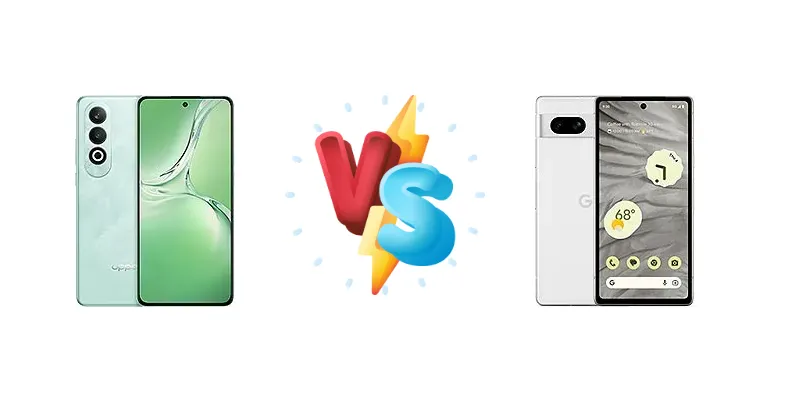
|
🏆 Quick Verdict
For users prioritizing performance and incredibly fast charging, the Oppo K12 is the clear winner. Its Snapdragon 7 Gen 3 offers a noticeable performance edge, and the 100W charging is unmatched. However, the Pixel 7a remains a strong contender for those valuing Google’s software experience and computational photography.
| PHONES | ||
|---|---|---|
| Phone Names | Oppo K12 | Google Pixel 7a |
| Network | ||
|---|---|---|
| 2G bands | GSM 850 / 900 / 1800 / 1900 | GSM 850 / 900 / 1800 / 1900 |
| 3G bands | HSDPA 850 / 900 / 1700(AWS) / 1900 / 2100 | HSDPA 800 / 850 / 900 / 1700(AWS) / 1900 / 2100 |
| 4G bands | 1, 3, 4, 5, 8, 28, 34, 38, 39, 40, 41 | 1, 2, 3, 4, 5, 7, 8, 12, 13, 14, 17, 20, 25, 26, 28, 29, 30, 38, 40, 41, 48, 66, 71 - GWKK3, G0DZQ |
| 5G bands | 1, 5, 8, 28, 41, 77, 78 SA/NSA | 1, 2, 3, 5, 7, 8, 12, 14, 20, 25, 28, 30, 38, 41, 48, 66, 71, 77, 78 SA/NSA/Sub6 - GWKK3 |
| Speed | HSPA, LTE, 5G | HSPA, LTE, 5G |
| Technology | GSM / CDMA / HSPA / LTE / 5G | GSM / HSPA / LTE / 5G |
| - | 1, 2, 3, 5, 7, 8, 12, 20, 25, 28, 38, 40, 41, 66, 75, 76, 77, 78, 79 SA/NSA/Sub6 - GHL1X, G82U8 | |
| Launch | ||
|---|---|---|
| Announced | 2024, April 24 | 2023, May 10 |
| Status | Available. Released 2024, April 29 | Available. Released 2023, May 10 |
| Body | ||
|---|---|---|
| Build | - | Glass front (Gorilla Glass 3), aluminum frame, plastic back |
| Dimensions | 162.5 x 75.3 x 8.4 mm (6.40 x 2.96 x 0.33 in) | 152 x 72.9 x 9 mm (5.98 x 2.87 x 0.35 in) |
| SIM | Nano-SIM + Nano-SIM | Nano-SIM + eSIM |
| Weight | 186 g (6.56 oz) | 193.5 g (6.84 oz) |
| - | IP67 dust/water resistant (up to 1m for 30 min) | |
| Display | ||
|---|---|---|
| Protection | - | Corning Gorilla Glass 3 |
| Resolution | 1080 x 2412 pixels, 20:9 ratio (~394 ppi density) | 1080 x 2400 pixels, 20:9 ratio (~429 ppi density) |
| Size | 6.7 inches, 108.0 cm2 (~88.3% screen-to-body ratio) | 6.1 inches, 90.7 cm2 (~81.8% screen-to-body ratio) |
| Type | AMOLED, 1B colors, 120Hz, HDR10+, 500 nits (typ), 900 nits (HBM), 1100 nits (peak) | OLED, HDR, 90Hz |
| - | Always-on display | |
| Platform | ||
|---|---|---|
| CPU | Octa-core (1x2.63 GHz Cortex-A715 & 4x2.4 GHz Cortex-A715 & 3x1.8 GHz Cortex-A510) | Octa-core (2x2.85 GHz Cortex-X1 & 2x2.35 GHz Cortex-A78 & 4x1.80 GHz Cortex-A55) |
| Chipset | Qualcomm SM7550-AB Snapdragon 7 Gen 3 (4 nm) | Google Tensor G2 (5 nm) |
| GPU | Adreno 720 | Mali-G710 MP7 |
| OS | Android 14, ColorOS 14 | Android 13, upgradable to Android 15, up to 5 major Android upgrades |
| Memory | ||
|---|---|---|
| Card slot | microSDXC (uses shared SIM slot) | No |
| Internal | 256GB 8GB RAM, 256GB 12GB RAM, 512GB 12GB RAM | 128GB 8GB RAM |
| - | UFS 3.1 | |
| Main Camera | ||
|---|---|---|
| Dual | 50 MP, f/1.8, 26mm (wide), 1/1.95", 0.8µm, PDAF, OIS 8 MP, f/2.2, 16mm, 112˚ (ultrawide), 1/4.0", 1.12µm | 64 MP, f/1.9, 26mm (wide), 1/1.73", 0.8µm, dual pixel PDAF, OIS 13 MP, f/2.2, 120˚ (ultrawide), 1.12µm |
| Features | Dual-LED flash, HDR, panorama | Dual-LED flash, Pixel Shift, Auto-HDR, panorama |
| Video | 4K@30fps, 1080p@30/60/120fps, gyro-EIS, OIS | 4K@30/60fps, 1080p@30/60/120/240fps, OIS |
| Selfie camera | ||
|---|---|---|
| Features | Panorama | HDR, panorama |
| Single | 16 MP, f/2.4, 26mm (wide), 1/3.0", 1.0µm | 13 MP, f/2.2, 20mm (ultrawide), 1.12µm |
| Video | 1080p@30fps | 4K@30fps, 1080p@30fps |
| Sound | ||
|---|---|---|
| 3.5mm jack | - | No |
| 35mm jack | No | No |
| Loudspeaker | Yes, with stereo speakers | Yes, with stereo speakers |
| Comms | ||
|---|---|---|
| Bluetooth | 5.4, A2DP, LE, aptX HD, LHDC | 5.3, A2DP, LE |
| Infrared port | Yes | - |
| NFC | Yes | Yes |
| Positioning | GPS, GALILEO, GLONASS, BDS, QZSS | GPS, GLONASS, GALILEO, BDS, QZSS, NavIC |
| Radio | No | No |
| USB | USB Type-C 2.0 | USB Type-C 3.2 |
| WLAN | Wi-Fi 802.11 a/b/g/n/ac/6, dual-band | Wi-Fi 802.11 a/b/g/n/ac/6e, tri-band |
| Features | ||
|---|---|---|
| Sensors | Fingerprint (under display, optical), accelerometer, gyro, proximity, compass | Fingerprint (under display, optical), accelerometer, gyro, proximity, compass, barometer |
| Battery | ||
|---|---|---|
| Charging | 100W wired, 100% in 27 min | 18W wired, PD3.0 7.5W wireless |
| Type | 5500 mAh | Li-Po 4385 mAh |
| Misc | ||
|---|---|---|
| Colors | Celadon Marble, Dark Chrome | Charcoal, Snow, Sea, Coral |
| Models | PJR110 | GWKK3, GHL1X, G0DZQ, G82U8 |
| Price | About 250 EUR | € 179.90 / $ 150.00 / £ 170.00 / ₹ 25,980 |
Oppo K12
- Incredibly fast 100W charging
- Snapdragon 7 Gen 3 offers strong performance
- Potentially better thermal management due to 4nm process
- Camera performance is unknown without sensor details
- Software experience may not be as refined as Pixel
Google Pixel 7a
- Excellent camera image processing and AI features
- Smooth and intuitive Google software experience
- High peak display brightness
- Slow 18W charging
- Tensor G2 may throttle under sustained load
- Older chipset architecture
Display Comparison
The Pixel 7a boasts a measured peak brightness of 1070 nits, providing excellent visibility in direct sunlight. While the Oppo K12’s display specifications aren’t provided, it’s likely to be slightly dimmer. The Pixel 7a’s display technology is well-regarded for its color accuracy, crucial for photo and video editing. The absence of LTPO on either device means refresh rates are likely fixed, impacting power consumption during prolonged use compared to adaptive refresh rate panels.
Camera Comparison
The Pixel 7a is renowned for its computational photography prowess, leveraging Google’s image processing algorithms to deliver consistently excellent results. While specific sensor details for the K12 are missing, the Pixel 7a’s camera system benefits from Google’s software optimizations, including features like Super Res Zoom and Night Sight. The Pixel 7a’s focus on image processing is a significant advantage, particularly in challenging lighting conditions. The K12 will likely rely more on hardware capabilities, but without detailed sensor information, it’s difficult to assess its low-light performance.
Performance
The core difference lies in the chipsets. The Oppo K12’s Snapdragon 7 Gen 3 (4nm) is built for efficiency and sustained performance, utilizing a 1+4+3 core configuration. The Google Pixel 7a’s Tensor G2 (5nm) prioritizes AI and machine learning tasks, featuring a 2+2+4 core setup with Cortex-X1 performance cores. While the X1 cores offer higher peak clock speeds (2.85 GHz vs 2.63 GHz), the Snapdragon 7 Gen 3’s newer architecture and 4nm process likely translate to better thermal management and sustained performance in demanding applications. The Pixel 7a’s Tensor G2 excels in tasks like voice recognition and image processing, but the K12 will likely show an advantage in graphically intensive games.
Battery Life
The Pixel 7a’s endurance rating of 76 hours suggests solid battery life, but this is an older metric. The Oppo K12 compensates for potentially smaller battery capacity with its blazing-fast 100W wired charging, achieving a full charge in just 27 minutes. The Pixel 7a’s 18W charging is significantly slower, taking considerably longer to reach 100%. This difference in charging speed is a major advantage for the K12, especially for users who frequently need to top up their battery.
Buying Guide
Buy the Oppo K12 if you need a phone for demanding mobile gaming, frequent fast charging, and prioritize raw processing power. You'll benefit from the Snapdragon 7 Gen 3's efficiency and the convenience of a full charge in under 30 minutes. Buy the Google Pixel 7a if you prefer a seamless software experience, exceptional camera image processing, and value Google’s AI-powered features like Magic Eraser and Call Screen. The Pixel 7a is ideal for users who prioritize photography and a clean, intuitive interface.