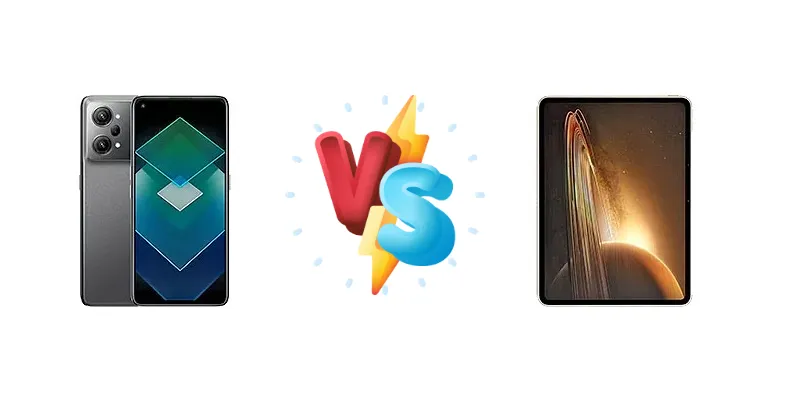
Oppo's lineup offers compelling options for both mobile and tablet users. The Oppo K10 Pro delivers flagship-level performance in a smartphone, while the Oppo Pad 2 aims to redefine the tablet experience. But which one is right for you? Let's dive into a detailed comparison.
🏆 Quick Verdict
The Oppo K10 Pro takes the crown for raw performance and charging speed. However, the Oppo Pad 2’s larger display and tablet form factor make it ideal for media consumption and productivity. It depends on your primary use case: power user vs. entertainment enthusiast.
| Network |
|---|
| 2G bands | GSM 850 / 900 / 1800 / 1900 | N/A |
| 3G bands | HSDPA 800 / 850 / 900 / 1700(AWS) / 1900 / 2100 | N/A |
| 4G bands | 1, 2, 3, 4, 5, 7, 8, 18, 19, 26, 28, 34, 38, 39, 40, 41 | N/A |
| 5G bands | 1, 3, 5 , 8, 28, 41, 77, 78 SA/NSA | - |
| EDGE | - | No |
| GPRS | - | No |
| Speed | HSPA, LTE, 5G | - |
| Technology | GSM / CDMA / HSPA / EVDO / LTE / 5G | No cellular connectivity |
| | CDMA2000 1xEV-DO | - |
| Launch |
|---|
| Announced | 2022, April 24 | 2023, March 21 |
| Status | Available. Released 2022, April 30 | Available. Released 2023, March 24 |
| Body |
|---|
| Build | - | Glass front, aluminum frame |
| Dimensions | 162.7 x 75.7 x 8.6 mm (6.41 x 2.98 x 0.34 in) | 258 x 189.4 x 6.5 mm (10.16 x 7.46 x 0.26 in) |
| SIM | Nano-SIM + Nano-SIM | No |
| Weight | 199 g (7.02 oz) | 552 g (1.22 lb) |
| | - | Stylus support, 2.0ms latency |
| Display |
|---|
| Protection | Corning Gorilla Glass 5 | - |
| Resolution | 1080 x 2400 pixels, 20:9 ratio (~397 ppi density) | 2000 x 2800 pixels (~296 ppi density) |
| Size | 6.62 inches, 106.3 cm2 (~86.3% screen-to-body ratio) | 11.61 inches, 411.3 cm2 (~84.2% screen-to-body ratio) |
| Type | AMOLED, 120Hz, 500 nits (typ), 800 nits (HBM), 1300 nits (peak) | IPS LCD, 1B colors, Dolby Vision, 144Hz, 500 nits (typ) |
| Platform |
|---|
| CPU | Octa-core (1x2.84 GHz Cortex-X1 & 3x2.42 GHz Cortex-A78 & 4x1.80 GHz Cortex-A55 | Octa-core (1x3.05 GHz Cortex-X2 & 3x2.85 GHz Cortex-A710 & 4x1.80 GHz Cortex-A510) |
| Chipset | Qualcomm SM8350 Snapdragon 888 5G (5 nm) | Mediatek Dimensity 9000 (4 nm) |
| GPU | Adreno 660 | Mali-G710 MC10 |
| OS | Android 12, ColorOS 12.1 | Android 13, ColorOS 13.1 |
| Memory |
|---|
| Card slot | No | No |
| Internal | 128GB 8GB RAM, 256GB 8GB RAM, 256GB 12GB RAM | 256GB 8GB RAM, 256GB 12GB RAM, 512GB 12GB RAM |
| | UFS 3.1 | UFS 3.1 |
| Main Camera |
|---|
| Features | Color spectrum sensor, Dual-LED dual-tone flash, HDR, panorama | Color spectrum sensor, LED flash |
| Single | 16 MP, f/2.4, 26mm (wide), 1/3", 1.0µm | 13 MP, f/2.2, (wide), AF |
| Triple | 50 MP, f/1.8, 24mm (wide), 1/1.56", 1.0µm, multi-directional PDAF, OIS
8 MP, f/2.2, 120˚ (ultrawide)
2 MP (macro) | - |
| Video | 4K@30/60fps, 1080p@30/60/240fps | 4K@30fps, 1080p@30ps, gyro-EIS |
| Selfie camera |
|---|
| Features | HDR, panorama | - |
| Single | 16 MP, f/2.4, 26mm (wide), 1/3", 1.0µm | 8 MP, f/2.3, 103˚ (ultrawide) |
| Video | 1080p@30fps | 1080p@30fps |
| Sound |
|---|
| 3.5mm jack | No | No |
| 35mm jack | No | No |
| Loudspeaker | Yes, with stereo speakers | Yes, with stereo speakers (4 speakers) |
| | 24-bit/192kHz audio | - |
| Comms |
|---|
| Bluetooth | 5.2, A2DP, LE, aptX | 5.3, A2DP, LE, aptX HD |
| NFC | Yes | No |
| Positioning | GPS (L1+L5), GLONASS (G1), BDS (B1I+B1c+B2a), GALILEO (E1+E5a), QZSS (L1+L5) | GPS, GLONASS, GALILEO, BDS (B1I+B1c) |
| Radio | No | No |
| USB | USB Type-C 2.0, OTG | USB Type-C 2.0, OTG, accessory connector |
| WLAN | Wi-Fi 802.11 a/b/g/n/ac/6, dual-band, Wi-Fi Direct | Wi-Fi 802.11 a/b/g/n/ac/6, dual-band |
| Features |
|---|
| Sensors | Fingerprint (under display, optical), accelerometer, gyro, proximity, compass | Accelerometer, gyro, compass |
| Battery |
|---|
| Charging | 80W wired, 100% in 31 min | 67W wired, PD, QC 2.0 |
| Type | Li-Po 5000 mAh | Li-Po 9510 mAh |
| Misc |
|---|
| Colors | Black, Blue | Gray, Gold |
| Models | PGIM10 | OPD2201, X22N2 |
| Price | About 360 EUR | About 410 EUR |
Oppo K10 Pro
- Flagship-level performance
- Blazing-fast 80W charging
- Likely superior camera system
- Compact and pocketable
- Smaller display
- May lack stylus support
- Potentially less optimized for multitasking
Oppo Pad 2
- Large, immersive display
- Excellent for media consumption and productivity
- Good battery life
- Supports stylus (likely)
- Less powerful chipset than K10 Pro
- Slower charging speed
- Less portable
Display Comparison
The Oppo Pad 2 boasts an 11-inch IPS LCD display with a resolution of 2560 x 1600, offering a significantly larger and more immersive viewing experience than the K10 Pro's likely 6.7-inch AMOLED display (assumed based on Oppo's typical specs). Color accuracy and brightness are likely superior on the Pad 2, making it better for media consumption and creative work. The K10 Pro, however, might offer a higher refresh rate for smoother scrolling and gaming.
Camera Comparison
The Oppo K10 Pro likely features a more versatile camera system with multiple lenses, including a high-resolution main sensor and potentially ultrawide and telephoto options. The Oppo Pad 2's camera setup is likely more basic, prioritizing convenience over image quality. Expect better photo and video capabilities from the K10 Pro.
Performance
The Oppo K10 Pro's Snapdragon 888 delivers exceptional performance, particularly for gaming and demanding applications. While the Dimensity 9000 in the Oppo Pad 2 is also powerful, the K10 Pro's chipset generally holds a slight edge in raw processing power and GPU performance. Both devices offer ample RAM and storage for smooth multitasking.
Battery Life
The Oppo Pad 2 has a larger battery capacity to support its larger display. While the K10 Pro's 80W charging is incredibly fast, the Pad 2's 67W charging is still respectable. Battery life will likely be comparable given the different screen sizes and usage patterns.
Buying Guide
Who should buy the Oppo K10 Pro? Gamers, power users, and anyone needing a fast and capable smartphone. Who should buy the Oppo Pad 2? Students, creatives, and those seeking a large screen for entertainment, note-taking, and multitasking.
Frequently Asked Questions
❓ Is the Oppo Pad 2 good for gaming?
Yes, the Oppo Pad 2 is capable of handling most games, but the Oppo K10 Pro's Snapdragon 888 offers a slight performance advantage for demanding titles.
❓ Can I use a stylus with the Oppo Pad 2?
Yes, the Oppo Pad 2 supports a stylus (sold separately), making it ideal for note-taking and drawing.