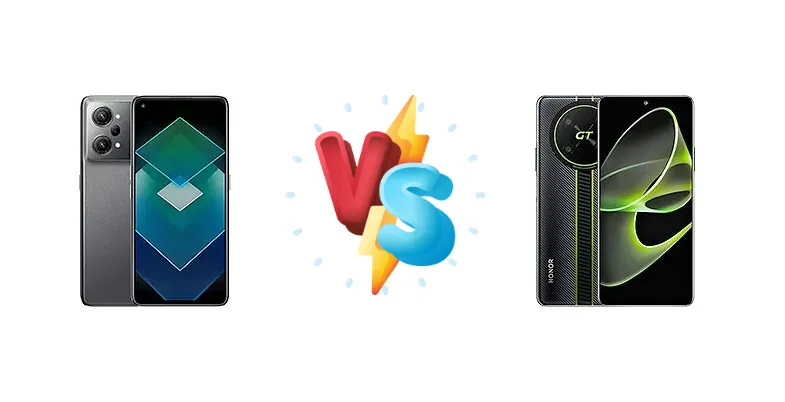
The Oppo K10 Pro and Honor X40 GT both pack the powerful Snapdragon 888 chipset, promising flagship-level performance at a more accessible price point. But which phone truly delivers the better overall experience? This comprehensive comparison dives deep into their features to help you decide.
🏆 Quick Verdict
The Oppo K10 Pro edges out the Honor X40 GT thanks to its faster 80W charging and potentially better software support. While the X40 GT offers reverse wireless charging, the K10 Pro's charging speed advantage makes it the slightly more compelling choice for most users.
| Network |
|---|
| 2G bands | GSM 850 / 900 / 1800 / 1900 | GSM 850 / 900 / 1800 / 1900 |
| 3G bands | HSDPA 800 / 850 / 900 / 1700(AWS) / 1900 / 2100 | HSDPA 850 / 900 / 1700(AWS) / 1900 / 2100 |
| 4G bands | 1, 2, 3, 4, 5, 7, 8, 18, 19, 26, 28, 34, 38, 39, 40, 41 | LTE |
| 5G bands | 1, 3, 5 , 8, 28, 41, 77, 78 SA/NSA | SA/NSA |
| Speed | HSPA, LTE, 5G | HSPA, LTE, 5G |
| Technology | GSM / CDMA / HSPA / EVDO / LTE / 5G | GSM / CDMA / HSPA / EVDO / LTE / 5G |
| | CDMA2000 1xEV-DO | CDMA2000 1xEV-DO |
| Launch |
|---|
| Announced | 2022, April 24 | 2022, October 13 |
| Status | Available. Released 2022, April 30 | Available. Released 2022, October 18 |
| Body |
|---|
| Dimensions | 162.7 x 75.7 x 8.6 mm (6.41 x 2.98 x 0.34 in) | 166.1 x 75.8 x 8.5 mm (6.54 x 2.98 x 0.33 in) |
| SIM | Nano-SIM + Nano-SIM | Nano-SIM + Nano-SIM |
| Weight | 199 g (7.02 oz) | 199.5 g (7.05 oz) |
| Display |
|---|
| Protection | Corning Gorilla Glass 5 | - |
| Resolution | 1080 x 2400 pixels, 20:9 ratio (~397 ppi density) | 1080 x 2388 pixels (~385 ppi density) |
| Size | 6.62 inches, 106.3 cm2 (~86.3% screen-to-body ratio) | 6.81 inches, 112.3 cm2 (~89.2% screen-to-body ratio) |
| Type | AMOLED, 120Hz, 500 nits (typ), 800 nits (HBM), 1300 nits (peak) | IPS LCD, 144Hz |
| Platform |
|---|
| CPU | Octa-core (1x2.84 GHz Cortex-X1 & 3x2.42 GHz Cortex-A78 & 4x1.80 GHz Cortex-A55 | Octa-core (1x2.84 GHz Cortex-X1 & 3x2.42 GHz Cortex-A78 & 4x1.80 GHz Cortex-A55) |
| Chipset | Qualcomm SM8350 Snapdragon 888 5G (5 nm) | Qualcomm SM8350 Snapdragon 888 5G (5 nm) |
| GPU | Adreno 660 | Adreno 660 |
| OS | Android 12, ColorOS 12.1 | Android 12, Magic UI 6.1 |
| Memory |
|---|
| Card slot | No | No |
| Internal | 128GB 8GB RAM, 256GB 8GB RAM, 256GB 12GB RAM | 256GB 8GB RAM, 256GB 12GB RAM |
| | UFS 3.1 | UFS 3.1 |
| Main Camera |
|---|
| Features | Color spectrum sensor, Dual-LED dual-tone flash, HDR, panorama | LED flash, panorama, HDR |
| Single | 16 MP, f/2.4, 26mm (wide), 1/3", 1.0µm | 16 MP, f/2.5 |
| Triple | 50 MP, f/1.8, 24mm (wide), 1/1.56", 1.0µm, multi-directional PDAF, OIS
8 MP, f/2.2, 120˚ (ultrawide)
2 MP (macro) | 50 MP, f/1.8, (wide), PDAF
2 MP (macro)
Auxiliary lens |
| Video | 4K@30/60fps, 1080p@30/60/240fps | 4K@30fps, 1080p@30fps; gyro-EIS |
| Selfie camera |
|---|
| Features | HDR, panorama | - |
| Single | 16 MP, f/2.4, 26mm (wide), 1/3", 1.0µm | 16 MP, f/2.5 |
| Video | 1080p@30fps | 1080p@30fps |
| Sound |
|---|
| 3.5mm jack | No | No |
| 35mm jack | No | No |
| Loudspeaker | Yes, with stereo speakers | Yes |
| | 24-bit/192kHz audio | - |
| Comms |
|---|
| Bluetooth | 5.2, A2DP, LE, aptX | 5.2, A2DP, LE, aptX HD |
| NFC | Yes | Yes |
| Positioning | GPS (L1+L5), GLONASS (G1), BDS (B1I+B1c+B2a), GALILEO (E1+E5a), QZSS (L1+L5) | GPS, GLONASS, GALILEO, BDS |
| Radio | No | No |
| USB | USB Type-C 2.0, OTG | USB Type-C 2.0, OTG |
| WLAN | Wi-Fi 802.11 a/b/g/n/ac/6, dual-band, Wi-Fi Direct | Wi-Fi 802.11 a/b/g/n/ac/6, dual-band, Wi-Fi Direct |
| Features |
|---|
| Sensors | Fingerprint (under display, optical), accelerometer, gyro, proximity, compass | Fingerprint (side-mounted), accelerometer, gyro, compass |
| | - | Virtual proximity sensing |
| Battery |
|---|
| Charging | 80W wired, 100% in 31 min | 66W wired, 90% in 30 min
5W reverse wired |
| Type | Li-Po 5000 mAh | Li-Po 4800 mAh |
| Misc |
|---|
| Colors | Black, Blue | Racing Black, Black, Silver |
| Models | PGIM10 | ADT-AN00 |
| Price | About 360 EUR | About 300 EUR |
Oppo K10 Pro
- Faster 80W Charging
- Potentially Better Software Support
- Likely More Versatile Camera System
- Good Performance with Snapdragon 888
- Design might be less distinctive
- Availability may vary by region
Honor X40 GT
- Reverse Wireless Charging
- Potentially More Affordable
- Stylish Design
- Good Performance with Snapdragon 888
- Slower 66W Charging
- Potentially Less Software Support
- Camera might be less impressive
Display Comparison
Both phones likely feature similar AMOLED displays with a 120Hz refresh rate, offering vibrant colors and smooth scrolling. However, screen size and resolution might differ slightly. The Honor X40 GT is rumored to have a slightly larger display. We'll need to confirm exact specifications for a definitive comparison.
Camera Comparison
Camera systems are likely to differ significantly. The Oppo K10 Pro is expected to have a more versatile camera setup, potentially including a higher resolution main sensor and improved image processing. The Honor X40 GT might focus on a different aesthetic or feature set. Detailed camera samples are needed for a proper evaluation.
Performance
Powered by the Snapdragon 888, both devices should offer excellent performance for gaming and demanding applications. Real-world performance will depend on software optimization and thermal management. Expect similar benchmark scores, but sustained performance could vary.
Battery Life
The Oppo K10 Pro boasts 80W wired charging, significantly faster than the Honor X40 GT's 66W. While both phones likely have similar battery capacities (around 4500-5000mAh), the K10 Pro will charge much quicker. The X40 GT's 5W reverse wireless charging is a unique feature.
Buying Guide
The Oppo K10 Pro is ideal for users prioritizing fast charging and potentially longer software updates. The Honor X40 GT is a good pick for those who value reverse wireless charging and a slightly more budget-friendly price (assuming price differences exist).
Frequently Asked Questions
❓ Is the Snapdragon 888 still a good chipset?
Yes, the Snapdragon 888 is still a capable chipset, offering excellent performance for most users. It's a flagship-level processor from a previous generation, making it a great value in mid-range devices.
❓ Which phone has better software support?
Oppo generally offers more consistent software updates and longer support periods compared to Honor, although this can vary by region. Check the manufacturer's website for specific update policies.