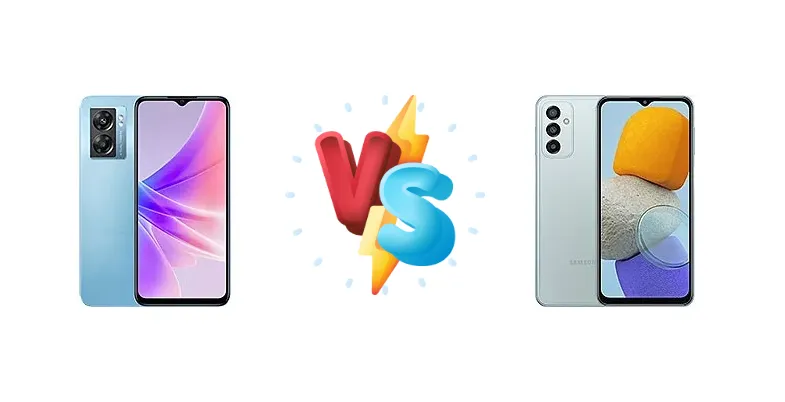
The budget 5G smartphone market is heating up, and the Oppo K10 5G and Samsung Galaxy F23 are two strong contenders. Both offer 5G connectivity and a range of features at an attractive price point, but which one comes out on top? Let's dive into a detailed comparison to help you decide.
🏆 Quick Verdict
The Oppo K10 5G edges out the Galaxy F23 thanks to its faster charging and slightly more powerful chipset. However, Samsung's brand recognition and potentially better software support make it a compelling alternative. Ultimately, the best choice depends on your priorities.
| Network |
|---|
| 2G bands | GSM 850 / 900 / 1800 / 1900 | GSM 850 / 900 / 1800 / 1900 |
| 3G bands | HSDPA 800 / 850 / 900 / 1700(AWS) / 1900 / 2100 | HSDPA 850 / 900 / 1700(AWS) / 1900 / 2100 |
| 4G bands | 1, 3, 5, 7, 8, 28, 34, 38, 39, 40, 41 | 1, 2, 3, 4, 5, 7, 8, 12, 17, 20, 26, 28, 38, 40, 41, 66 |
| 5G bands | 1, 5, 8, 28, 41, 77, 78 SA/NSA | 1, 3, 5, 7, 8, 20, 28, 38, 40, 41, 66, 78 SA/NSA/Sub6 |
| Speed | HSPA, LTE, 5G | HSPA, LTE, 5G |
| Technology | GSM / HSPA / LTE / 5G | GSM / HSPA / LTE / 5G |
| Launch |
|---|
| Announced | 2022, June 01 | 2022, March 08 |
| Status | Available. Released 2022, June 10 | Available. Released 2022, March 16 |
| Body |
|---|
| Build | Glass front, plastic frame, plastic back | Glass front (Gorilla Glass 5), plastic frame, plastic back |
| Dimensions | 163.8 x 75.1 x 8 mm (6.45 x 2.96 x 0.31 in) | 165.5 x 77 x 8.4 mm (6.52 x 3.03 x 0.33 in) |
| SIM | Nano-SIM + Nano-SIM | Nano-SIM + Nano-SIM |
| Weight | 190 g (6.70 oz) | 198 g (6.98 oz) |
| | IPX4 water resistant | - |
| Display |
|---|
| Protection | - | Corning Gorilla Glass 5 |
| Resolution | 720 x 1612 pixels, 20:9 ratio (~269 ppi density) | 1080 x 2408 pixels, 20:9 ratio (~400 ppi density) |
| Size | 6.56 inches, 103.4 cm2 (~84.0% screen-to-body ratio) | 6.6 inches, 104.9 cm2 (~82.3% screen-to-body ratio) |
| Type | IPS LCD, 90Hz, 480 nits (typ), 600 nits (HBM) | TFT LCD, 120Hz |
| Platform |
|---|
| CPU | Octa-core (2x2.4 GHz Cortex-A76 & 6x2.0 GHz Cortex-A55) | Octa-core (2x2.2 GHz Kryo 570 & 6x1.8 GHz Kryo 570) |
| Chipset | Mediatek Dimensity 810 (6 nm) | Qualcomm SM7225 Snapdragon 750G 5G (8 nm) |
| GPU | Mali-G57 MC2 | Adreno 619 |
| OS | Android 12, ColorOS 12.1 | Android 12, upgradable to Android 14, One UI 6 |
| Memory |
|---|
| Card slot | microSDXC | microSDXC (dedicated slot) |
| Internal | 128GB 6GB RAM, 128GB 8GB RAM | 128GB 4GB RAM, 128GB 6GB RAM |
| | UFS 2.2 | - |
| Main Camera |
|---|
| Dual | 48 MP, f/1.7, 26mm (wide), PDAF
Auxiliary lens | - |
| Features | LED flash, HDR, panorama | LED flash, panorama, HDR |
| Single | - | 8 MP, f/2.2, (wide) |
| Triple | - | 50 MP, f/1.8, (wide), PDAF
8 MP, f/2.2, 123˚ (ultrawide), 1/4.0", 1.12µm
2 MP (macro) |
| Video | 1080p@30fps | 4K@30fps, 1080p@30fps, 720p@480fps |
| Selfie camera |
|---|
| Features | Panorama | - |
| Single | 8 MP, f/2.0, 26mm (wide) | 8 MP, f/2.2, (wide) |
| Video | 1080p@30fps | 1080p@30fps |
| Sound |
|---|
| 3.5mm jack | Yes | Yes |
| 35mm jack | Yes | Yes |
| Loudspeaker | Yes, with stereo speakers | Yes |
| Comms |
|---|
| Bluetooth | 5.3, A2DP, LE, aptX HD | 5.0, A2DP, LE |
| NFC | Yes | Yes |
| Positioning | GPS, GLONASS, BDS, GALILEO, QZSS | GPS, GLONASS, GALILEO, BDS, QZSS |
| Radio | No | FM radio, recording |
| USB | USB Type-C 2.0, OTG | USB Type-C 2.0, OTG |
| WLAN | Wi-Fi 802.11 a/b/g/n/ac, dual-band, Wi-Fi Direct | Wi-Fi 802.11 a/b/g/n/ac, dual-band, Wi-Fi Direct |
| Features |
|---|
| Sensors | Fingerprint (side-mounted), accelerometer, proximity, compass | Fingerprint (side-mounted), accelerometer, gyro, compass |
| | - | Virtual Proximity Sensing |
| Battery |
|---|
| Charging | 33W wired, 53% in 30 min | 25W wired |
| Type | Li-Po 5000 mAh | Li-Po 5000 mAh |
| Misc |
|---|
| Colors | Ocean Blue, Midnight Black | Aqua Blue, Forest Green |
| Models | CPH2337 | SM-E236B, SM-E236B/DS |
| Price | About 270 EUR | About 190 EUR |
| SAR | - | 1.24 W/kg (head) |
Oppo K10 5G
- Faster Charging (33W)
- Slightly More Powerful Chipset (Dimensity 810)
- Competitive Price
- Camera may not be as good as Samsung
- Software updates might be less frequent
Samsung Galaxy F23
- Samsung Brand & Ecosystem
- Potentially Better Camera Performance
- Reliable Software Updates
- Slower Charging (25W)
- Slightly Less Powerful Chipset (Snapdragon 750G)
Display Comparison
Both phones feature a 6.6-inch FHD+ display, likely with a 120Hz refresh rate for smooth scrolling. The Oppo K10 5G might have slightly better color accuracy, but both offer a decent viewing experience for the price. Samsung's display technology often provides slightly better brightness and outdoor visibility.
Camera Comparison
The Samsung Galaxy F23 likely boasts a more versatile camera system, potentially including a higher resolution main sensor and improved image processing. While the Oppo K10 5G has a decent camera, Samsung's expertise in mobile photography often shines through. Expect better low-light performance and more natural-looking images from the F23.
Performance
The Oppo K10 5G's Mediatek Dimensity 810 generally outperforms the Snapdragon 750G in benchmarks and real-world usage. Expect smoother multitasking and slightly better gaming performance on the Oppo. However, the Snapdragon 750G is still a capable chipset for everyday tasks.
Battery Life
The Oppo K10 5G has a clear advantage with its 33W fast charging, significantly faster than the Galaxy F23's 25W charging. Both phones likely have a similar battery capacity (around 5000mAh), so the Oppo will charge much quicker.
Buying Guide
The Oppo K10 5G is ideal for users prioritizing fast charging and a bit more processing power for gaming or demanding apps. The Samsung Galaxy F23 is a good fit for those who value Samsung's ecosystem, software updates, and a reliable overall experience.
Frequently Asked Questions
❓ Which phone has better gaming performance?
The Oppo K10 5G generally offers slightly better gaming performance due to its more powerful Dimensity 810 chipset.
❓ How long does it take to fully charge each phone?
The Oppo K10 5G charges significantly faster, reaching 53% in 30 minutes with its 33W charger, while the Galaxy F23 takes longer with its 25W charger.