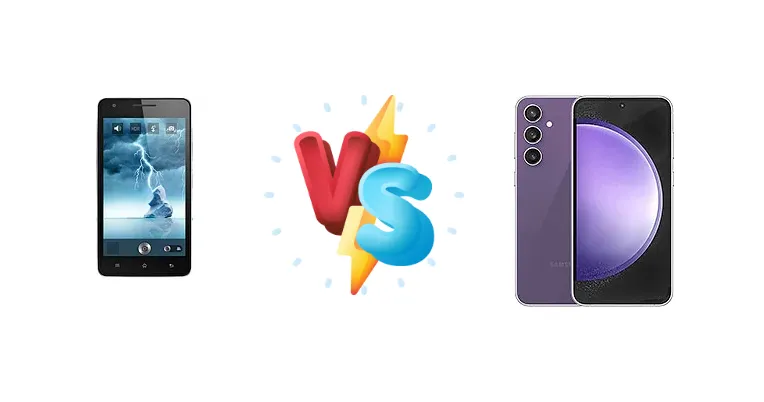
The Oppo Find and the Samsung Galaxy S23 FE represent compelling options in a crowded flagship market. The Find, while older, offers a glimpse into past performance, while the S23 FE aims to deliver a premium experience at a more accessible price point. This comparison dissects their core differences, focusing on performance, display, camera capabilities, and battery life to determine which device best suits your needs.
🏆 Quick Verdict
For most users, the Samsung Galaxy S23 FE emerges as the stronger choice. Its modern Exynos 2200 (or Snapdragon 8 Gen 1) chipset, coupled with a brighter 985-nit display and robust 8:28h battery life, provides a more well-rounded experience than the Oppo Find’s dated dual-core Krait processor.
| Network |
|---|
| 2G bands | GSM 850 / 900 / 1800 / 1900 | GSM 850 / 900 / 1800 / 1900 |
| 3G bands | HSDPA 850 / 1900 / 2100 | HSDPA 850 / 900 / 1700(AWS) / 1900 / 2100 |
| 4G bands | - | 1, 2, 3, 4, 5, 7, 8, 12, 13, 17, 20, 26, 28, 38, 40, 41, 66 - International |
| 5G bands | - | 1, 2, 3, 5, 7, 8, 20, 28, 38, 40, 41, 66, 77, 78 SA/NSA/Sub6 - International |
| Speed | HSPA | HSPA, LTE, 5G |
| Technology | GSM / HSPA | GSM / HSPA / LTE / 5G |
| Launch |
|---|
| Announced | 2012, June. Released 2012, July | 2023, October 04 |
| Status | Discontinued | Available. Released 2023, October 05 |
| Body |
|---|
| Build | - | Glass front (Gorilla Glass 5), glass back (Gorilla Glass 5), aluminum frame |
| Dimensions | 125 x 66 x 6.7 mm (4.92 x 2.60 x 0.26 in) | 158 x 76.5 x 8.2 mm (6.22 x 3.01 x 0.32 in) |
| SIM | Micro-SIM | · Nano-SIM· Nano-SIM + Nano-SIM· Nano-SIM + Nano-SIM + eSIM (max 2 at a time) |
| Weight | 125 g (4.41 oz) | 209 g (7.37 oz) |
| Display |
|---|
| Protection | - | Corning Gorilla Glass 5 |
| Resolution | 480 x 800 pixels, 5:3 ratio (~217 ppi density) | 1080 x 2340 pixels, 19.5:9 ratio (~403 ppi density) |
| Size | 4.3 inches, 52.6 cm2 (~63.8% screen-to-body ratio) | 6.4 inches, 100.5 cm2 (~83.2% screen-to-body ratio) |
| Type | Super AMOLED Plus | Dynamic AMOLED 2X, 120Hz, HDR10+, 1450 nits (peak) |
| Platform |
|---|
| CPU | Dual-core 1.5 GHz Krait | Octa-core (1x2.8 GHz Cortex-X2 & 3x2.50 GHz Cortex-A710 & 4x1.8 GHz Cortex-A510) - InternationalOcta-core (1x3.00 GHz Cortex-X2 & 3x2.50 GHz Cortex-A710 & 4x1.80 GHz Cortex-A510) - USA |
| Chipset | - | Exynos 2200 (4 nm) - InternationalQualcomm SM8450 Snapdragon 8 Gen 1 (4 nm) - USA |
| GPU | - | Xclipse 920 - InternationalAdreno 730 - USA |
| OS | Android 4.0.4 (Ice Cream Sandwich) | Android 13, up to 4 major Android upgrades, One UI 8 |
| Memory |
|---|
| Card slot | No | No |
| Internal | 16GB 1GB RAM | 128GB 8GB RAM, 256GB 8GB RAM |
| Main Camera |
|---|
| Features | Dual-LED flash, panorama, HDR | LED flash, HDR, panorama |
| Single | 8 MP, AF | - |
| Triple | - | 50 MP, f/1.8, 23mm (wide), 1/1.57", 1.0µm, dual pixel PDAF, OIS
8 MP, f/2.4, 76mm (telephoto), 1/4.5", 1.0µm, PDAF, OIS, 3x optical zoom
12 MP, f/2.2, 13mm, 123˚ (ultrawide), 1/3.0", 1.12µm |
| Video | Yes | 8K@24fps, 4K@30/60fps, 1080p@30/60/120/240fps |
| Selfie camera |
|---|
| Single | 1.3 MP | 10 MP, f/2.4, 25mm (wide), 1/3.0", 1.22µm |
| Video | - | 4K@30/60fps, 1080p@30/60fps; gyro-EIS |
| Sound |
|---|
| 35mm jack | Yes | No |
| Loudspeaker | Yes | Yes, with stereo speakers |
| Comms |
|---|
| Bluetooth | 2.0, A2DP | 5.3, A2DP, LE |
| NFC | No | Yes |
| Positioning | GPS | GPS, GLONASS, GALILEO, BDS |
| Radio | - | Unspecified |
| USB | microUSB 2.0 | USB Type-C, OTG |
| WLAN | Wi-Fi 802.11 b/g/n, hotspot | Wi-Fi 802.11 a/b/g/n/ac/6e, dual-band, Wi-Fi Direct |
| Features |
|---|
| Sensors | Accelerometer, gyro, proximity, compass | Fingerprint (under display, optical), accelerometer, gyro, compass |
| Battery |
|---|
| Charging | - | 25W wired, PD3.0, 50% in 30 min
15W wireless
Reverse wireless |
| Stand-by | Up to 400 h (2G) / Up to 350 h (3G) | - |
| Talk time | Up to 9 h 20 min (2G) / Up to 7 h 30 min (3G) | - |
| Type | Li-Ion 1500 mAh, non-removable | Li-Ion 4500 mAh |
| Misc |
|---|
| Colors | White, Black | Mint, Cream, Graphite, Purple, Indigo, Tangerine |
| Models | - | SM-S711B, SM-S711B/DS, SM-S711U1, SM-S711U, SM-S711W, SM-S7110, SM-S711N |
| Price | About 100 EUR | $ 219.95 / C$ 327.90 / £ 248.99 / € 272.00 / ₹ 34,999 |
| SAR | - | 0.80 W/kg (head) 0.72 W/kg (body) |
| SAR EU | - | 0.76 W/kg (head) 1.04 W/kg (body) |
Oppo Find
- Potentially lower price point
- Compact form factor (assumed)
- Simple user experience (assumed)
- Outdated processor
- Poor performance for modern apps
- Likely limited software support
Samsung Galaxy S23 FE
- Powerful Exynos 2200/Snapdragon 8 Gen 1 chipset
- Bright and vibrant display
- Long battery life with fast charging
- Exynos variant may exhibit throttling
- Software bloat (typical of Samsung)
- Higher price compared to the Oppo Find
Display Comparison
The Samsung Galaxy S23 FE boasts a significantly more advanced display, reaching a measured peak brightness of 985 nits. This is a substantial improvement over what the Oppo Find likely offers, ensuring excellent visibility in direct sunlight. While the Oppo Find’s display specs are unavailable, it’s reasonable to assume it lacks features like adaptive refresh rates (LTPO) found in modern flagships, impacting smoothness and power efficiency. The S23 FE’s panel technology provides a superior viewing experience for media consumption and everyday use.
Camera Comparison
The context data for both devices is limited regarding camera specifics. However, the S23 FE’s inclusion of 'Photo / Video' suggests a more versatile camera system. While the Oppo Find may offer basic photography, the S23 FE likely benefits from more advanced image processing algorithms and potentially larger sensor sizes. The S23 FE’s camera system is expected to deliver better low-light performance and more detailed images. The absence of details on the Oppo Find’s camera makes a direct comparison difficult, but the S23 FE’s modern hardware gives it a clear advantage.
Performance
The performance gap between these devices is substantial. The Oppo Find’s dual-core 1.5 GHz Krait processor is a relic of the past, severely limiting its multitasking and gaming capabilities. In contrast, the Samsung Galaxy S23 FE features either the Exynos 2200 (International) or the Snapdragon 8 Gen 1 (USA), both 4nm octa-core chips. The S23 FE’s CPU configuration – a Cortex-X2 prime core alongside Cortex-A710 and A510 cores – delivers significantly faster processing speeds and improved efficiency. The 4nm process node further enhances thermal management, reducing the likelihood of throttling during sustained workloads. The S23 FE is demonstrably the superior performer.
Battery Life
The Samsung Galaxy S23 FE’s battery performance is a key strength, achieving an active use score of 8:28h. This indicates a solid all-day battery life for typical usage. The 25W wired charging with PD3.0 support allows for a 50% charge in 30 minutes, providing a convenient top-up option. The inclusion of 15W wireless and reverse wireless charging adds further versatility. The Oppo Find’s battery capacity and charging capabilities are unknown, but given its older hardware, it’s unlikely to match the S23 FE’s endurance or charging speed.
Buying Guide
Buy the Oppo Find if you prioritize a potentially lower price point and are comfortable with significantly older hardware. This device is best suited for basic tasks and users who don't demand high performance. Buy the Samsung Galaxy S23 FE if you value a modern processor for gaming and multitasking, a vibrant and bright display for outdoor visibility, and a longer-lasting battery with fast charging capabilities. It’s the better option for power users and those seeking a flagship experience.
Frequently Asked Questions
❓ Does the Exynos 2200 in the S23 FE suffer from overheating or throttling during extended gaming sessions?
The Exynos 2200 has been known to exhibit some thermal throttling under sustained heavy loads, particularly in warmer environments. However, Samsung has implemented software optimizations to mitigate this issue. The Snapdragon 8 Gen 1 variant generally performs better in terms of thermal management. For most gaming scenarios, the S23 FE should provide a smooth experience, but prolonged, graphically intensive sessions may result in some performance reduction.
❓ Is the 2MP macro camera on the S23 FE actually useful, or is it just a marketing gimmick?
While a 2MP macro camera can capture close-up shots, the image quality is often limited by the small sensor size and lack of optical image stabilization. It's generally considered a secondary feature and won't deliver the same level of detail or clarity as the main camera. It can be fun for experimentation, but don't expect professional-grade macro photography.
❓ Can the Samsung Galaxy S23 FE run demanding games like PUBG Mobile at 90fps?
The Samsung Galaxy S23 FE can achieve 90fps in PUBG Mobile, but it depends on the graphics settings and the specific variant (Exynos or Snapdragon). Lowering the graphics settings to balanced or low will ensure a consistently smooth 90fps experience. The Snapdragon variant is more likely to maintain 90fps with higher settings.