
Oppo Find X9+ vs Samsung Galaxy S23 Ultra: A Deep Dive into Flagship Android
| Phones Images | |||||
|---|---|---|---|---|---|
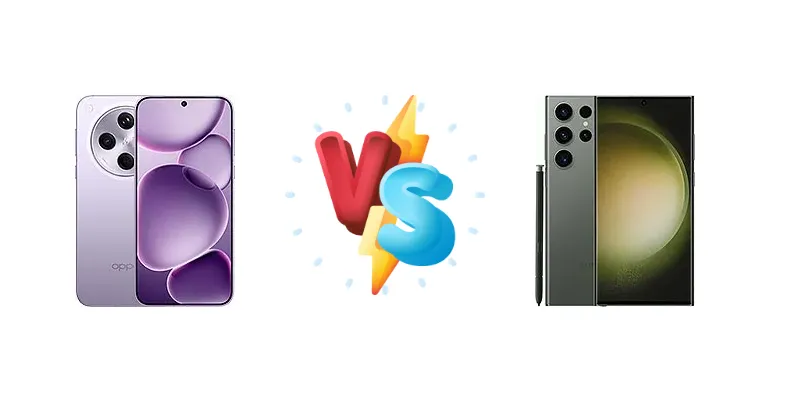
|
🏆 Quick Verdict
For the average user prioritizing all-around excellence and a mature software experience, the Samsung Galaxy S23 Ultra remains the safer bet. However, the Oppo Find X9+’s Dimensity 9500 and 80W charging present a compelling alternative for power users and those seeking cutting-edge technology.
| PHONES | ||
|---|---|---|
| Phone Names | Oppo Find X9+ | Samsung Galaxy S23 Ultra |
| Network | ||
|---|---|---|
| 2G bands | GSM 850 / 900 / 1800 / 1900 | GSM 850 / 900 / 1800 / 1900 |
| 3G bands | HSDPA 800 / 850 / 900 / 1700(AWS) / 1900 / 2100 | HSDPA 850 / 900 / 1700(AWS) / 1900 / 2100 |
| 4G bands | LTE | 1, 2, 3, 4, 5, 7, 8, 12, 13, 17, 18, 19, 20, 25, 26, 28, 32, 38, 39, 40, 41, 66 - International |
| 5G bands | SA/NSA | 1, 2, 3, 5, 7, 8, 12, 20, 25, 28, 38, 40, 41, 66, 75, 77, 78 SA/NSA/Sub6 - International |
| Speed | HSPA, LTE, 5G | HSPA, LTE (up to 7CA), 5G |
| Technology | GSM / HSPA / LTE / 5G | GSM / CDMA / HSPA / EVDO / LTE / 5G |
| - | 1, 7, 28, 41, 66, 71, 78, 258, 260, 261 SA/NSA/Sub6/mmWave - USA | |
| Launch | ||
|---|---|---|
| Announced | Not announced yet | 2023, February 01 |
| Status | Rumored | Available. Released 2023, February 17 |
| Body | ||
|---|---|---|
| Build | Glass front, glass back, aluminum frame | Glass front (Gorilla Glass Victus 2), glass back (Gorilla Glass Victus 2), aluminum frame |
| Dimensions | - | 163.4 x 78.1 x 8.9 mm (6.43 x 3.07 x 0.35 in) |
| SIM | Nano-SIM + Nano-SIM | · Nano-SIM + eSIM· Nano-SIM + Nano-SIM + eSIM (max 2 at a time) |
| Weight | - | 234 g (8.25 oz) |
| - | IP68 dust/water resistant (up to 1.5m for 30 min) Armor aluminum frame with tougher drop and scratch resistance (advertised) Stylus (Bluetooth integration, accelerometer, gyro) | |
| Display | ||
|---|---|---|
| Protection | - | Corning Gorilla Glass Victus 2 |
| Resolution | 1256 x 2760 pixels (~460 ppi density) | 1440 x 3088 pixels, 19.3:9 ratio (~500 ppi density) |
| Size | 6.59 inches, 105.6 cm2 | 6.8 inches, 114.7 cm2 (~89.9% screen-to-body ratio) |
| Type | LTPO AMOLED, 1B colors, 120Hz, 2160Hz PWM, Dolby Vision, HDR Vivid, HDR10+ | Dynamic AMOLED 2X, 120Hz, HDR10+, 1200 nits (HBM), 1750 nits (peak) |
| - | Always-on display | |
| Platform | ||
|---|---|---|
| CPU | Octa-core (1x4.21 GHz C1-Ultra & 3x3.5 GHz C1-Premium & 4x2.7 GHz C1-Pro) | Octa-core (1x3.36 GHz Cortex-X3 & 2x2.8 GHz Cortex-A715 & 2x2.8 GHz Cortex-A710 & 3x2.0 GHz Cortex-A510) |
| Chipset | Mediatek Dimensity 9500 (3 nm) | Qualcomm SM8550-AC Snapdragon 8 Gen 2 (4 nm) |
| GPU | Arm G1-Ultra | Adreno 740 |
| OS | Android 16, ColorOS 16 | Android 13, up to 4 major Android upgrades, One UI 8 |
| Memory | ||
|---|---|---|
| Card slot | No | No |
| Internal | 256GB 12GB RAM, 512GB 12GB RAM, 512GB 16GB RAM, 1TB 16GB RAM | 256GB 8GB RAM, 256GB 12GB RAM, 512GB 12GB RAM, 1TB 12GB RAM |
| - | UFS 4.0 | |
| Main Camera | ||
|---|---|---|
| Features | Laser AF, color spectrum sensor, Hasselblad Color Calibration, LED flash, HDR, panorama | Laser AF, LED flash, auto-HDR, panorama |
| Quad | - | 200 MP, f/1.7, 24mm (wide), 1/1.3", 0.6µm, multi-directional PDAF, OIS 10 MP, f/2.4, 70mm (telephoto), 1/3.52", 1.12µm, PDAF, OIS, 3x optical zoom 10 MP, f/4.9, 230mm (periscope telephoto), 1/3.52", 1.12µm, PDAF, OIS, 10x optical zoom 12 MP, f/2.2, 13mm, 120˚ (ultrawide), 1/2.55", 1.4µm, dual pixel PDAF, Super Steady video |
| Single | - | 12 MP, f/2.2, 26mm (wide), Dual Pixel PDAF |
| Triple | 50 MP, (wide), 1/1.4", 1.12µm, multi-directional PDAF, OIS 50 MP, (periscope telephoto), 1/1.57", 1.0µm, 3x optical zoom, multi-directional PDAF, OIS 50 MP, f/2.0, 15mm, 120˚ (ultrawide), 1/2.76", 0.64µm, multi-directional PDAF | - |
| Video | 4K@30/60fps, 1080p@30/60/240fps; gyro-EIS; HDR, 10‑bit video, Dolby Vision | 8K@24/30fps, 4K@30/60fps, 1080p@30/60/120/240fps, HDR10+, stereo sound rec., gyro-EIS |
| Selfie camera | ||
|---|---|---|
| Features | Panorama, HDR | HDR, HDR10+ |
| Single | 50 MP, (wide), 1/2.76", 0.64µm, AF | 12 MP, f/2.2, 26mm (wide), 1/3.2", 1.12µm, dual pixel PDAF |
| Video | 4K@30/60fps, 1080p@30/60fps, gyro-EIS | 4K@30/60fps, 1080p@30fps |
| Sound | ||
|---|---|---|
| 3.5mm jack | - | No |
| 35mm jack | No | No |
| Loudspeaker | Yes, with stereo speakers | Yes, with stereo speakers |
| - | 32-bit/384kHz audio Tuned by AKG | |
| Comms | ||
|---|---|---|
| Bluetooth | 5.4, A2DP, LE, aptX HD, LHDC 5 | 5.3, A2DP, LE |
| Infrared port | Yes | - |
| NFC | Yes | Yes |
| Positioning | GPS (L1+L5), BDS (B1I+B1c+B2a+B2b), GALILEO (E1+E5a+E5b), QZSS (L1+L5), GLONASS, NavIC (L5) | GPS, GALILEO, GLONASS, BDS, QZSS |
| Radio | No | No |
| USB | USB Type-C 2.0, OTG | USB Type-C 3.2, OTG |
| WLAN | Wi-Fi 802.11 a/b/g/n/ac/6/7, dual-band, Wi-Fi Direct | Wi-Fi 802.11 a/b/g/n/ac/6e, tri-band, Wi-Fi Direct |
| Features | ||
|---|---|---|
| Sensors | Fingerprint (under display, ultrasonic), accelerometer, proximity, gyro, compass | Fingerprint (under display, ultrasonic), accelerometer, gyro, proximity, compass, barometer |
| - | Samsung DeX, Samsung Wireless DeX (desktop experience support) Bixby natural language commands and dictation Samsung Pay (Visa, MasterCard certified) Ultra Wideband (UWB) support | |
| Battery | ||
|---|---|---|
| Charging | 80W wired, 12W PD, 33W PPS 50W wireless 10W reverse wireless | 45W wired, PD3.0, 65% in 30 min 15W wireless (Qi) 4.5W reverse wireless |
| Type | Si/C Li-Ion 7025 mAh | Li-Ion 5000 mAh |
| Misc | ||
|---|---|---|
| Colors | Black; other colors | Phantom Black, Green, Cream, Lavender, Graphite, Sky Blue, Lime, Red, BMW M Edition |
| Models | - | SM-S918B, SM-S918B/DS, SM-S918U, SM-S918U1, SM-S918W, SM-S918N, SM-S9180, SM-S918E, SM-S918E/DS |
| Price | - | € 549.90 / $ 454.99 / £ 433.00 |
| SAR | - | 1.12 W/kg (head) 0.92 W/kg (body) |
| SAR EU | - | 0.96 W/kg (head) 1.40 W/kg (body) |
| Tests | ||
|---|---|---|
| Battery life | - | Endurance rating 126h |
| Camera | - | Photo / Video |
| Display | - | Contrast ratio: Infinite (nominal) |
| Loudspeaker | - | -25.6 LUFS (Very good) |
| Performance | - | AnTuTu: 1241531 (v9) GeekBench: 4927 (v5.1) GFXBench: 67fps (ES 3.1 onscreen) |
Oppo Find X9+
- Significantly faster 80W wired charging
- Potentially superior performance with Dimensity 9500 (3nm)
- Faster wireless charging (50W vs 15W)
- Software experience may be less refined than Samsung
- Battery capacity and camera specs currently unknown
Samsung Galaxy S23 Ultra
- Proven performance and stability with Snapdragon 8 Gen 2
- Excellent camera system with versatile features
- Long-term software support and ecosystem integration
- Slower charging speeds (45W wired, 15W wireless)
- Higher price point compared to potential Find X9+ pricing
Display Comparison
The Samsung Galaxy S23 Ultra boasts a peak brightness of 1274 nits, ensuring excellent visibility even in direct sunlight. While the Find X9+’s display specs are not provided, Oppo typically employs high-quality AMOLED panels. The S23 Ultra’s ‘Infinite’ contrast ratio, typical of AMOLED technology, delivers deep blacks and vibrant colors. The lack of PWM frequency data for the Find X9+ means we can’t assess potential flicker-related eye strain compared to the S23 Ultra, a crucial factor for sensitive users. Bezels are expected to be minimal on both devices, reflecting current flagship design trends.
Camera Comparison
Both devices are expected to deliver exceptional camera performance, but their approaches differ. The S23 Ultra is renowned for its versatile camera system, including a high-resolution main sensor and advanced image processing. While specific sensor details for the Find X9+ are missing, Oppo has a history of prioritizing image quality and computational photography. The S23 Ultra’s OIS (Optical Image Stabilization) is crucial for stable video recording and low-light photography. The absence of details regarding the Find X9+’s lens apertures and sensor sizes makes a direct comparison challenging, but Oppo will need to deliver competitive specs to challenge Samsung’s established camera prowess. We can safely assume both will offer robust photo and video capabilities.
Performance
The core battleground lies in the chipsets. The Oppo Find X9+ utilizes the Mediatek Dimensity 9500, fabricated on a leading-edge 3nm process, promising superior power efficiency and performance compared to the Samsung Galaxy S23 Ultra’s 4nm Snapdragon 8 Gen 2. The Dimensity 9500’s octa-core configuration, with its C1-Ultra core clocked at 4.21 GHz, suggests a focus on peak performance, potentially exceeding the Snapdragon’s 3.36 GHz Cortex-X3. However, the Snapdragon 8 Gen 2 benefits from Qualcomm’s extensive optimization and software support. The Find X9+’s performance will heavily rely on Oppo’s software implementation to manage the new chipset effectively. Both devices likely feature LPDDR5x RAM, but the speed and configuration could vary, impacting multitasking and app loading times.
Battery Life
The Samsung Galaxy S23 Ultra achieves an impressive endurance rating of 126 hours and a real-world active use score of 13:24h, demonstrating excellent battery life. The Oppo Find X9+’s battery capacity is unknown, but its 80W wired charging significantly surpasses the S23 Ultra’s 45W charging. This translates to potentially much faster charging times – Oppo claims 65% in 30 minutes for the S23 Ultra, while the Find X9+ should achieve a full charge in a similar timeframe. The Find X9+ also offers 50W wireless charging and 10W reverse wireless charging, exceeding the S23 Ultra’s 15W wireless and 4.5W reverse wireless capabilities. The faster charging speeds could offset a potentially smaller battery capacity on the Find X9+.
Buying Guide
Buy the Oppo Find X9+ if you need the absolute fastest charging speeds available on a smartphone and are comfortable with a potentially less refined software experience. You’ll also benefit from the latest Mediatek silicon. Buy the Samsung Galaxy S23 Ultra if you prefer a polished, feature-rich experience with a proven track record, exceptional camera versatility, and long-term software support. It’s the choice for users who value stability and a comprehensive ecosystem.