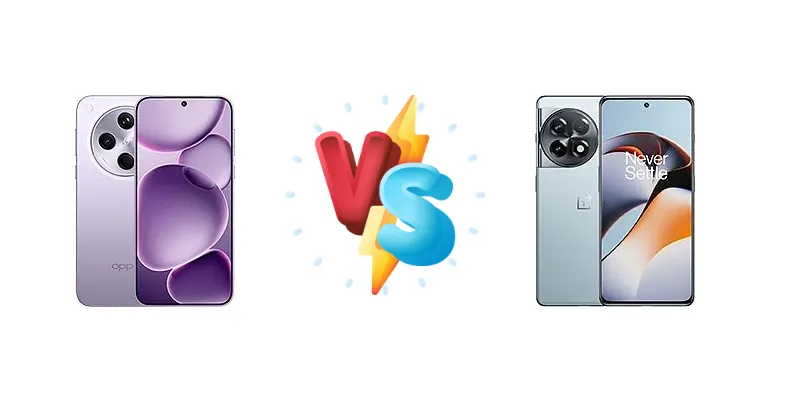
The Oppo Find X9+ arrives with Mediatek’s latest Dimensity 9500, promising cutting-edge efficiency, while the OnePlus 11R leverages the proven Snapdragon 8+ Gen 1. This comparison isn’t about raw horsepower alone; it’s about how these different approaches translate into real-world performance, battery life, and overall user experience, particularly as the 11R’s price has dropped since launch.
🏆 Quick Verdict
For most users, the Oppo Find X9+ emerges as the stronger choice. Its newer 3nm Dimensity 9500 chipset offers a compelling blend of performance and efficiency, potentially mitigating throttling issues seen in the Snapdragon 8+ Gen 1. While the OnePlus 11R boasts faster 100W charging, the X9+'s more advanced charging suite and potentially superior thermal management give it the edge.
| Network |
|---|
| 2G bands | GSM 850 / 900 / 1800 / 1900 | GSM 850 / 900 / 1800 / 1900 |
| 3G bands | HSDPA 800 / 850 / 900 / 1700(AWS) / 1900 / 2100 | HSDPA 850 / 900 / 1700(AWS) / 2100 |
| 4G bands | LTE | 1, 3, 4, 5, 8, 28, 34, 38, 39, 40, 41 |
| 5G bands | SA/NSA | 1, 3, 5, 8, 28, 40, 41, 77, 78 SA/NSA |
| Speed | HSPA, LTE, 5G | HSPA, LTE (3CA), 5G |
| Technology | GSM / HSPA / LTE / 5G | GSM / CDMA / HSPA / LTE / 5G |
| | - | CDMA 800 |
| Launch |
|---|
| Announced | Not announced yet | 2023, February 07 |
| Status | Rumored | Available. Released 2023, February 21 |
| Body |
|---|
| Build | Glass front, glass back, aluminum frame | Glass front, glass back (Gorilla Glass 5), plastic frame |
| Dimensions | - | 163.4 x 74.3 x 8.7 mm (6.43 x 2.93 x 0.34 in) |
| SIM | Nano-SIM + Nano-SIM | Nano-SIM + Nano-SIM |
| Weight | - | 204 g (7.20 oz) |
| Display |
|---|
| Resolution | 1256 x 2760 pixels (~460 ppi density) | 1240 x 2772 pixels, 20:9 ratio (~451 ppi density) |
| Size | 6.59 inches, 105.6 cm2 | 6.74 inches, 109.2 cm2 (~90.0% screen-to-body ratio) |
| Type | LTPO AMOLED, 1B colors, 120Hz, 2160Hz PWM, Dolby Vision, HDR Vivid, HDR10+ | Fluid AMOLED, 1B colors, 120Hz, HDR10+, 1450 nits (peak) |
| Platform |
|---|
| CPU | Octa-core (1x4.21 GHz C1-Ultra & 3x3.5 GHz C1-Premium & 4x2.7 GHz C1-Pro) | Octa-core (1x3.0 GHz Cortex-X2 & 3x2.5 GHz Cortex-A710 & 4x1.80 GHz Cortex-A510) |
| Chipset | Mediatek Dimensity 9500 (3 nm) | Qualcomm SM8475 Snapdragon 8+ Gen 1 (4 nm) |
| GPU | Arm G1-Ultra | Adreno 730 |
| OS | Android 16, ColorOS 16 | Android 13, upgradable to Android 15, OxygenOS 15 |
| Memory |
|---|
| Card slot | No | No |
| Internal | 256GB 12GB RAM, 512GB 12GB RAM, 512GB 16GB RAM, 1TB 16GB RAM | 128GB 8GB RAM, 256GB 16GB RAM, 512GB 18GB RAM |
| | - | UFS 3.1 |
| Main Camera |
|---|
| Features | Laser AF, color spectrum sensor, Hasselblad Color Calibration, LED flash, HDR, panorama | Color spectrum sensor, LED flash, HDR, panorama |
| Single | - | 16 MP, f/2.4, 24mm (wide), 1/3.09", 1.0µm |
| Triple | 50 MP, (wide), 1/1.4", 1.12µm, multi-directional PDAF, OIS
50 MP, (periscope telephoto), 1/1.57", 1.0µm, 3x optical zoom, multi-directional PDAF, OIS
50 MP, f/2.0, 15mm, 120˚ (ultrawide), 1/2.76", 0.64µm, multi-directional PDAF | 50 MP, f/1.8, 24mm (wide), 1/1.56", 1.0µm, multi-directional PDAF, OIS
8 MP, f/2.2, 120˚ (ultrawide), 1/4.0", 1.12µm
2 MP (macro) |
| Video | 4K@30/60fps, 1080p@30/60/240fps; gyro-EIS; HDR, 10‑bit video, Dolby Vision | 4K@30/60fps, 1080p@30/60/240fps, gyro-EIS |
| Selfie camera |
|---|
| Features | Panorama, HDR | HDR |
| Single | 50 MP, (wide), 1/2.76", 0.64µm, AF | 16 MP, f/2.4, 24mm (wide), 1/3.09", 1.0µm |
| Video | 4K@30/60fps, 1080p@30/60fps, gyro-EIS | 1080p@30fps |
| Sound |
|---|
| 3.5mm jack | - | No |
| 35mm jack | No | No |
| Loudspeaker | Yes, with stereo speakers | Yes, with stereo speakers |
| | - | 24-bit/192kHz audio |
| Comms |
|---|
| Bluetooth | 5.4, A2DP, LE, aptX HD, LHDC 5 | 5.3, A2DP, LE, aptX HD |
| Infrared port | Yes | Yes |
| NFC | Yes | Yes |
| Positioning | GPS (L1+L5), BDS (B1I+B1c+B2a+B2b), GALILEO (E1+E5a+E5b), QZSS (L1+L5), GLONASS, NavIC (L5) | GPS (L1+L5), GLONASS (G1), BDS (B1I+B1c+B2a), GALILEO (E1+E5a), QZSS (L1+L5) |
| Radio | No | No |
| USB | USB Type-C 2.0, OTG | USB Type-C 2.0 |
| WLAN | Wi-Fi 802.11 a/b/g/n/ac/6/7, dual-band, Wi-Fi Direct | Wi-Fi 802.11 a/b/g/n/ac/6, dual-band |
| Features |
|---|
| Sensors | Fingerprint (under display, ultrasonic), accelerometer, proximity, gyro, compass | Fingerprint (under display, optical), accelerometer, gyro, proximity, compass |
| Battery |
|---|
| Charging | 80W wired, 12W PD, 33W PPS
50W wireless
10W reverse wireless | 100W wired |
| Type | Si/C Li-Ion 7025 mAh | Li-Po 5000 mAh |
| Misc |
|---|
| Colors | Black; other colors | Galactic Silver, Sonic Black, Solar Red |
| Models | - | CPH2487 |
| Price | - | About 600 EUR |
| SAR | - | 1.16 W/kg (head) 0.61 W/kg (body) |
Oppo Find X9+
- More efficient 3nm Dimensity 9500 chipset
- Versatile charging options (wired, wireless, reverse)
- Potentially superior thermal management
- Camera specs currently unknown
- Price likely to be higher than the 11R
OnePlus 11R
- Incredibly fast 100W wired charging
- Proven Snapdragon 8+ Gen 1 performance
- Potentially lower price point
- Snapdragon 8+ Gen 1 prone to throttling
- Limited charging versatility (wired only)
Display Comparison
Display specifications are currently unavailable for the Oppo Find X9+. However, given Oppo’s flagship history, we anticipate a high-refresh-rate LTPO AMOLED panel with excellent color accuracy. The OnePlus 11R features a 6.72-inch 120Hz AMOLED display. The key difference will likely be peak brightness and potentially PWM dimming frequency; the X9+ is expected to push higher nits for better outdoor visibility. The 4nm Snapdragon 8+ Gen 1 in the 11R will consume more power driving the display than the 3nm Dimensity 9500 in the X9+.
Camera Comparison
Camera details for the Oppo Find X9+ are currently unknown. The OnePlus 11R features a 50MP main sensor with OIS, an 8MP ultrawide, and a 2MP macro lens. The X9+ is expected to feature a more sophisticated camera system, potentially with a larger main sensor and improved image processing algorithms. The 2MP macro lens on the 11R offers limited utility; the X9+ will likely focus on delivering high-quality images from its primary and ultrawide lenses. The Dimensity 9500’s ISP (Image Signal Processor) is expected to be more advanced, enabling better low-light performance and dynamic range.
Performance
The core of this comparison lies in the chipsets. The Oppo Find X9+’s Mediatek Dimensity 9500, built on a 3nm process, boasts a unique core configuration: 1x4.21 GHz C1-Ultra, 3x3.5 GHz C1-Premium, and 4x2.7 GHz C1-Pro. This contrasts with the OnePlus 11R’s Snapdragon 8+ Gen 1 (4nm) featuring a 1x3.0 GHz Cortex-X2, 3x2.5 GHz Cortex-A710, and 4x1.80 GHz Cortex-A510. The 3nm node of the Dimensity 9500 should deliver superior power efficiency, translating to less heat generation under sustained load. While the Snapdragon 8+ Gen 1 is a capable performer, it’s known to throttle under prolonged stress, a potential issue the X9+ aims to address. Both devices likely utilize LPDDR5x RAM, but the Dimensity 9500’s integrated memory controller could offer slight advantages in latency.
Battery Life
The OnePlus 11R excels in charging speed with its 100W wired charging, capable of a full charge in around 25 minutes. The Oppo Find X9+ offers a more versatile charging suite: 80W wired, 12W PD, 33W PPS, 50W wireless, and 10W reverse wireless. While the 11R’s wired charging is faster, the X9+ provides greater flexibility. The Dimensity 9500’s efficiency should also contribute to better battery life, potentially offsetting any capacity differences (battery capacity for the X9+ is currently unknown). The X9+'s wireless charging capabilities are a significant advantage over the 11R.
Buying Guide
Buy the Oppo Find X9+ if you prioritize sustained performance during demanding tasks like gaming or video editing, and value the benefits of a more efficient chipset. You’ll also appreciate the more versatile charging options. Buy the OnePlus 11R if your primary concern is incredibly fast wired charging and you’re looking for a strong performer at a potentially lower price point, accepting that sustained peak performance might be limited by thermal constraints.
Frequently Asked Questions
❓ Will the Dimensity 9500 in the Oppo Find X9+ overheat during extended gaming sessions?
The Dimensity 9500’s 3nm process is designed to mitigate overheating. While no chip is immune to thermal throttling, the X9+ is expected to maintain higher sustained performance levels than the OnePlus 11R’s Snapdragon 8+ Gen 1, which is known to throttle more aggressively under load. Oppo’s cooling system implementation will also play a crucial role.
❓ How does the charging speed of the Oppo Find X9+ compare to the OnePlus 11R in real-world usage?
The OnePlus 11R’s 100W charging is undeniably faster for a full 0-100% charge. However, the Oppo Find X9+’s 80W wired, 50W wireless, and reverse wireless charging provide greater flexibility. For topping up quickly, the 11R wins, but the X9+ offers more convenient options for daily use and sharing power with other devices.
❓ Is the Snapdragon 8+ Gen 1 in the OnePlus 11R still a viable option for demanding games like Genshin Impact or PUBG?
Yes, the Snapdragon 8+ Gen 1 remains a powerful chipset capable of running demanding games. However, you may experience frame rate drops or throttling during extended gaming sessions, particularly at the highest graphics settings. The Oppo Find X9+’s Dimensity 9500 is expected to offer a more consistent gaming experience.