
Oppo Find X9+ vs Huawei P60 Pro: A Deep Dive into Flagship Performance and Camera Capabilities
| Phones Images | |||||
|---|---|---|---|---|---|
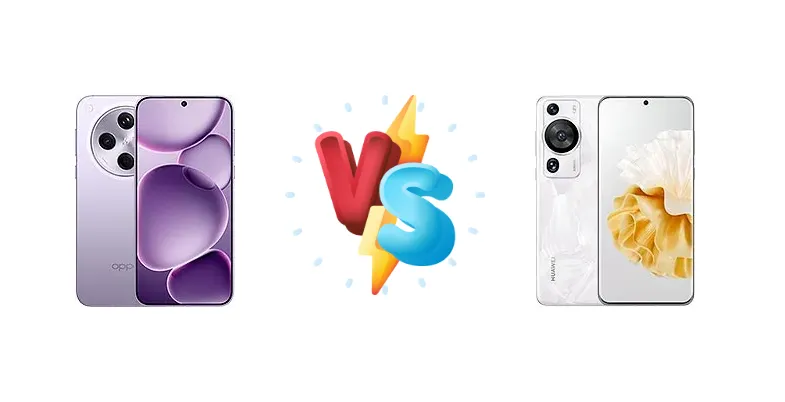
|
🏆 Quick Verdict
For the average user prioritizing raw performance and future-proofing, the Oppo Find X9+ emerges as the winner. Its Dimensity 9500 chipset, built on a 3nm process, offers a significant advantage over the 4nm Snapdragon 8+ Gen 1 in the Huawei P60 Pro, despite the latter's excellent camera system.
| PHONES | ||
|---|---|---|
| Phone Names | Oppo Find X9+ | Huawei P60 Pro |
| Network | ||
|---|---|---|
| 2G bands | GSM 850 / 900 / 1800 / 1900 | GSM 850 / 900 / 1800 / 1900 |
| 3G bands | HSDPA 800 / 850 / 900 / 1700(AWS) / 1900 / 2100 | HSDPA 800 / 850 / 900 / 1700(AWS) / 1900 / 2100 |
| 4G bands | LTE | 1, 2, 3, 4, 5, 7, 8, 12, 13, 17, 18, 19, 20, 26, 28, 32, 34, 38, 39, 40, 41, 66 - International |
| 5G bands | SA/NSA | - |
| Speed | HSPA, LTE, 5G | HSPA, LTE |
| Technology | GSM / HSPA / LTE / 5G | GSM / CDMA / HSPA / CDMA2000 / LTE |
| - | 1, 2, 3, 4, 5, 7, 8, 12, 17, 18, 19, 20, 26, 28, 34, 38, 39, 40, 41 - China | |
| Launch | ||
|---|---|---|
| Announced | Not announced yet | 2023, March 23 |
| Status | Rumored | Available. Released 2023, March 31 |
| Body | ||
|---|---|---|
| Build | Glass front, glass back, aluminum frame | - |
| Dimensions | - | 161 x 74.5 x 8.3 mm (6.34 x 2.93 x 0.33 in) |
| SIM | Nano-SIM + Nano-SIM | · Nano-SIM· Nano-SIM + Nano-SIM |
| Weight | - | 200 g (7.05 oz) |
| - | IP68 dust/water resistant (up to 1.5m for 30 min) | |
| Display | ||
|---|---|---|
| Protection | - | Kunlun Glass |
| Resolution | 1256 x 2760 pixels (~460 ppi density) | 1220 x 2700 pixels (~444 ppi density) |
| Size | 6.59 inches, 105.6 cm2 | 6.67 inches, 107.7 cm2 (~89.8% screen-to-body ratio) |
| Type | LTPO AMOLED, 1B colors, 120Hz, 2160Hz PWM, Dolby Vision, HDR Vivid, HDR10+ | LTPO OLED, 1B colors, 120Hz |
| Platform | ||
|---|---|---|
| CPU | Octa-core (1x4.21 GHz C1-Ultra & 3x3.5 GHz C1-Premium & 4x2.7 GHz C1-Pro) | Octa-core (1x3.19 GHz Cortex-X2 & 3x2.75 GHz Cortex-A710 & 4x2.0 GHz Cortex-A510) |
| Chipset | Mediatek Dimensity 9500 (3 nm) | Qualcomm SM8475 Snapdragon 8+ Gen 1 4G (4 nm) |
| GPU | Arm G1-Ultra | Adreno 730 |
| OS | Android 16, ColorOS 16 | HarmonyOS 3.1 (China), EMUI 13.1 (Europe), no Google Play Services |
| Memory | ||
|---|---|---|
| Card slot | No | Nano Memory (uses shared SIM slot) |
| Internal | 256GB 12GB RAM, 512GB 12GB RAM, 512GB 16GB RAM, 1TB 16GB RAM | 256GB 8GB RAM, 256GB 12GB RAM, 512GB 12GB RAM |
| - | UFS | |
| Main Camera | ||
|---|---|---|
| Features | Laser AF, color spectrum sensor, Hasselblad Color Calibration, LED flash, HDR, panorama | Laser AF, color spectrum sensor, LED flash, HDR, panorama |
| Triple | 50 MP, (wide), 1/1.4", 1.12µm, multi-directional PDAF, OIS 50 MP, (periscope telephoto), 1/1.57", 1.0µm, 3x optical zoom, multi-directional PDAF, OIS 50 MP, f/2.0, 15mm, 120˚ (ultrawide), 1/2.76", 0.64µm, multi-directional PDAF | 48 MP, f/1.4-f/4.0, 25mm (wide), PDAF, OIS 48 MP, f/2.1, 90mm (telephoto), PDAF, sensor-shift OIS, 3.5x optical zoom 13 MP, f/2.2, 13mm (ultrawide), AF |
| Video | 4K@30/60fps, 1080p@30/60/240fps; gyro-EIS; HDR, 10‑bit video, Dolby Vision | 4K@30/60fps, 1080p@30/60fps, 1080p@960fps; gyro-EIS, HDR Vivid |
| Selfie camera | ||
|---|---|---|
| Features | Panorama, HDR | Panorama, HDR |
| Single | 50 MP, (wide), 1/2.76", 0.64µm, AF | 13 MP, f/2.4, (ultrawide) |
| Video | 4K@30/60fps, 1080p@30/60fps, gyro-EIS | 4K@30/60fps, 1080p@30fps, HDR Vivid |
| Sound | ||
|---|---|---|
| 3.5mm jack | - | No |
| 35mm jack | No | No |
| Loudspeaker | Yes, with stereo speakers | Yes, with stereo speakers |
| Comms | ||
|---|---|---|
| Bluetooth | 5.4, A2DP, LE, aptX HD, LHDC 5 | 5.2, A2DP, LE |
| Infrared port | Yes | Yes |
| NFC | Yes | Yes |
| Positioning | GPS (L1+L5), BDS (B1I+B1c+B2a+B2b), GALILEO (E1+E5a+E5b), QZSS (L1+L5), GLONASS, NavIC (L5) | GPS (L1+L5), GLONASS (B1I+B1c+B2a), BDS (B1I+B1c+B2a), GALILEO (E1+E5a), QZSS (L1+L5), NavIC |
| Radio | No | No |
| USB | USB Type-C 2.0, OTG | USB Type-C 3.1, OTG |
| WLAN | Wi-Fi 802.11 a/b/g/n/ac/6/7, dual-band, Wi-Fi Direct | Wi-Fi 802.11 a/b/g/n/ac/6, dual-band, Wi-Fi Direct |
| Features | ||
|---|---|---|
| Sensors | Fingerprint (under display, ultrasonic), accelerometer, proximity, gyro, compass | Fingerprint (under display, optical), accelerometer, gyro, proximity, compass |
| - | BDS Satellite Message | |
| Battery | ||
|---|---|---|
| Charging | 80W wired, 12W PD, 33W PPS 50W wireless 10W reverse wireless | 88W wired 50W wireless Reverse wireless |
| Type | Si/C Li-Ion 7025 mAh | Li-Po 4815 mAh |
| Misc | ||
|---|---|---|
| Colors | Black; other colors | Black, Green, Violet, Rococo Pearl |
| Models | - | MNA-AL00, MNA-LX9 |
| Price | - | € 738.50 |
| Tests | ||
|---|---|---|
| Battery life | - | Endurance rating 96h |
| Camera | - | Photo / Video |
| Display | - | Contrast ratio: Infinite (nominal) |
| Loudspeaker | - | -27.3 LUFS (Good) |
| Performance | - | AnTuTu: 1030473 (v9) GeekBench: 4422 (v6) GFXBench: 65fps (ES 3.1 onscreen) |
Oppo Find X9+
- Cutting-edge Dimensity 9500 chipset for superior performance
- 3nm process for improved power efficiency
- Versatile charging options (80W wired, 50W wireless, 10W reverse)
- Display specifications are currently unknown
- Camera performance details are lacking
Huawei P60 Pro
- Excellent camera system with established reputation
- High peak display brightness (1135 nits)
- Fast 88W wired charging
- Snapdragon 8+ Gen 1 is an older generation chipset
- Limited to 4G connectivity
Display Comparison
The Huawei P60 Pro boasts a measured peak brightness of 1135 nits, ensuring excellent visibility in direct sunlight. While the Oppo Find X9+'s display specifications are not provided, it's reasonable to expect a comparable or superior brightness level given its flagship positioning. Both devices feature an 'infinite' (nominal) contrast ratio, typical of OLED panels. The absence of refresh rate data for the Find X9+ is notable; the P60 Pro likely employs a variable refresh rate (LTPO) for power efficiency, a feature the Find X9+ will likely need to match to compete.
Camera Comparison
Both devices are described as excelling in 'Photo / Video,' but specific details are lacking. The Huawei P60 Pro has a strong reputation for its camera capabilities, particularly its image processing and color science. Without sensor size or aperture information for either phone, a direct comparison is difficult. However, Huawei’s history suggests a focus on computational photography, while Oppo often prioritizes natural-looking images. The absence of details regarding optical image stabilization (OIS) on either device is a significant omission. The P60 Pro’s established camera system is a known quantity, while the Find X9+'s camera performance remains an unknown.
Performance
The core difference lies in the chipsets. The Oppo Find X9+'s Mediatek Dimensity 9500, fabricated on a 3nm process, represents a significant architectural advancement over the Huawei P60 Pro’s 4nm Snapdragon 8+ Gen 1. The Dimensity 9500’s octa-core configuration – 1x4.21 GHz C1-Ultra, 3x3.5 GHz C1-Premium, and 4x2.7 GHz C1-Pro – suggests a focus on sustained performance across various workloads. The Snapdragon 8+ Gen 1, with its 1x3.19 GHz Cortex-X2, 3x2.75 GHz Cortex-A710, and 4x2.0 GHz Cortex-A510 cores, is a capable performer but will likely exhibit more thermal throttling under prolonged heavy load due to the larger process node. The Find X9+ benefits from the efficiency gains of 3nm, potentially leading to longer battery life despite similar usage.
Battery Life
Both the Oppo Find X9+ and Huawei P60 Pro share an endurance rating of 96 hours, suggesting comparable battery life in typical usage scenarios. However, the charging speeds differ significantly. The Find X9+ supports 80W wired, 50W wireless, and 10W reverse wireless charging, offering greater flexibility. The P60 Pro offers 88W wired, 50W wireless, and reverse wireless charging. While the P60 Pro’s wired charging is slightly faster, the Find X9+’s inclusion of both PD and PPS standards for wired charging ensures compatibility with a wider range of chargers. The 3nm process of the Dimensity 9500 may also contribute to improved power efficiency, potentially offsetting any battery capacity differences.
Buying Guide
Buy the Oppo Find X9+ if you need uncompromising processing power for demanding tasks like gaming, video editing, or heavy multitasking. Its advanced chipset and faster charging will appeal to power users. Buy the Huawei P60 Pro if you prioritize camera versatility and a consistently excellent photographic experience, and if 4G connectivity is not a limitation.