
Oppo Find X9+ vs Google Pixel 7 Pro: A Deep Dive into Flagship Performance and Photography
| Phones Images | |||||
|---|---|---|---|---|---|
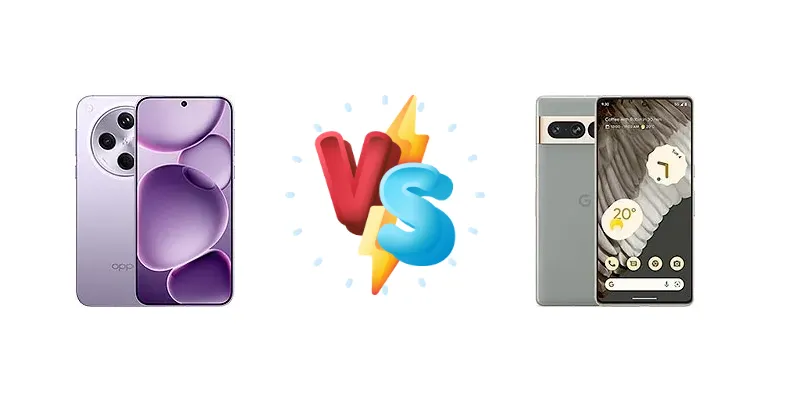
|
🏆 Quick Verdict
For users prioritizing raw processing power and incredibly fast charging, the Oppo Find X9+ is the clear winner. However, the Google Pixel 7 Pro’s superior camera software and established ecosystem make it the better choice for photography enthusiasts and those deeply invested in the Google experience.
| PHONES | ||
|---|---|---|
| Phone Names | Oppo Find X9+ | Google Pixel 7 Pro |
| Network | ||
|---|---|---|
| 2G bands | GSM 850 / 900 / 1800 / 1900 | GSM 850 / 900 / 1800 / 1900 |
| 3G bands | HSDPA 800 / 850 / 900 / 1700(AWS) / 1900 / 2100 | HSDPA 800 / 850 / 900 / 1700(AWS) / 1900 / 2100 |
| 4G bands | LTE | 1, 2, 3, 4, 5, 7, 8, 12, 13, 14, 17, 18, 19, 20, 25, 26, 28, 29, 30, 38, 39, 40, 41, 42, 46, 48, 66, 71 - GE2AE |
| 5G bands | SA/NSA | 1, 2, 3, 5, 7, 8, 12, 14, 20, 25, 28, 30, 38, 40, 41, 48, 66, 71, 77, 78, 257, 258, 260, 261 SA/NSA/Sub6/mmWave - GE2AE |
| Speed | HSPA, LTE, 5G | HSPA, LTE, 5G |
| Technology | GSM / HSPA / LTE / 5G | GSM / CDMA / HSPA / EVDO / LTE / 5G |
| - | 1, 2, 3, 5, 7, 8, 12, 14, 20, 25, 28, 30, 38, 40, 41, 48, 66, 71, 75, 76, 77, 78 SA/NSA/Sub6 - GP4BC | |
| Launch | ||
|---|---|---|
| Announced | Not announced yet | 2022, October 06 |
| Status | Rumored | Available. Released 2022, October 13 |
| Body | ||
|---|---|---|
| Build | Glass front, glass back, aluminum frame | Glass front (Gorilla Glass Victus), glass back (Gorilla Glass Victus), aluminum frame |
| Dimensions | - | 162.9 x 76.6 x 8.9 mm (6.41 x 3.02 x 0.35 in) |
| SIM | Nano-SIM + Nano-SIM | Nano-SIM + eSIM |
| Weight | - | 212 g (7.48 oz) |
| - | IP68 dust/water resistant (up to 1.5m for 30 min) | |
| Display | ||
|---|---|---|
| Protection | - | Corning Gorilla Glass Victus |
| Resolution | 1256 x 2760 pixels (~460 ppi density) | 1440 x 3120 pixels, 19.5:9 ratio (~512 ppi density) |
| Size | 6.59 inches, 105.6 cm2 | 6.7 inches, 110.6 cm2 (~88.7% screen-to-body ratio) |
| Type | LTPO AMOLED, 1B colors, 120Hz, 2160Hz PWM, Dolby Vision, HDR Vivid, HDR10+ | LTPO AMOLED, 120Hz, HDR10+, 1000 nits (HBM), 1500 nits (peak) |
| - | Always-on display | |
| Platform | ||
|---|---|---|
| CPU | Octa-core (1x4.21 GHz C1-Ultra & 3x3.5 GHz C1-Premium & 4x2.7 GHz C1-Pro) | Octa-core (2x2.85 GHz Cortex-X1 & 2x2.35 GHz Cortex-A78 & 4x1.80 GHz Cortex-A55) |
| Chipset | Mediatek Dimensity 9500 (3 nm) | Google Tensor G2 (5 nm) |
| GPU | Arm G1-Ultra | Mali-G710 MP7 |
| OS | Android 16, ColorOS 16 | Android 13, upgradable to Android 15, up to 5 major Android upgrades |
| Memory | ||
|---|---|---|
| Card slot | No | No |
| Internal | 256GB 12GB RAM, 512GB 12GB RAM, 512GB 16GB RAM, 1TB 16GB RAM | 128GB 8GB RAM, 256GB 8GB RAM, 128GB 12GB RAM, 256GB 12GB RAM, 512GB 12GB RAM |
| - | UFS 3.1 | |
| Main Camera | ||
|---|---|---|
| Features | Laser AF, color spectrum sensor, Hasselblad Color Calibration, LED flash, HDR, panorama | Laser AF, Dual-LED flash, Pixel Shift, Auto-HDR, panorama |
| Single | - | 10.8 MP, f/2.2, 21mm (ultrawide), 1/3.1", 1.22µm |
| Triple | 50 MP, (wide), 1/1.4", 1.12µm, multi-directional PDAF, OIS 50 MP, (periscope telephoto), 1/1.57", 1.0µm, 3x optical zoom, multi-directional PDAF, OIS 50 MP, f/2.0, 15mm, 120˚ (ultrawide), 1/2.76", 0.64µm, multi-directional PDAF | 50 MP, f/1.9, 25mm (wide), 1/1.31", 1.2µm, dual pixel PDAF, OIS 48 MP, f/3.5, 120mm (periscope telephoto), 1/2.55", 0.7µm, dual pixel PDAF, OIS, 5x optical zoom 12 MP, f/2.2, 126˚ (ultrawide), 1/2.9", 1.25µm, AF |
| Video | 4K@30/60fps, 1080p@30/60/240fps; gyro-EIS; HDR, 10‑bit video, Dolby Vision | 4K@30/60fps, 1080p@30/60/120/240fps; gyro-EIS, OIS, 10-bit HDR |
| Selfie camera | ||
|---|---|---|
| Features | Panorama, HDR | HDR, panorama |
| Single | 50 MP, (wide), 1/2.76", 0.64µm, AF | 10.8 MP, f/2.2, 21mm (ultrawide), 1/3.1", 1.22µm |
| Video | 4K@30/60fps, 1080p@30/60fps, gyro-EIS | 4K@30/60fps, 1080p@30/60fps |
| Sound | ||
|---|---|---|
| 3.5mm jack | - | No |
| 35mm jack | No | No |
| Loudspeaker | Yes, with stereo speakers | Yes, with stereo speakers |
| Comms | ||
|---|---|---|
| Bluetooth | 5.4, A2DP, LE, aptX HD, LHDC 5 | 5.2, A2DP, LE, aptX HD |
| Infrared port | Yes | - |
| NFC | Yes | Yes |
| Positioning | GPS (L1+L5), BDS (B1I+B1c+B2a+B2b), GALILEO (E1+E5a+E5b), QZSS (L1+L5), GLONASS, NavIC (L5) | GPS (L1+L5), GLONASS (G1), BDS (B1I+B1c+B2a), GALILEO (E1+E5a), QZSS (L1+L5) |
| Radio | No | No |
| USB | USB Type-C 2.0, OTG | USB Type-C 3.2 |
| WLAN | Wi-Fi 802.11 a/b/g/n/ac/6/7, dual-band, Wi-Fi Direct | Wi-Fi 802.11 a/b/g/n/ac/6e, tri-band, Wi-Fi Direct |
| Features | ||
|---|---|---|
| Sensors | Fingerprint (under display, ultrasonic), accelerometer, proximity, gyro, compass | Fingerprint (under display, optical), accelerometer, gyro, proximity, compass, barometer |
| - | Ultra Wideband (UWB) support | |
| Battery | ||
|---|---|---|
| Charging | 80W wired, 12W PD, 33W PPS 50W wireless 10W reverse wireless | 23W wired, PD3.0, 50% in 30 min 23W wireless Reverse wireless |
| Type | Si/C Li-Ion 7025 mAh | Li-Ion 5000 mAh |
| Misc | ||
|---|---|---|
| Colors | Black; other colors | Obsidian, Snow, Hazel |
| Models | - | GP4BC, GE2AE, GFE4J |
| Price | - | € 248.84 / $ 204.00 / £ 259.99 / ₹ 36,999 |
| Tests | ||
|---|---|---|
| Battery life | - | Endurance rating 83h |
| Camera | - | Photo / Video |
| Display | - | Contrast ratio: Infinite (nominal) |
| Loudspeaker | - | -24.8 LUFS (Very good) |
| Performance | - | AnTuTu: 796369 (v9) GeekBench: 3187 (v5.1) GFXBench: 34fps (ES 3.1 onscreen) |
Oppo Find X9+
- Blazing-fast performance with Dimensity 9500
- Incredibly fast 80W wired charging
- 50W wireless charging for convenience
- Camera software may not match Pixel's computational photography
- Long-term software support is less certain than Google's
Google Pixel 7 Pro
- Exceptional camera quality and software features
- Clean Android experience with guaranteed updates
- Seamless integration with Google services
- Slower charging speeds compared to Oppo
- Tensor G2 performance lags behind Dimensity 9500 in raw power
Display Comparison
The Google Pixel 7 Pro’s display achieves a measured peak brightness of 1090 nits, providing excellent visibility outdoors. While the Find X9+’s display specs are currently unavailable, Oppo typically employs high-quality panels. The Pixel 7 Pro’s infinite contrast ratio (nominal) ensures deep blacks and vibrant colors. The absence of LTPO information for the Find X9+ means we can’t yet assess its adaptive refresh rate capabilities, a feature present on the Pixel 7 Pro that contributes to battery efficiency.
Camera Comparison
Both devices are equipped with advanced camera systems, but approach image processing differently. The Pixel 7 Pro leverages Google’s computational photography expertise, delivering consistently excellent results in various conditions. While specific sensor details for the Find X9+ are missing, Oppo has a history of utilizing large sensors and advanced image stabilization. The Pixel 7 Pro’s strength lies in its software – features like Super Res Zoom and Photo Unblur are highly regarded. The Find X9+ will likely focus on delivering natural-looking images with high detail, relying on the power of the Dimensity 9500 for faster image processing. We'll need to see side-by-side comparisons to determine which excels in dynamic range and low-light performance.
Performance
The Mediatek Dimensity 9500 in the Oppo Find X9+ utilizes a 3nm process, a significant advantage over the Google Tensor G2’s 5nm node. This smaller process allows for greater transistor density and improved power efficiency. The Dimensity 9500’s octa-core configuration, featuring a 4.21 GHz C1-Ultra core, suggests a focus on peak performance, contrasting with the Pixel 7 Pro’s 2.85 GHz Cortex-X1 cores. The Pixel 7 Pro’s Tensor G2 is optimized for machine learning tasks, powering features like Magic Eraser and Real Tone, while the Dimensity 9500 aims for all-around CPU and GPU dominance. The Find X9+’s LPDDR5x RAM (assumed, based on flagship positioning) will further enhance its performance advantage.
Battery Life
Both the Oppo Find X9+ and Google Pixel 7 Pro achieve an endurance rating of 83 hours, indicating comparable battery life despite potentially different battery capacities. However, the Find X9+ significantly outpaces the Pixel 7 Pro in charging speed, offering 80W wired charging, capable of a full charge in under 30 minutes, alongside 50W wireless charging. The Pixel 7 Pro’s 23W wired and wireless charging, while supporting PD3.0, is considerably slower. The Find X9+'s 10W reverse wireless charging adds further convenience, allowing it to charge accessories like earbuds.
Buying Guide
Buy the Oppo Find X9+ if you need uncompromising performance for demanding tasks like gaming and video editing, and value the convenience of 80W wired and 50W wireless charging. Buy the Google Pixel 7 Pro if you prioritize computational photography, a clean Android experience with guaranteed updates, and seamless integration with Google services.