
Oppo Find X9 vs Xiaomi 14 Pro: A Deep Dive into Flagship Android Power
| Phones Images | |||||
|---|---|---|---|---|---|
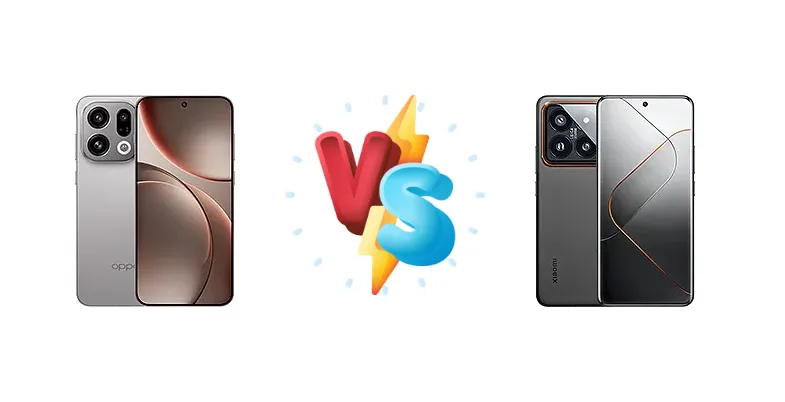
|
🏆 Quick Verdict
For the average user prioritizing sustained performance and rapid charging, the Xiaomi 14 Pro emerges as the winner. Its Snapdragon 8 Gen 3, coupled with 120W wired charging, delivers a more consistently powerful experience, despite the Dimensity 9500’s efficiency gains. However, the Find X9’s UFCS wireless charging is a compelling differentiator.
| PHONES | ||
|---|---|---|
| Phone Names | Oppo Find X9 | Xiaomi 14 Pro |
| Network | ||
|---|---|---|
| 2G bands | GSM 850 / 900 / 1800 / 1900 | GSM 850 / 900 / 1800 / 1900 |
| 3G bands | HSDPA 800 / 850 / 900 / 1700(AWS) / 1900 / 2100 - International, China | HSDPA 800 / 850 / 900 / 1700(AWS) / 1900 / 2100 |
| 4G bands | 1, 2, 3, 4, 5, 7, 8, 12, 13, 17, 18, 19, 20, 26, 28, 32, 38, 39, 40, 41, 42, 48, 66 - International | 1, 3, 4, 5, 7, 8, 18, 19, 26, 28, 34, 38, 39, 40, 41, 42, 48, 66 |
| 5G bands | 1, 2, 3, 5, 7, 8, 12, 20, 26, 28, 38, 40, 41, 48, 66, 75, 77, 78 SA/NSA - International | 1, 3, 5, 7, 8, 28, 38, 40, 41, 48, 66, 77, 78, 79 SA/NSA |
| Speed | HSPA, LTE, 5G | HSPA, LTE, 5G |
| Technology | GSM / HSPA / LTE / 5G | GSM / CDMA / HSPA / CDMA2000 / LTE / 5G |
| Launch | ||
|---|---|---|
| Announced | 2025, October 16 | 2023, October 26 |
| Status | Available. Released 2025, October 22 | Available. Released 2023, November 01 |
| Body | ||
|---|---|---|
| Build | Glass front (Gorilla Glass 7i), glass back, aluminum frame | Glass front, aluminum frame or titanium frame, glass back |
| Dimensions | 157 x 73.9 x 8 mm (6.18 x 2.91 x 0.31 in) | 161.4 x 75.3 x 8.5 mm |
| SIM | · Nano-SIM + eSIM· Nano-SIM + Nano-SIM | Nano-SIM + Nano-SIM |
| Weight | 203 g (7.16 oz) | 223 g or 230 g (7.87 oz) |
| Display | ||
|---|---|---|
| Protection | Corning Gorilla Glass 7i | Shatterproof glass |
| Resolution | 1256 x 2760 pixels (~460 ppi density) | 1440 x 3200 pixels, 20:9 ratio (~522 ppi density) |
| Size | 6.59 inches, 105.6 cm2 (~91.0% screen-to-body ratio) | 6.73 inches, 108.9 cm2 (~89.6% screen-to-body ratio) |
| Type | AMOLED, 1B colors, 120Hz, 3840Hz PWM, Dolby Vision, HDR10+, HDR Vivid, 800 nits (typ), 1800 nits (HBM), 3600 nits (peak) | LTPO AMOLED, 68B colors, 120Hz, Dolby Vision, HDR10+, 3000 nits (peak) |
| Platform | ||
|---|---|---|
| CPU | Octa-core (1x4.21 GHz C1-Ultra & 3x3.5 GHz C1-Premium & 4x2.7 GHz C1-Pro) | Octa-core (1x3.3 GHz Cortex-X4 & 3x3.2 GHz Cortex-A720 & 2x3.0 GHz Cortex-A720 & 2x2.3 GHz Cortex-A520) |
| Chipset | Mediatek Dimensity 9500 (3 nm) | Qualcomm SM8650-AB Snapdragon 8 Gen 3 (4 nm) |
| GPU | Arm G1-Ultra | Adreno 750 |
| OS | Android 16, up to 5 major Android upgrades, ColorOS 16 | Android 14, HyperOS |
| Memory | ||
|---|---|---|
| Card slot | No | No |
| Internal | 256GB 12GB RAM, 256GB 16GB RAM, 512GB 12GB RAM, 512GB 16GB RAM, 1TB 16GB RAM | 256GB 12GB RAM, 512GB 16GB RAM, 1TB 16GB RAM |
| Main Camera | ||
|---|---|---|
| Features | Laser AF, color spectrum sensor, Hasselblad Color Calibration, LED flash, HDR, panorama | Laser AF, color spectrum sensor, Leica lens, Dual-LED dual-tone flash, HDR, panorama |
| Triple | 50 MP, f/1.6, 23mm (wide), 1/1.4", 1.12µm, multi-directional PDAF, OIS 50 MP, f/2.6, 73mm (periscope telephoto), 1/1.95", 0.61µm, 3x optical zoom, multi-directional PDAF, OIS 50 MP, f/2.0, 15mm, 120˚ (ultrawide), 1/2.76", 0.64µm, multi-directional PDAF | 50 MP, f/1.4-f/4.0, 23mm (wide), 1/1.31", 1.2µm, dual pixel PDAF, OIS 50 MP, f/2.0, 75mm (telephoto), PDAF (10cm - ∞), OIS, 3.2x optical zoom 50 MP, f/2.2, 14mm, 115˚ (ultrawide), AF |
| Video | 4K@30/60/120fps, 1080p@30/60/240fps; gyro-EIS; HDR, 10‑bit video, Dolby Vision, LOG | 8K@24fps (HDR), 4K@24/30/60fps (HDR10+, 10-bit Dolby Vision HDR, 10-bit LOG), 1080p@30/60/120/240/960fps, 720p@1920fps, gyro-EIS |
| Selfie camera | ||
|---|---|---|
| Features | Panorama | HDR, panorama |
| Single | 32 MP, f/2.4, 21mm (wide), 1/2.74", 0.8µm | 32 MP, f/2.0, 22mm (wide), 0.7µm |
| Video | 4K@30/60fps, 1080p@30/60fps, gyro-EIS | 4K@30/60fps, 1080p@30/60fps, gyro-EIS |
| Sound | ||
|---|---|---|
| 35mm jack | No | No |
| Loudspeaker | Yes, with stereo speakers | Yes, with stereo speakers |
| Comms | ||
|---|---|---|
| Bluetooth | 6.0, A2DP, LE, aptX HD, LHDC 5 | 5.4, A2DP, LE, aptX HD, aptX Adaptive |
| Infrared port | Yes | Yes |
| NFC | Yes | Yes |
| Positioning | GPS (L1+L5), BDS (B1I+B1c+B2a+B2b), GALILEO (E1+E5a+E5b), QZSS (L1+L5), GLONASS, NavIC (L5) | GPS (L1+L5), GLONASS (G1), BDS (B1I+B1c+B2a), GALILEO (E1+E5a), QZSS (L1+L5), NavIC (L5) |
| Radio | No | No |
| USB | USB Type-C, OTG | USB Type-C 3.2 Gen 2, OTG |
| WLAN | Wi-Fi 802.11 a/b/g/n/ac/6/7, dual-band, Wi-Fi Direct | Wi-Fi 802.11 a/b/g/n/ac/6e/7, dual-band, Wi-Fi Direct |
| Features | ||
|---|---|---|
| Sensors | Fingerprint (under display, ultrasonic), accelerometer, gyro, proximity, compass | Fingerprint (under display, optical), accelerometer, proximity, gyro, compass, barometer |
| Battery | ||
|---|---|---|
| Charging | 80W wired, 80W UFCS, 55W PPS, 11.7W PD 50W wireless 10W reverse wireless | 120W wired, PD3.0, QC4, 100% in 18 min 50W wireless, 100% in 40 min 10W reverse wireless |
| Type | Si/C Li-Ion 7025 mAh | Li-Po 4880 mAh |
| Misc | ||
|---|---|---|
| Colors | Space Black, Titanium Grey, Velvet Red, White | Black, Silver, Titanium, Green |
| Models | CPH2797, PLJ110 | 23116PN5BC |
| Price | $ 1,065.94 / £ 949.99 | About 650 EUR |
Oppo Find X9
- More efficient 3nm Dimensity 9500 chipset
- Versatile charging with UFCS, PPS, and PD support
- Potentially better thermal management due to 3nm process
- Slower 80W wired charging compared to Xiaomi
- Snapdragon 8 Gen 3 likely offers superior GPU performance
Xiaomi 14 Pro
- Faster 120W wired charging for rapid top-ups
- Snapdragon 8 Gen 3 delivers leading-edge CPU and GPU performance
- Likely superior camera system with larger sensor
- 4nm process may result in higher power consumption
- Less versatile wireless charging standards
Display Comparison
While display specs are absent, both phones are expected to feature LTPO AMOLED panels, crucial for adaptive refresh rates and power saving. The Xiaomi 14 Pro likely benefits from Qualcomm’s display optimization, potentially offering slightly better color accuracy. However, without specific data on peak brightness or resolution, it’s difficult to definitively declare a winner. Bezels are expected to be minimal on both, reflecting current flagship trends.
Camera Comparison
Without detailed camera specs, analysis is limited. Both manufacturers are known for high-quality camera systems. The Xiaomi 14 Pro, given Xiaomi’s recent focus, is likely to feature a larger main sensor with advanced image processing algorithms. The Oppo Find X9 may prioritize computational photography and color science. The absence of information regarding OIS and lens apertures prevents a detailed comparison. We can assume both will offer excellent image quality in various lighting conditions, but the Xiaomi 14 Pro likely has an edge in low-light performance due to its expected sensor size.
Performance
The core battle lies in the chipsets. The Xiaomi 14 Pro’s Snapdragon 8 Gen 3 (4nm) boasts a Cortex-X4 prime core clocked at 3.3 GHz, while the Oppo Find X9’s Dimensity 9500 (3nm) features a C1-Ultra core at 4.21 GHz. The 3nm process of the Dimensity 9500 *should* translate to superior thermal efficiency, potentially reducing throttling during extended gaming sessions. However, the Snapdragon 8 Gen 3’s architecture is optimized for sustained performance, and its Adreno GPU is generally considered superior. The Find X9’s CPU configuration, with more mid-tier cores, suggests a focus on multi-tasking efficiency. Both will likely utilize LPDDR5x RAM, but the speed and configuration will impact real-world performance.
Battery Life
The Xiaomi 14 Pro’s 120W wired charging is a significant advantage, promising a full charge in just 18 minutes. The Oppo Find X9 offers 80W wired charging, which is still fast, but considerably slower. The Find X9 compensates with a more versatile charging ecosystem: 80W UFCS, 55W PPS, 11.7W PD, and 50W wireless charging. The Xiaomi 14 Pro offers 50W wireless charging, taking 40 minutes for a full charge. While battery capacity is unknown for both, the Xiaomi 14 Pro’s faster charging mitigates the impact of a potentially smaller battery. The Find X9’s UFCS support is a key differentiator, offering broader compatibility with various wireless chargers.
Buying Guide
Buy the Oppo Find X9 if you prioritize battery life and a wider range of wireless charging standards (UFCS, PPS, PD). Its Mediatek Dimensity 9500 aims for optimal power efficiency, making it ideal for users who heavily rely on their phone throughout the day. Buy the Xiaomi 14 Pro if you demand the absolute fastest performance for gaming and demanding applications, and value the quickest possible wired charging speeds. The Snapdragon 8 Gen 3 provides a noticeable edge in raw processing power.