
Oppo Find X9 vs vivo X100 Pro: A Deep Dive into Mediatek's Flagship Showdown
| Phones Images | |||||
|---|---|---|---|---|---|
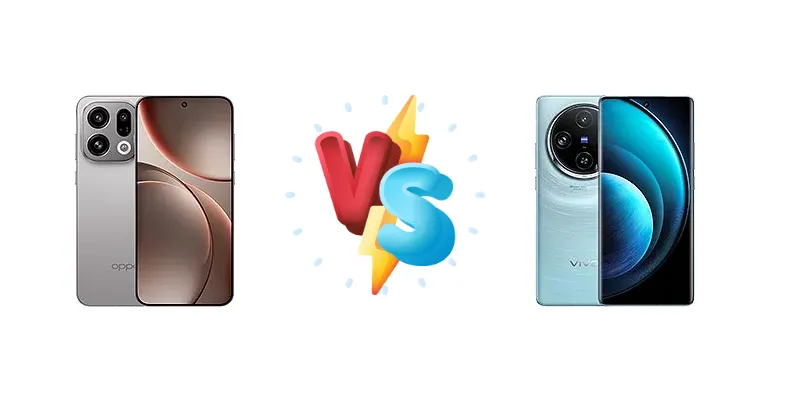
|
🏆 Quick Verdict
For users prioritizing absolute performance and cutting-edge charging technology, the Oppo Find X9 is the winner. Its Dimensity 9500 chipset and comprehensive charging suite (80W wired, 80W UFCS, 50W wireless) offer a compelling package. However, the vivo X100 Pro’s superior battery life and brighter display make it a strong contender for those valuing efficiency and visual experience.
| PHONES | ||
|---|---|---|
| Phone Names | Oppo Find X9 | vivo X100 Pro |
| Network | ||
|---|---|---|
| 2G bands | GSM 850 / 900 / 1800 / 1900 | GSM 850 / 900 / 1800 / 1900 |
| 3G bands | HSDPA 800 / 850 / 900 / 1700(AWS) / 1900 / 2100 - International, China | HSDPA 800 / 850 / 900 / 1700(AWS) / 1900 / 2100 |
| 4G bands | 1, 2, 3, 4, 5, 7, 8, 12, 13, 17, 18, 19, 20, 26, 28, 32, 38, 39, 40, 41, 42, 48, 66 - International | 1, 2, 3, 4, 5, 7, 8, 12, 17, 18, 19, 20, 26, 28, 32, 38, 39, 40, 41, 42, 66 - International |
| 5G bands | 1, 2, 3, 5, 7, 8, 12, 20, 26, 28, 38, 40, 41, 48, 66, 75, 77, 78 SA/NSA - International | 1, 3, 5, 7, 8, 20, 28, 38, 40, 41, 66, 75, 77, 78, 79 SA/NSA - International |
| Speed | HSPA, LTE, 5G | HSPA, LTE, 5G |
| Technology | GSM / HSPA / LTE / 5G | GSM / CDMA / HSPA / LTE / 5G |
| Launch | ||
|---|---|---|
| Announced | 2025, October 16 | 2023, November 13 |
| Status | Available. Released 2025, October 22 | Available. Released 2023, November 21 |
| Body | ||
|---|---|---|
| Build | Glass front (Gorilla Glass 7i), glass back, aluminum frame | Glass front, aluminum frame, glass back |
| Dimensions | 157 x 73.9 x 8 mm (6.18 x 2.91 x 0.31 in) | 164.1 x 75.3 x 8.9 mm or 9.1 mm |
| SIM | · Nano-SIM + eSIM· Nano-SIM + Nano-SIM | · Nano-SIM + eSIM· Nano-SIM + Nano-SIM |
| Weight | 203 g (7.16 oz) | 221 g or 225 g (7.80 oz) |
| Display | ||
|---|---|---|
| Protection | Corning Gorilla Glass 7i | - |
| Resolution | 1256 x 2760 pixels (~460 ppi density) | 1260 x 2800 pixels, 20:9 ratio (~452 ppi density) |
| Size | 6.59 inches, 105.6 cm2 (~91.0% screen-to-body ratio) | 6.78 inches, 111.5 cm2 (~90.2% screen-to-body ratio) |
| Type | AMOLED, 1B colors, 120Hz, 3840Hz PWM, Dolby Vision, HDR10+, HDR Vivid, 800 nits (typ), 1800 nits (HBM), 3600 nits (peak) | LTPO AMOLED, 1B colors, 120Hz, HDR10+, 3000 nits (peak) |
| Platform | ||
|---|---|---|
| CPU | Octa-core (1x4.21 GHz C1-Ultra & 3x3.5 GHz C1-Premium & 4x2.7 GHz C1-Pro) | Octa-core (1x3.25 GHz Cortex-X4 & 3x2.85 GHz Cortex-X4 & 4x2.0 GHz Cortex-A720) |
| Chipset | Mediatek Dimensity 9500 (3 nm) | Mediatek Dimensity 9300 (4 nm) |
| GPU | Arm G1-Ultra | Immortalis-G720 MC12 |
| OS | Android 16, up to 5 major Android upgrades, ColorOS 16 | Android 14, upgradable to Android 15, Funtouch 15 (International), OriginOS 4 (China) |
| Memory | ||
|---|---|---|
| Card slot | No | No |
| Internal | 256GB 12GB RAM, 256GB 16GB RAM, 512GB 12GB RAM, 512GB 16GB RAM, 1TB 16GB RAM | 256GB 12GB RAM, 256GB 16GB RAM, 512GB 16GB RAM, 1TB 16GB RAM |
| Main Camera | ||
|---|---|---|
| Features | Laser AF, color spectrum sensor, Hasselblad Color Calibration, LED flash, HDR, panorama | Laser AF, color spectrum sensor, Zeiss optics, Zeiss T* lens coating, LED flash, panorama, HDR, 3D LUT import |
| Triple | 50 MP, f/1.6, 23mm (wide), 1/1.4", 1.12µm, multi-directional PDAF, OIS 50 MP, f/2.6, 73mm (periscope telephoto), 1/1.95", 0.61µm, 3x optical zoom, multi-directional PDAF, OIS 50 MP, f/2.0, 15mm, 120˚ (ultrawide), 1/2.76", 0.64µm, multi-directional PDAF | 50 MP, f/1.8, 23mm (wide), 1/0.98", 1.6µm, dual pixel PDAF, OIS 50 MP, f/2.5, 100mm (periscope telephoto), 1/2.51", 0.7µm, PDAF (18cm - ∞), OIS, 4.3x optical zoom 50 MP, f/2.0, 15mm, 119˚ (ultrawide), 1/2.76", 0.64µm, AF |
| Video | 4K@30/60/120fps, 1080p@30/60/240fps; gyro-EIS; HDR, 10‑bit video, Dolby Vision, LOG | 8K@30fps, 4K@30/60fps, 1080p, gyro-EIS |
| Selfie camera | ||
|---|---|---|
| Features | Panorama | HDR |
| Single | 32 MP, f/2.4, 21mm (wide), 1/2.74", 0.8µm | 32 MP, f/2.0, 20mm (ultrawide) |
| Video | 4K@30/60fps, 1080p@30/60fps, gyro-EIS | 4K@30/60fps, 1080p@30/60fps |
| Sound | ||
|---|---|---|
| 35mm jack | No | No |
| Loudspeaker | Yes, with stereo speakers | Yes, with stereo speakers |
| Comms | ||
|---|---|---|
| Bluetooth | 6.0, A2DP, LE, aptX HD, LHDC 5 | 5.4, A2DP, LE, aptX HD, LHDC |
| Infrared port | Yes | Yes |
| NFC | Yes | Yes |
| Positioning | GPS (L1+L5), BDS (B1I+B1c+B2a+B2b), GALILEO (E1+E5a+E5b), QZSS (L1+L5), GLONASS, NavIC (L5) | GPS (L1+L5), GLONASS (L1), BDS (B1I+B1c+B2a+B2b), GALILEO (E1+E5a+E5b), QZSS (L1+L5), NavIC (L5) |
| Radio | No | No |
| USB | USB Type-C, OTG | USB Type-C 3.2, OTG |
| WLAN | Wi-Fi 802.11 a/b/g/n/ac/6/7, dual-band, Wi-Fi Direct | Wi-Fi 802.11 a/b/g/n/ac/6/7, tri-band, Wi-Fi Direct |
| Features | ||
|---|---|---|
| Sensors | Fingerprint (under display, ultrasonic), accelerometer, gyro, proximity, compass | Fingerprint (under display, optical), accelerometer, gyro, proximity, compass |
| Battery | ||
|---|---|---|
| Charging | 80W wired, 80W UFCS, 55W PPS, 11.7W PD 50W wireless 10W reverse wireless | 100W wired, 50% in 14 min 50W wireless Reverse wired |
| Type | Si/C Li-Ion 7025 mAh | Li-Ion 5400 mAh |
| Misc | ||
|---|---|---|
| Colors | Space Black, Titanium Grey, Velvet Red, White | Startrail Blue, Asteroid Black, Sunset Orange, White |
| Models | CPH2797, PLJ110 | V2324A, V2309 |
| Price | $ 1,065.94 / £ 949.99 | ₹ 59,999 |
| SAR EU | - | 0.99 W/kg (head) 1.19 W/kg (body) |
Oppo Find X9
- Potentially higher CPU/GPU performance with Dimensity 9500
- Comprehensive charging options (80W wired, 80W UFCS, 50W wireless)
- 3nm process for improved thermal efficiency
- Battery life and capacity are unknown
- Limited camera details provided
vivo X100 Pro
- Excellent battery life (13:53h active use)
- Brighter display (1472 nits)
- Faster 100W wired charging
- Dimensity 9300 may offer slightly lower peak performance
- Reverse wired charging is the only reverse charging option
Display Comparison
The vivo X100 Pro boasts a significantly brighter display, reaching a measured 1472 nits, making it ideal for outdoor use where the Find X9’s brightness remains unspecified. While both likely utilize LTPO technology for adaptive refresh rates, the X100 Pro’s peak brightness provides a tangible advantage in visibility. The absence of detailed display specs for the Find X9 leaves a gap in comparison, but the X100 Pro clearly leads in this area.
Camera Comparison
The context data for both devices is limited regarding camera specifics. However, the vivo X100 Pro’s emphasis on ‘Photo / Video’ suggests a more refined and feature-rich camera system. While sensor sizes and apertures are unknown, the X100 Pro’s brand reputation points towards a more comprehensive camera experience. The Find X9’s camera capabilities remain largely undefined based on the provided information, making it difficult to assess its performance relative to the X100 Pro.
Performance
The Oppo Find X9’s Mediatek Dimensity 9500, built on a 3nm process, theoretically offers a performance edge over the vivo X100 Pro’s 4nm Dimensity 9300. The 9500’s CPU configuration – 1x4.21 GHz C1-Ultra, 3x3.5 GHz C1-Premium, and 4x2.7 GHz C1-Pro – suggests a focus on peak clock speeds. However, the 9300’s Cortex-X4 cores, while clocked lower at 3.25 GHz, are newer generation and may offer improved IPC (Instructions Per Clock). The 3nm node of the 9500 should also provide better thermal efficiency, potentially mitigating throttling during sustained workloads. Real-world testing would be needed to determine which chipset delivers superior sustained performance.
Battery Life
The vivo X100 Pro demonstrates a clear advantage in battery life, achieving an active use score of 13:53h. The Oppo Find X9’s battery capacity is not specified, making a direct mAh comparison impossible. However, the X100 Pro’s longer runtime, combined with its 100W wired charging (50% in 14 minutes) and 50W wireless charging, provides a more convenient and efficient charging experience. The Find X9’s 80W wired, 80W UFCS, 55W PPS, 11.7W PD, and 50W wireless options are comprehensive, but the X100 Pro’s faster wired charging and longer battery life are compelling advantages.
Buying Guide
Buy the Oppo Find X9 if you need uncompromising CPU and GPU performance for demanding tasks like gaming and video editing, and if you value the fastest possible wired and wireless charging speeds. Buy the vivo X100 Pro if you prefer a longer-lasting battery, a brighter and more visible display in direct sunlight, and a refined camera experience optimized for both photos and videos.