
Oppo Find X9 vs Sony Xperia 1 VII: A Flagship Face-Off
| Phones Images | |||||
|---|---|---|---|---|---|
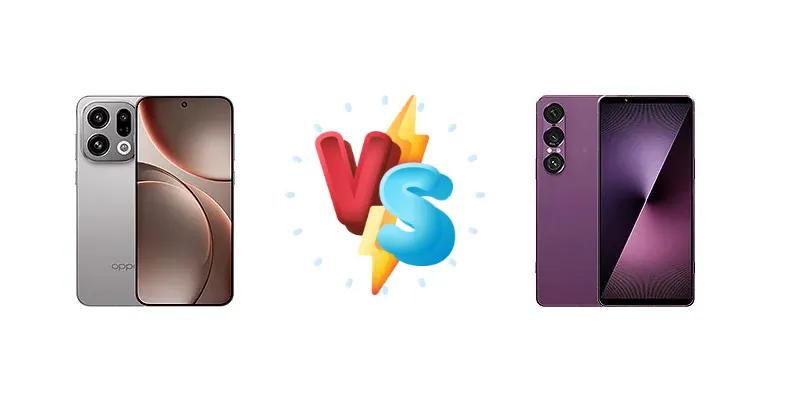
|
🏆 Quick Verdict
For the average user prioritizing peak performance and incredibly fast charging, the Oppo Find X9 emerges as the winner. Its 80W wired and wireless charging, coupled with the potent Dimensity 9500, offers a compelling package. However, the Sony Xperia 1 VII’s exceptional battery endurance and display quality make it a strong contender for power users.
| PHONES | ||
|---|---|---|
| Phone Names | Oppo Find X9 | Sony Xperia 1 VII |
| Network | ||
|---|---|---|
| 2G bands | GSM 850 / 900 / 1800 / 1900 | GSM 850 / 900 / 1800 / 1900 |
| 3G bands | HSDPA 800 / 850 / 900 / 1700(AWS) / 1900 / 2100 - International, China | HSDPA 800 / 850 / 900 / 1700(AWS) / 1900 / 2100 |
| 4G bands | 1, 2, 3, 4, 5, 7, 8, 12, 13, 17, 18, 19, 20, 26, 28, 32, 38, 39, 40, 41, 42, 48, 66 - International | 1, 2, 3, 4, 5, 7, 8, 12, 13, 17, 19, 20, 25, 26, 28, 32, 34, 38, 39, 40, 41, 66 - Europe |
| 5G bands | 1, 2, 3, 5, 7, 8, 12, 20, 26, 28, 38, 40, 41, 48, 66, 75, 77, 78 SA/NSA - International | 1, 3, 5, 7, 8, 20, 28, 38, 40, 41, 75, 77, 78 SA/NSA/Sub6 - Europe |
| Speed | HSPA, LTE, 5G | HSPA, LTE, 5G |
| Technology | GSM / HSPA / LTE / 5G | GSM / HSPA / LTE / 5G |
| Launch | ||
|---|---|---|
| Announced | 2025, October 16 | 2025, May 13 |
| Status | Available. Released 2025, October 22 | Available. Released 2025, June 04 |
| Body | ||
|---|---|---|
| Build | Glass front (Gorilla Glass 7i), glass back, aluminum frame | Glass front (Gorilla Glass Victus 2), glass back (Gorilla Glass Victus), aluminum frame |
| Dimensions | 157 x 73.9 x 8 mm (6.18 x 2.91 x 0.31 in) | 162 x 74 x 8.2 mm (6.38 x 2.91 x 0.32 in) |
| SIM | · Nano-SIM + eSIM· Nano-SIM + Nano-SIM | · Nano-SIM + eSIM· Nano-SIM + Nano-SIM |
| Weight | 203 g (7.16 oz) | 197 g (6.95 oz) |
| Display | ||
|---|---|---|
| Protection | Corning Gorilla Glass 7i | Corning Gorilla Glass Victus 2, Mohs level 5 |
| Resolution | 1256 x 2760 pixels (~460 ppi density) | 1080 x 2340 pixels, 19.5:9 ratio (~396 ppi density) |
| Size | 6.59 inches, 105.6 cm2 (~91.0% screen-to-body ratio) | 6.5 inches, 103.7 cm2 (~86.5% screen-to-body ratio) |
| Type | AMOLED, 1B colors, 120Hz, 3840Hz PWM, Dolby Vision, HDR10+, HDR Vivid, 800 nits (typ), 1800 nits (HBM), 3600 nits (peak) | LTPO OLED, 1B colors, 120Hz, HDR BT.2020 |
| Platform | ||
|---|---|---|
| CPU | Octa-core (1x4.21 GHz C1-Ultra & 3x3.5 GHz C1-Premium & 4x2.7 GHz C1-Pro) | Octa-core (2x4.32 GHz Oryon V2 Phoenix L + 6x3.53 GHz Oryon V2 Phoenix M) |
| Chipset | Mediatek Dimensity 9500 (3 nm) | Qualcomm SM8750-AB Snapdragon 8 Elite (3 nm) |
| GPU | Arm G1-Ultra | Adreno 830 |
| OS | Android 16, up to 5 major Android upgrades, ColorOS 16 | Android 15, up to 4 major Android upgrades |
| Memory | ||
|---|---|---|
| Card slot | No | microSDXC (uses shared SIM slot) |
| Internal | 256GB 12GB RAM, 256GB 16GB RAM, 512GB 12GB RAM, 512GB 16GB RAM, 1TB 16GB RAM | 256GB 12GB RAM, 512GB 12GB RAM |
| Main Camera | ||
|---|---|---|
| Features | Laser AF, color spectrum sensor, Hasselblad Color Calibration, LED flash, HDR, panorama | Zeiss optics, Zeiss T* lens coating, color spectrum sensor, LED flash, panorama, HDR, eye tracking |
| Triple | 50 MP, f/1.6, 23mm (wide), 1/1.4", 1.12µm, multi-directional PDAF, OIS 50 MP, f/2.6, 73mm (periscope telephoto), 1/1.95", 0.61µm, 3x optical zoom, multi-directional PDAF, OIS 50 MP, f/2.0, 15mm, 120˚ (ultrawide), 1/2.76", 0.64µm, multi-directional PDAF | 48 MP, f/1.9, 24mm (wide), 1/1.35", 1.12µm, dual pixel PDAF, OIS 12 MP, f/2.3, 85mm (telephoto), f/3.5, 170mm (telephoto), 1/3.5", 1.0µm, dual pixel PDAF, 3.5x-7.1x continuous optical zoom, OIS, 4cm macro @ 120mm, no AF 48 MP, f/2.0, 16mm (ultrawide), 1/1.56", 1.0µm, PDAF |
| Video | 4K@30/60/120fps, 1080p@30/60/240fps; gyro-EIS; HDR, 10‑bit video, Dolby Vision, LOG | 4K@24/30/60/120fps HDR, 1080p@30/60/120fps; 5-axis gyro-EIS, OIS |
| Selfie camera | ||
|---|---|---|
| Features | Panorama | HDR |
| Single | 32 MP, f/2.4, 21mm (wide), 1/2.74", 0.8µm | 12 MP, f/2.0, 24mm (wide), 1/2.9", 1.22µm |
| Video | 4K@30/60fps, 1080p@30/60fps, gyro-EIS | 4K@30/60fps, 1080p@30/60fps, 5-axis gyro-EIS |
| Sound | ||
|---|---|---|
| 35mm jack | No | Yes |
| Loudspeaker | Yes, with stereo speakers | Yes, with stereo speakers |
| Comms | ||
|---|---|---|
| Bluetooth | 6.0, A2DP, LE, aptX HD, LHDC 5 | 6.0, A2DP, LE Audio, aptX HD, aptX Adaptive, aptX Lossless |
| Infrared port | Yes | - |
| NFC | Yes | Yes |
| Positioning | GPS (L1+L5), BDS (B1I+B1c+B2a+B2b), GALILEO (E1+E5a+E5b), QZSS (L1+L5), GLONASS, NavIC (L5) | GPS, GLONASS, BDS, GALILEO, QZSS |
| Radio | No | No |
| USB | USB Type-C, OTG | USB Type-C 3.2, OTG, video output |
| WLAN | Wi-Fi 802.11 a/b/g/n/ac/6/7, dual-band, Wi-Fi Direct | Wi-Fi 802.11 a/b/g/n/ac/6e/7, tri-band, Wi-Fi Direct, DLNA |
| Features | ||
|---|---|---|
| Sensors | Fingerprint (under display, ultrasonic), accelerometer, gyro, proximity, compass | Fingerprint (side-mounted), accelerometer, gyro, proximity, barometer, compass |
| Battery | ||
|---|---|---|
| Charging | 80W wired, 80W UFCS, 55W PPS, 11.7W PD 50W wireless 10W reverse wireless | 30W wired, PD3.0, PPS, 50% in 30 min 15W wireless Reverse wireless |
| Type | Si/C Li-Ion 7025 mAh | 5000 mAh |
| Misc | ||
|---|---|---|
| Colors | Space Black, Titanium Grey, Velvet Red, White | Moss Green, Orchid Purple, Slate Black |
| Models | CPH2797, PLJ110 | XQ-FS54, XQFS54EUKCG.GC, XQFS54EUKCV.GC, XQFS54EUKCB.GC, PDX256 |
| Price | $ 1,065.94 / £ 949.99 | € 1,338.99 / $ 1,394.99 / £ 1,149.94 |
| EU LABEL | ||
|---|---|---|
| Battery | - | 43:30h endurance, 1400 cycles |
| Energy | - | Class B |
| Free fall | - | Class B (181 falls) |
| Repairability | - | Class D |
Oppo Find X9
- Incredibly fast 80W wired and wireless charging.
- Potentially higher peak CPU performance with Dimensity 9500.
- Advanced MediaTek ISP for image processing.
- Battery life data currently unavailable.
- Long-term battery health not explicitly addressed.
Sony Xperia 1 VII
- Exceptional battery endurance (43:30h).
- Bright and color-accurate display (1475 nits).
- Long-term battery health with 1400 cycles.
- Slower 30W wired charging.
- May not match the Find X9’s peak CPU performance.
Display Comparison
The Sony Xperia 1 VII boasts a significantly brighter display, reaching a measured 1475 nits, which translates to superior visibility in direct sunlight. While the Find X9’s display specs are not provided, Sony’s focus on professional-grade color accuracy and brightness gives it an edge for content creators and media consumers. The Xperia 1 VII’s display technology likely incorporates LTPO for adaptive refresh rates, further enhancing efficiency, a feature not confirmed for the Find X9.
Camera Comparison
Without detailed camera specifications for the Oppo Find X9, a direct comparison is limited. However, Sony’s Xperia 1 series traditionally emphasizes image quality and manual controls. The Xperia 1 VII likely features a sophisticated image processing pipeline and advanced autofocus capabilities. The Find X9 will need to offer a compelling camera system to compete, potentially leveraging MediaTek’s image signal processor (ISP) for computational photography features. Sensor size and lens apertures will be critical factors in determining real-world image quality.
Performance
Both the Oppo Find X9 and Sony Xperia 1 VII utilize 3nm chipsets, but their architectures differ significantly. The Find X9’s Mediatek Dimensity 9500 features a tri-cluster configuration (1x4.21 GHz C1-Ultra, 3x3.5 GHz C1-Premium, 4x2.7 GHz C1-Pro) designed for burst performance. The Xperia 1 VII’s Snapdragon 8 Elite employs Qualcomm’s Oryon V2 Phoenix cores (2x4.32 GHz Phoenix L + 6x3.53 GHz Phoenix M), prioritizing sustained performance and efficiency. The Snapdragon 8 Elite’s Oryon cores are known for their strong single-core performance, potentially benefiting everyday tasks and responsiveness. The Dimensity 9500’s higher clock speed on the primary core may give it an edge in heavily threaded workloads.
Battery Life
The Sony Xperia 1 VII distinguishes itself with a remarkable 43:30h endurance and 15:32h active use score, indicating exceptional battery life. While the Oppo Find X9 doesn’t provide these metrics, its charging capabilities are a major draw. 80W wired and wireless charging, alongside 50W wireless and 10W reverse wireless, significantly reduce downtime. The Xperia 1 VII’s 30W wired charging, while supporting PD3.0 and PPS, is slower. The Xperia 1 VII’s stated 1400 battery cycles suggest a focus on long-term battery health, a factor not explicitly mentioned for the Find X9.
Buying Guide
Buy the Oppo Find X9 if you need the absolute fastest charging speeds available, prioritize peak CPU performance for demanding tasks, and frequently engage in power-intensive activities like gaming. Buy the Sony Xperia 1 VII if you prefer a phone with exceptional battery life, a brighter and more color-accurate display, and value long-term battery health over the quickest possible charge times.