
Oppo Find X9 vs OnePlus 12R: A Deep Dive into Flagship Performance and Value
| Phones Images | |||||
|---|---|---|---|---|---|
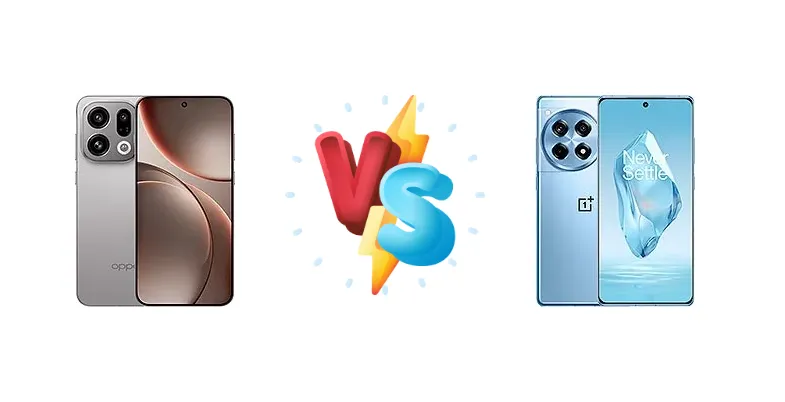
|
🏆 Quick Verdict
For the average user, the OnePlus 12R emerges as the more practical choice. Its Snapdragon 8 Gen 2 delivers excellent performance, coupled with a class-leading 100W charging solution and a measured 14:32h active use battery life. While the Find X9’s Dimensity 9500 holds theoretical advantages, real-world benefits may be limited without further optimization.
| PHONES | ||
|---|---|---|
| Phone Names | Oppo Find X9 | OnePlus 12R |
| Network | ||
|---|---|---|
| 2G bands | GSM 850 / 900 / 1800 / 1900 | GSM 850 / 900 / 1800 / 1900 |
| 3G bands | HSDPA 800 / 850 / 900 / 1700(AWS) / 1900 / 2100 - International, China | HSDPA 850 / 900 / 1700(AWS) / 1900 / 2100 |
| 4G bands | 1, 2, 3, 4, 5, 7, 8, 12, 13, 17, 18, 19, 20, 26, 28, 32, 38, 39, 40, 41, 42, 48, 66 - International | 1, 2, 3, 4, 5, 7, 8, 12, 17, 18, 19, 20, 26, 28, 32, 38, 39, 40, 41, 66 |
| 5G bands | 1, 2, 3, 5, 7, 8, 12, 20, 26, 28, 38, 40, 41, 48, 66, 75, 77, 78 SA/NSA - International | 1, 2, 3, 5, 7, 8, 12, 20, 28, 38, 40, 41, 66, 77, 78 SA/NSA |
| Speed | HSPA, LTE, 5G | HSPA, LTE, 5G |
| Technology | GSM / HSPA / LTE / 5G | GSM / CDMA / HSPA / LTE / 5G |
| Launch | ||
|---|---|---|
| Announced | 2025, October 16 | 2024, January 23 |
| Status | Available. Released 2025, October 22 | Available. Released 2024, February 06 |
| Body | ||
|---|---|---|
| Build | Glass front (Gorilla Glass 7i), glass back, aluminum frame | Glass front (Gorilla Glass Victus 2), aluminum frame, glass back |
| Dimensions | 157 x 73.9 x 8 mm (6.18 x 2.91 x 0.31 in) | 163.3 x 75.3 x 8.8 mm (6.43 x 2.96 x 0.35 in) |
| SIM | · Nano-SIM + eSIM· Nano-SIM + Nano-SIM | · Nano-SIM + Nano-SIM + eSIM (max 2 at a time)· Nano-SIM + Nano-SIM |
| Weight | 203 g (7.16 oz) | 207 g (7.30 oz) |
| Display | ||
|---|---|---|
| Protection | Corning Gorilla Glass 7i | Corning Gorilla Glass Victus 2 |
| Resolution | 1256 x 2760 pixels (~460 ppi density) | 1264 x 2780 pixels (~450 ppi density) |
| Size | 6.59 inches, 105.6 cm2 (~91.0% screen-to-body ratio) | 6.78 inches, 111.7 cm2 (~90.9% screen-to-body ratio) |
| Type | AMOLED, 1B colors, 120Hz, 3840Hz PWM, Dolby Vision, HDR10+, HDR Vivid, 800 nits (typ), 1800 nits (HBM), 3600 nits (peak) | LTPO4 AMOLED, 1B colors, 120Hz, HDR10+, Dolby Vision, 1600 nits (HBM), 4500 nits (peak) |
| Platform | ||
|---|---|---|
| CPU | Octa-core (1x4.21 GHz C1-Ultra & 3x3.5 GHz C1-Premium & 4x2.7 GHz C1-Pro) | Octa-core (1x3.2 GHz Cortex-X3 & 2x2.8 GHz Cortex-A715 & 2x2.8 GHz Cortex-A710 & 3x2.0 GHz Cortex-A510) |
| Chipset | Mediatek Dimensity 9500 (3 nm) | Qualcomm SM8550-AB Snapdragon 8 Gen 2 (4 nm) |
| GPU | Arm G1-Ultra | Adreno 740 |
| OS | Android 16, up to 5 major Android upgrades, ColorOS 16 | Android 14, up to 3 major Android upgrades, OxygenOS 15 |
| Memory | ||
|---|---|---|
| Card slot | No | No |
| Internal | 256GB 12GB RAM, 256GB 16GB RAM, 512GB 12GB RAM, 512GB 16GB RAM, 1TB 16GB RAM | 128GB 8GB RAM, 256GB 8GB RAM, 256GB 12GB RAM, 256GB 16GB RAM |
| Main Camera | ||
|---|---|---|
| Features | Laser AF, color spectrum sensor, Hasselblad Color Calibration, LED flash, HDR, panorama | Laser AF, color spectrum sensor, LED flash, HDR, panorama |
| Triple | 50 MP, f/1.6, 23mm (wide), 1/1.4", 1.12µm, multi-directional PDAF, OIS 50 MP, f/2.6, 73mm (periscope telephoto), 1/1.95", 0.61µm, 3x optical zoom, multi-directional PDAF, OIS 50 MP, f/2.0, 15mm, 120˚ (ultrawide), 1/2.76", 0.64µm, multi-directional PDAF | 50 MP, f/1.8, 24mm (wide), 1/1.56", 1.0µm, multi-directional PDAF, OIS 8 MP, f/2.2, 16mm, 112˚ (ultrawide), 1/4.0", 1.12µm 2 MP (macro) |
| Video | 4K@30/60/120fps, 1080p@30/60/240fps; gyro-EIS; HDR, 10‑bit video, Dolby Vision, LOG | 4K@30/60fps, 1080p@30/60/120/240fps, gyro-EIS, OIS |
| Selfie camera | ||
|---|---|---|
| Features | Panorama | HDR, panorama |
| Single | 32 MP, f/2.4, 21mm (wide), 1/2.74", 0.8µm | 16 MP, f/2.4, 26mm (wide), 1/3", 1.0µm |
| Video | 4K@30/60fps, 1080p@30/60fps, gyro-EIS | 1080p@30fps, gyro-EIS |
| Sound | ||
|---|---|---|
| 35mm jack | No | No |
| Loudspeaker | Yes, with stereo speakers | Yes, with stereo speakers |
| Comms | ||
|---|---|---|
| Bluetooth | 6.0, A2DP, LE, aptX HD, LHDC 5 | 5.3, A2DP, LE, aptX HD |
| Infrared port | Yes | Yes |
| NFC | Yes | Yes |
| Positioning | GPS (L1+L5), BDS (B1I+B1c+B2a+B2b), GALILEO (E1+E5a+E5b), QZSS (L1+L5), GLONASS, NavIC (L5) | GPS, GALILEO, GLONASS, BDS, QZSS |
| Radio | No | No |
| USB | USB Type-C, OTG | USB Type-C 2.0 |
| WLAN | Wi-Fi 802.11 a/b/g/n/ac/6/7, dual-band, Wi-Fi Direct | Wi-Fi 802.11 a/b/g/n/ac/6/7, dual-band |
| Features | ||
|---|---|---|
| Sensors | Fingerprint (under display, ultrasonic), accelerometer, gyro, proximity, compass | Fingerprint (under display, optical), accelerometer, gyro, proximity, compass |
| Battery | ||
|---|---|---|
| Charging | 80W wired, 80W UFCS, 55W PPS, 11.7W PD 50W wireless 10W reverse wireless | 100W wired, 100% in 26 min |
| Type | Si/C Li-Ion 7025 mAh | Li-Ion 5500 mAh |
| Misc | ||
|---|---|---|
| Colors | Space Black, Titanium Grey, Velvet Red, White | Iron Gray, Cool Blue, Electric Violet, Sunset Dune |
| Models | CPH2797, PLJ110 | CPH2609, CPH2585, CPH2611 |
| Price | $ 1,065.94 / £ 949.99 | € 410.84 / $ 399.95 / £ 649.00 |
| SAR | - | 1.19 W/kg (head) 0.82 W/kg (body) |
Oppo Find X9
- Potentially higher peak CPU performance with Dimensity 9500
- More versatile charging options (wired and wireless)
- Cutting-edge 3nm chipset technology
- Potential for thermal throttling and software optimization issues
- Unknown battery capacity and real-world endurance
- Camera specifications currently unknown
OnePlus 12R
- Proven Snapdragon 8 Gen 2 performance and efficiency
- Incredibly fast 100W charging (0-100% in 26 minutes)
- Excellent battery life (14:32h active use)
- Less versatile charging options compared to Find X9
- May not match the theoretical peak performance of Dimensity 9500
- Relies on Qualcomm's ecosystem
Display Comparison
The OnePlus 12R boasts a display capable of reaching 1181 nits of peak brightness, ensuring excellent visibility even in direct sunlight. While the Find X9’s display specifications are currently unknown, Oppo typically employs high-quality panels. The 12R’s brightness level is a concrete advantage, and its panel technology likely utilizes LTPO for adaptive refresh rates, contributing to power efficiency. Without comparable data for the Find X9, the 12R currently holds the edge in display performance.
Camera Comparison
Detailed camera specifications for the Oppo Find X9 are unavailable. The OnePlus 12R’s camera system, while not explicitly detailed in the provided data, is expected to follow OnePlus’s tradition of delivering strong image quality. The focus should be on the main sensor’s size and aperture, as well as the quality of Optical Image Stabilization (OIS). Without knowing the Find X9’s sensor details, it’s difficult to assess its camera capabilities. We can assume both phones will feature multiple lenses, but the image processing algorithms will likely differentiate their output.
Performance
The core of this comparison lies in the chipsets. The Oppo Find X9’s Mediatek Dimensity 9500, fabricated on a 3nm process, features a unique core configuration – 1x4.21 GHz C1-Ultra, 3x3.5 GHz C1-Premium, and 4x2.7 GHz C1-Pro. This suggests a focus on sustained peak performance. However, the OnePlus 12R’s Snapdragon 8 Gen 2 (4nm) is a mature platform with excellent thermal management and software optimization. The Snapdragon’s Cortex-X3 prime core, clocked at 3.2 GHz, is a formidable competitor. The 3nm process of the Dimensity 9500 *should* offer better efficiency, but the real-world impact will depend on Oppo’s thermal design and software tuning. The 12R benefits from Qualcomm’s established ecosystem and optimized drivers.
Battery Life
The OnePlus 12R shines in battery and charging. Its 100W wired charging can fully replenish the battery in just 26 minutes, a significant time saver. The reported 14:32h active use score demonstrates excellent real-world endurance. The Oppo Find X9 offers a more diverse charging ecosystem with 80W wired, 80W UFCS, 55W PPS, 11.7W PD, 50W wireless, and 10W reverse wireless. While versatile, the wired charging isn’t as fast as the 12R’s. The Find X9’s battery capacity is unknown, but the 12R’s combination of capacity and charging speed is a clear advantage.
Buying Guide
Buy the Oppo Find X9 if you absolutely demand the latest silicon and are willing to potentially troubleshoot early software optimizations for maximum performance. This phone is for the enthusiast who wants to push the boundaries. Buy the OnePlus 12R if you prioritize a refined, reliable experience with exceptional battery life, incredibly fast charging, and a proven chipset – a perfect all-rounder for daily use and gaming.