
Oppo Find X9 vs Honor Magic6 Pro: A Deep Dive into Flagship Performance and Battery Life
| Phones Images | |||||
|---|---|---|---|---|---|
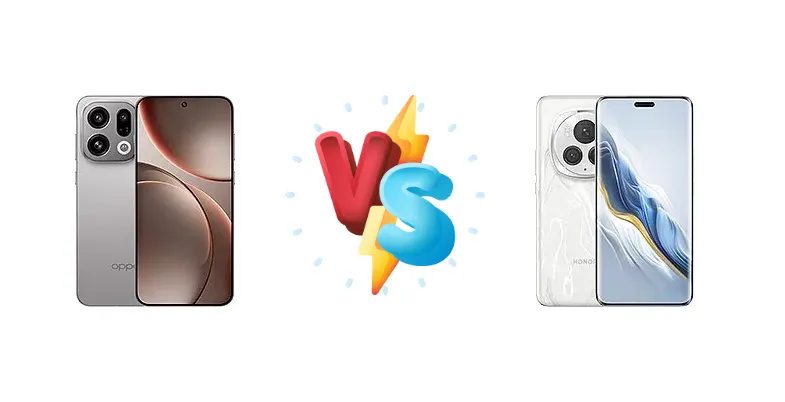
|
🏆 Quick Verdict
For the average user prioritizing all-day battery life and consistent performance, the Honor Magic6 Pro emerges as the winner. Its Snapdragon 8 Gen 3 chipset and impressive 14:06h active use score provide a smoother, more reliable experience. However, the Oppo Find X9’s unparalleled charging speeds and UFCS support make it a compelling choice for those who value rapid replenishment above all else.
| PHONES | ||
|---|---|---|
| Phone Names | Oppo Find X9 | Honor Magic6 Pro |
| Network | ||
|---|---|---|
| 2G bands | GSM 850 / 900 / 1800 / 1900 | GSM 850 / 900 / 1800 / 1900 |
| 3G bands | HSDPA 800 / 850 / 900 / 1700(AWS) / 1900 / 2100 - International, China | HSDPA 800 / 850 / 900 / 1700(AWS) / 1900 / 2100 |
| 4G bands | 1, 2, 3, 4, 5, 7, 8, 12, 13, 17, 18, 19, 20, 26, 28, 32, 38, 39, 40, 41, 42, 48, 66 - International | LTE |
| 5G bands | 1, 2, 3, 5, 7, 8, 12, 20, 26, 28, 38, 40, 41, 48, 66, 75, 77, 78 SA/NSA - International | SA/NSA |
| Speed | HSPA, LTE, 5G | HSPA, LTE, 5G |
| Technology | GSM / HSPA / LTE / 5G | GSM / CDMA / HSPA / CDMA2000 / LTE / 5G |
| Launch | ||
|---|---|---|
| Announced | 2025, October 16 | 2024, January 11 |
| Status | Available. Released 2025, October 22 | Available. Released 2024, January 18 |
| Body | ||
|---|---|---|
| Build | Glass front (Gorilla Glass 7i), glass back, aluminum frame | Glass front (NanoCrystal Shield), glass back or silicone polymer back (eco leather) |
| Dimensions | 157 x 73.9 x 8 mm (6.18 x 2.91 x 0.31 in) | 162.5 x 75.8 x 8.9 mm (6.40 x 2.98 x 0.35 in) |
| SIM | · Nano-SIM + eSIM· Nano-SIM + Nano-SIM | · Nano-SIM + eSIM· Nano-SIM + Nano-SIM |
| Weight | 203 g (7.16 oz) | 225 g or 229 g (7.94 oz) |
| Display | ||
|---|---|---|
| Protection | Corning Gorilla Glass 7i | NanoCrystal Shield |
| Resolution | 1256 x 2760 pixels (~460 ppi density) | 1280 x 2800 pixels, 19.5:9 ratio (~453 ppi density) |
| Size | 6.59 inches, 105.6 cm2 (~91.0% screen-to-body ratio) | 6.8 inches, 112.8 cm2 (~91.6% screen-to-body ratio) |
| Type | AMOLED, 1B colors, 120Hz, 3840Hz PWM, Dolby Vision, HDR10+, HDR Vivid, 800 nits (typ), 1800 nits (HBM), 3600 nits (peak) | LTPO OLED, 1B colors, 120Hz, Dolby Vision, HDR, 1600 nits (HBM), 5000 nits (peak) |
| Platform | ||
|---|---|---|
| CPU | Octa-core (1x4.21 GHz C1-Ultra & 3x3.5 GHz C1-Premium & 4x2.7 GHz C1-Pro) | Octa-core (1x3.3 GHz Cortex-X4 & 3x3.2 GHz Cortex-A720 & 2x3.0 GHz Cortex-A720 & 2x2.3 GHz Cortex-A520) |
| Chipset | Mediatek Dimensity 9500 (3 nm) | Qualcomm SM8650-AB Snapdragon 8 Gen 3 (4 nm) |
| GPU | Arm G1-Ultra | Adreno 750 |
| OS | Android 16, up to 5 major Android upgrades, ColorOS 16 | Android 14, up to 4 major Android upgrades, MagicOS 8 |
| Memory | ||
|---|---|---|
| Card slot | No | No |
| Internal | 256GB 12GB RAM, 256GB 16GB RAM, 512GB 12GB RAM, 512GB 16GB RAM, 1TB 16GB RAM | 256GB 12GB RAM, 256GB 16GB RAM, 512GB 12GB RAM, 512GB 16GB RAM, 1TB 16GB RAM |
| Main Camera | ||
|---|---|---|
| Features | Laser AF, color spectrum sensor, Hasselblad Color Calibration, LED flash, HDR, panorama | Laser AF, color spectrum sensor, LED flash, HDR, panorama |
| Triple | 50 MP, f/1.6, 23mm (wide), 1/1.4", 1.12µm, multi-directional PDAF, OIS 50 MP, f/2.6, 73mm (periscope telephoto), 1/1.95", 0.61µm, 3x optical zoom, multi-directional PDAF, OIS 50 MP, f/2.0, 15mm, 120˚ (ultrawide), 1/2.76", 0.64µm, multi-directional PDAF | 50 MP, f/1.4-2.0, 23mm (wide), 1/1.3", 1.2µm, PDAF, OIS 180 MP, f/2.6, (periscope telephoto), 1/1.49", 0.56µm, PDAF, OIS, 2.5x optical zoom 50 MP, f/2.0, 13mm, 122˚ (ultrawide), 1/2.88", 0.61µm, AF |
| Video | 4K@30/60/120fps, 1080p@30/60/240fps; gyro-EIS; HDR, 10‑bit video, Dolby Vision, LOG | 4K@24/30/60fps, 1080p@30/60/120/240fps, gyro-EIS, OIS, HDR, 10-bit video |
| Selfie camera | ||
|---|---|---|
| Features | Panorama | - |
| Single | 32 MP, f/2.4, 21mm (wide), 1/2.74", 0.8µm | 50 MP, f/2.0, 22mm (wide), 1/2.93", 0.6µm, AF TOF 3D, (depth/biometrics sensor) |
| Video | 4K@30/60fps, 1080p@30/60fps, gyro-EIS | 4K@30fps, 1080p@30/60fps, gyro-EIS |
| Sound | ||
|---|---|---|
| 35mm jack | No | No |
| Loudspeaker | Yes, with stereo speakers | Yes, with stereo speakers |
| Comms | ||
|---|---|---|
| Bluetooth | 6.0, A2DP, LE, aptX HD, LHDC 5 | 5.3, A2DP, LE, aptX HD |
| Infrared port | Yes | Yes |
| NFC | Yes | Yes |
| Positioning | GPS (L1+L5), BDS (B1I+B1c+B2a+B2b), GALILEO (E1+E5a+E5b), QZSS (L1+L5), GLONASS, NavIC (L5) | GPS (L1+L5), GLONASS, BDS (B1I+B1c+B2a), GALILEO (E1+E5a) |
| Radio | No | No |
| USB | USB Type-C, OTG | USB Type-C 3.2, DisplayPort 1.2, OTG |
| WLAN | Wi-Fi 802.11 a/b/g/n/ac/6/7, dual-band, Wi-Fi Direct | Wi-Fi 802.11 a/b/g/n/ac/6/7, dual-band, Wi-Fi Direct |
| Features | ||
|---|---|---|
| Sensors | Fingerprint (under display, ultrasonic), accelerometer, gyro, proximity, compass | Fingerprint (under display, optical), Face ID, accelerometer, gyro, proximity, compass |
| Battery | ||
|---|---|---|
| Charging | 80W wired, 80W UFCS, 55W PPS, 11.7W PD 50W wireless 10W reverse wireless | 80W wired 66W wireless Reverse wireless 5W reverse wired |
| Type | Si/C Li-Ion 7025 mAh | Si/C Li-Ion 5600 mAh |
| Misc | ||
|---|---|---|
| Colors | Space Black, Titanium Grey, Velvet Red, White | Black, Green, Blue, Purple, White |
| Models | CPH2797, PLJ110 | BVL-AN16, BVL-N49 |
| Price | $ 1,065.94 / £ 949.99 | € 455.54 / $ 899.00 / £ 598.99 |
Oppo Find X9
- Unmatched charging speeds with multiple protocols
- Potentially higher peak CPU performance with Dimensity 9500
- UFCS support for universal fast charging compatibility
- Battery life likely inferior to the Magic6 Pro
- Potential for thermal throttling under sustained load
- Display brightness data currently unavailable
Honor Magic6 Pro
- Exceptional battery life (14:06h active use)
- Brighter display (1578 nits) for outdoor visibility
- Snapdragon 8 Gen 3 offers balanced performance and efficiency
- Slower wireless charging compared to Oppo Find X9
- Charging protocol options are more limited
- Reverse wired charging is slower (5W)
Display Comparison
The Honor Magic6 Pro boasts a significantly brighter display, reaching a measured 1578 nits, making it far more usable outdoors under direct sunlight compared to the Oppo Find X9 (brightness data unavailable). While both likely employ LTPO technology for adaptive refresh rates, the Magic6 Pro’s peak brightness is a clear advantage. The Find X9’s display specs are currently unknown, but a flagship device at this price point would be expected to have excellent color accuracy and resolution.
Camera Comparison
Camera details are currently limited. However, given the flagship positioning of both devices, we can expect high-quality camera systems. The focus will likely be on sensor size and image processing algorithms. Without specific sensor details, it’s difficult to make a direct comparison. The presence of OIS (Optical Image Stabilization) is almost guaranteed on both, and lens apertures will play a crucial role in low-light performance. We anticipate both phones will offer versatile camera setups, but the image processing style – Oppo’s tendency towards vibrant colors versus Honor’s more natural approach – will be a key differentiator.
Performance
The core difference lies in the chipsets. The Honor Magic6 Pro utilizes the Qualcomm Snapdragon 8 Gen 3 (4nm), known for its balanced performance and efficiency. The Oppo Find X9, however, features the Mediatek Dimensity 9500 (3nm). While the 3nm process *should* offer improved efficiency, the Dimensity 9500’s CPU configuration – with a 4.21 GHz C1-Ultra core – suggests a focus on peak performance. The Snapdragon 8 Gen 3’s Cortex-X4 core runs at 3.3 GHz. This suggests the Dimensity 9500 may initially deliver higher benchmark scores, but the Snapdragon 8 Gen 3’s architecture is optimized for sustained performance and thermal management, potentially leading to less throttling during extended gaming sessions. Both devices likely utilize LPDDR5x RAM, but the specific speed is unknown.
Battery Life
The Honor Magic6 Pro’s 14:06h active use score is a standout feature, indicating exceptional battery life. While the Oppo Find X9’s battery capacity is unknown, its charging capabilities are its defining characteristic. The Find X9 supports 80W wired charging, 80W UFCS, 55W PPS, 11.7W PD, and 50W wireless charging, alongside 10W reverse wireless. The Magic6 Pro offers 80W wired and 66W wireless charging, plus 5W reverse wired. The Find X9’s wider range of charging protocols and higher wireless charging wattage provide greater flexibility, but the Magic6 Pro’s superior battery life may negate the need for frequent top-ups.
Buying Guide
Buy the Oppo Find X9 if you need the absolute fastest charging available, including versatile wired and wireless options, and are willing to potentially trade some sustained performance for it. Buy the Honor Magic6 Pro if you prefer a phone that excels in battery endurance, offers consistently high performance thanks to the Snapdragon 8 Gen 3, and boasts a brighter, more visible display in direct sunlight.