
Oppo Find X8s+ vs vivo X100 Pro: A Deep Dive into Dimensity Power
| Phones Images | |||||
|---|---|---|---|---|---|
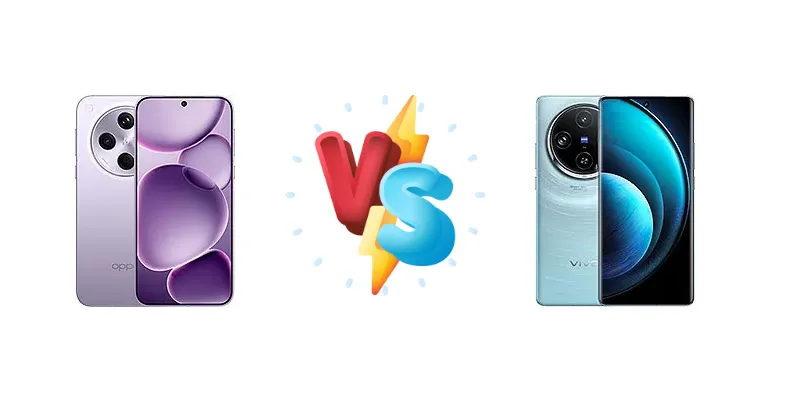
|
🏆 Quick Verdict
For users prioritizing raw processing power and future-proofing, the Oppo Find X8s+ with its Dimensity 9400+ chipset takes the lead. While the vivo X100 Pro offers excellent battery life and a bright display, the X8s+'s newer architecture and faster CPU core configuration provide a noticeable performance edge.
| PHONES | ||
|---|---|---|
| Phone Names | Oppo Find X8s+ | vivo X100 Pro |
| Network | ||
|---|---|---|
| 2G bands | GSM 850 / 900 / 1800 / 1900 | GSM 850 / 900 / 1800 / 1900 |
| 3G bands | HSDPA 800 / 850 / 900 / 1700(AWS) / 1900 / 2100 | HSDPA 800 / 850 / 900 / 1700(AWS) / 1900 / 2100 |
| 4G bands | 1, 3, 4, 5, 7, 8, 18, 19, 26, 28, 34, 38, 39, 40, 41, 42, 48, 66 | 1, 2, 3, 4, 5, 7, 8, 12, 17, 18, 19, 20, 26, 28, 32, 38, 39, 40, 41, 42, 66 - International |
| 5G bands | 1, 3, 5, 7, 8, 26, 28, 38, 40, 41, 48, 66, 77, 78 SA/NSA | 1, 3, 5, 7, 8, 20, 28, 38, 40, 41, 66, 75, 77, 78, 79 SA/NSA - International |
| Speed | HSPA, LTE, 5G | HSPA, LTE, 5G |
| Technology | GSM / HSPA / LTE / 5G | GSM / CDMA / HSPA / LTE / 5G |
| Launch | ||
|---|---|---|
| Announced | 2025, April 10 | 2023, November 13 |
| Status | Available. Released 2025, April 16 | Available. Released 2023, November 21 |
| Body | ||
|---|---|---|
| Build | Glass front, glass back, aluminum frame | Glass front, aluminum frame, glass back |
| Dimensions | 157.5 x 74.5 x 8 mm (6.20 x 2.93 x 0.31 in) | 164.1 x 75.3 x 8.9 mm or 9.1 mm |
| SIM | Nano-SIM + Nano-SIM | · Nano-SIM + eSIM· Nano-SIM + Nano-SIM |
| Weight | 198 g (6.98 oz) | 221 g or 225 g (7.80 oz) |
| Display | ||
|---|---|---|
| Resolution | 1256 x 2760 pixels (~460 ppi density) | 1260 x 2800 pixels, 20:9 ratio (~452 ppi density) |
| Size | 6.59 inches, 105.6 cm2 (~90.0% screen-to-body ratio) | 6.78 inches, 111.5 cm2 (~90.2% screen-to-body ratio) |
| Type | AMOLED, 1B colors, 120Hz, 2160Hz PWM, Dolby Vision, HDR Vivid, HDR10+, 800 nits (typ), 1600 nits (HBM) | LTPO AMOLED, 1B colors, 120Hz, HDR10+, 3000 nits (peak) |
| Platform | ||
|---|---|---|
| CPU | Octa-core (1x3.73 GHz Cortex-X925 & 3x3.3 GHz Cortex-X4 & 4x2.4 GHz Cortex-A720) | Octa-core (1x3.25 GHz Cortex-X4 & 3x2.85 GHz Cortex-X4 & 4x2.0 GHz Cortex-A720) |
| Chipset | Mediatek Dimensity 9400+ (3 nm) | Mediatek Dimensity 9300 (4 nm) |
| GPU | Immortalis-G925 MC12 | Immortalis-G720 MC12 |
| OS | Android 15, ColorOS 15 | Android 14, upgradable to Android 15, Funtouch 15 (International), OriginOS 4 (China) |
| Memory | ||
|---|---|---|
| Card slot | No | No |
| Internal | 256GB 12GB RAM, 512GB 12GB RAM, 512GB 16GB RAM, 1TB 16GB RAM | 256GB 12GB RAM, 256GB 16GB RAM, 512GB 16GB RAM, 1TB 16GB RAM |
| Main Camera | ||
|---|---|---|
| Features | Laser AF, color spectrum sensor, Hasselblad Color Calibration, LED flash, HDR, panorama | Laser AF, color spectrum sensor, Zeiss optics, Zeiss T* lens coating, LED flash, panorama, HDR, 3D LUT import |
| Triple | 50 MP, f/1.8, 24mm (wide), 1/1.56", 1.0µm, multi-directional PDAF, OIS 50 MP, f/2.6, 73mm (periscope telephoto), 1/1.95", 0.61µm, 3x optical zoom, multi-directional PDAF, OIS 50 MP, f/2.0, 15mm, 120˚ (ultrawide), 1/2.75", 0.64µm, multi-directional PDAF | 50 MP, f/1.8, 23mm (wide), 1/0.98", 1.6µm, dual pixel PDAF, OIS 50 MP, f/2.5, 100mm (periscope telephoto), 1/2.51", 0.7µm, PDAF (18cm - ∞), OIS, 4.3x optical zoom 50 MP, f/2.0, 15mm, 119˚ (ultrawide), 1/2.76", 0.64µm, AF |
| Video | 4K@30/60fps, 1080p@30/60/240fps; gyro-EIS; HDR, 10‑bit video, Dolby Vision | 8K@30fps, 4K@30/60fps, 1080p, gyro-EIS |
| Selfie camera | ||
|---|---|---|
| Features | Panorama, HDR | HDR |
| Single | 32 MP, f/2.4, 21mm (wide), 1/2.74", 0.8µm, AF | 32 MP, f/2.0, 20mm (ultrawide) |
| Video | 4K@30/60fps, 1080p@30/60fps, gyro-EIS | 4K@30/60fps, 1080p@30/60fps |
| Sound | ||
|---|---|---|
| 35mm jack | No | No |
| Loudspeaker | Yes, with stereo speakers | Yes, with stereo speakers |
| Comms | ||
|---|---|---|
| Bluetooth | 5.4, A2DP, LE, aptX HD, LHDC 5 | 5.4, A2DP, LE, aptX HD, LHDC |
| Infrared port | Yes | Yes |
| NFC | Yes | Yes |
| Positioning | GPS (L1+L5), BDS (B1I+B1c+B2a+B2b), GALILEO (E1+E5a+E5b), QZSS (L1+L5), GLONASS, NavIC (L5) | GPS (L1+L5), GLONASS (L1), BDS (B1I+B1c+B2a+B2b), GALILEO (E1+E5a+E5b), QZSS (L1+L5), NavIC (L5) |
| Radio | No | No |
| USB | USB Type-C 2.0, OTG | USB Type-C 3.2, OTG |
| WLAN | Wi-Fi 802.11 a/b/g/n/ac/6/7, dual-band, Wi-Fi Direct | Wi-Fi 802.11 a/b/g/n/ac/6/7, tri-band, Wi-Fi Direct |
| Features | ||
|---|---|---|
| Sensors | Fingerprint (under display, optical), accelerometer, gyro, proximity, compass | Fingerprint (under display, optical), accelerometer, gyro, proximity, compass |
| Battery | ||
|---|---|---|
| Charging | 80W wired, 12W PD, 33W PPS 50W wireless 10W reverse wireless | 100W wired, 50% in 14 min 50W wireless Reverse wired |
| Type | Si/C Li-Ion 6000 mAh | Li-Ion 5400 mAh |
| Misc | ||
|---|---|---|
| Colors | Black, White, Purple | Startrail Blue, Asteroid Black, Sunset Orange, White |
| Models | PLB110 | V2324A, V2309 |
| Price | - | ₹ 59,999 |
| SAR EU | - | 0.99 W/kg (head) 1.19 W/kg (body) |
Oppo Find X8s+
- Potentially superior performance with Dimensity 9400+ (3nm)
- Faster CPU core configuration for demanding tasks
- 50W wireless charging and 10W reverse wireless charging
- Battery capacity and real-world battery life are unknown
- Wired charging is slower than the vivo X100 Pro
vivo X100 Pro
- Excellent battery life (13:53h active use)
- 1472 nits peak brightness for outdoor visibility
- Faster 100W wired charging
- Dimensity 9300 (4nm) is a generation behind
- CPU core configuration is less powerful than the X8s+
Display Comparison
The vivo X100 Pro boasts a measured peak brightness of 1472 nits, ensuring excellent visibility in direct sunlight. While the Oppo Find X8s+’s display specifications are currently unknown, it’s reasonable to expect a comparable or slightly lower peak brightness given the focus on internal performance. Both devices likely employ LTPO technology for adaptive refresh rates, conserving battery life. The X8s+’s display technology will be crucial to assess, as a higher PWM dimming rate would benefit users sensitive to flicker.
Camera Comparison
Both devices are expected to deliver exceptional camera performance, but details beyond 'Photo/Video' capabilities for the vivo X100 Pro are lacking. The X8s+’s camera specifications are currently unknown, but Oppo’s history suggests a focus on computational photography and sensor size. The X100 Pro’s camera system will likely emphasize color science and dynamic range. Without knowing sensor sizes and lens apertures, it’s difficult to definitively declare a winner, but the X8s+’s potential for a larger sensor and more advanced image processing could give it an edge. We'll need to ignore the typical 2MP macro cameras found on both devices as they offer minimal real-world benefit.
Performance
The core difference lies in the chipsets: the Oppo Find X8s+ utilizes the Mediatek Dimensity 9400+ (3nm) while the vivo X100 Pro features the Dimensity 9300 (4nm). The 9400+’s 3nm process node promises superior power efficiency and transistor density compared to the 9300’s 4nm node, potentially leading to less thermal throttling under sustained load. The X8s+’s CPU configuration – 1x3.73 GHz Cortex-X925, 3x3.3 GHz Cortex-X4, and 4x2.4 GHz Cortex-A720 – is a step up from the X100 Pro’s 1x3.25 GHz Cortex-X4, 3x2.85 GHz Cortex-X4, and 4x2.0 GHz Cortex-A720. This translates to faster single-core and multi-core performance for the Oppo device. Both phones will likely feature LPDDR5x RAM, but the X8s+’s chipset advantage will be the dominant factor.
Battery Life
The vivo X100 Pro demonstrates strong battery performance with an active use score of 13:53h. The Oppo Find X8s+’s battery capacity is unknown, but the Dimensity 9400+’s improved efficiency could offset a potentially smaller battery. The X100 Pro’s 100W wired charging (50% in 14 minutes) is faster than the X8s+’s 80W wired charging. However, the X8s+ offers 50W wireless charging compared to the X100 Pro’s 50W, and adds 10W reverse wireless charging, a feature the X100 Pro only offers wired. The X100 Pro’s faster wired charging is a clear advantage for quick top-ups.
Buying Guide
Buy the Oppo Find X8s+ if you demand the absolute fastest Android performance for demanding tasks like video editing, gaming, and AI workloads. Buy the vivo X100 Pro if you prioritize all-day battery life, a consistently bright display for outdoor use, and a refined camera experience with a focus on consistent image quality.