
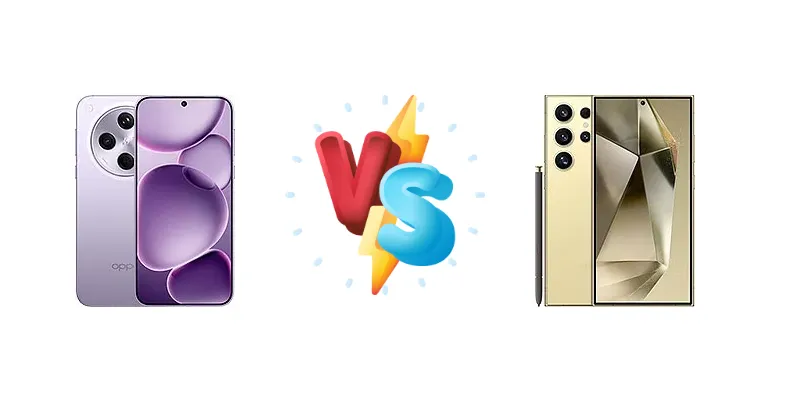
Oppo Find X8s+ vs Samsung Galaxy S24 Ultra: A Deep Dive into Flagship Performance
| Phones Images | |||||
|---|---|---|---|---|---|
|
🏆 Quick Verdict
For the average user prioritizing all-around excellence and a mature software experience, the Samsung Galaxy S24 Ultra remains the safer bet. However, the Oppo Find X8s+’s Dimensity 9400+ chipset offers a potential performance edge, particularly for demanding tasks, making it a strong contender for power users.
| PHONES | ||
|---|---|---|
| Phone Names | Oppo Find X8s+ | Samsung Galaxy S24 Ultra |
| Network | ||
|---|---|---|
| 2G bands | GSM 850 / 900 / 1800 / 1900 | GSM 850 / 900 / 1800 / 1900 |
| 3G bands | HSDPA 800 / 850 / 900 / 1700(AWS) / 1900 / 2100 | HSDPA 850 / 900 / 1700(AWS) / 1900 / 2100 |
| 4G bands | 1, 3, 4, 5, 7, 8, 18, 19, 26, 28, 34, 38, 39, 40, 41, 42, 48, 66 | 1, 2, 3, 4, 5, 7, 8, 12, 13, 17, 18, 19, 20, 25, 26, 28, 32, 38, 39, 40, 41, 66 - International |
| 5G bands | 1, 3, 5, 7, 8, 26, 28, 38, 40, 41, 48, 66, 77, 78 SA/NSA | 1, 2, 3, 5, 7, 8, 12, 20, 25, 26, 28, 38, 40, 41, 66, 75, 77, 78 SA/NSA/Sub6 - International |
| Speed | HSPA, LTE, 5G | HSPA, LTE (up to 7CA), 5G |
| Technology | GSM / HSPA / LTE / 5G | GSM / CDMA / HSPA / EVDO / LTE / 5G |
| Launch | ||
|---|---|---|
| Announced | 2025, April 10 | 2024, January 17 |
| Status | Available. Released 2025, April 16 | Available. Released 2024, January 24 |
| Body | ||
|---|---|---|
| Build | Glass front, glass back, aluminum frame | Glass front (Corning Gorilla Armor), glass back (Corning Gorilla Armor), titanium frame (grade 2) |
| Dimensions | 157.5 x 74.5 x 8 mm (6.20 x 2.93 x 0.31 in) | 162.3 x 79 x 8.6 mm (6.39 x 3.11 x 0.34 in) |
| SIM | Nano-SIM + Nano-SIM | · Nano-SIM + Nano-SIM + eSIM + eSIM (max 2 at a time) - INT· Nano-SIM + eSIM + eSIM (max 2 at a time) - USA· Nano-SIM + Nano-SIM - CN |
| Weight | 198 g (6.98 oz) | 232 g or 233 g (8.18 oz) |
| Display | ||
|---|---|---|
| Protection | - | Corning Gorilla Armor |
| Resolution | 1256 x 2760 pixels (~460 ppi density) | 1440 x 3120 pixels, 19.5:9 ratio (~505 ppi density) |
| Size | 6.59 inches, 105.6 cm2 (~90.0% screen-to-body ratio) | 6.8 inches, 113.5 cm2 (~88.5% screen-to-body ratio) |
| Type | AMOLED, 1B colors, 120Hz, 2160Hz PWM, Dolby Vision, HDR Vivid, HDR10+, 800 nits (typ), 1600 nits (HBM) | Dynamic LTPO AMOLED 2X, 120Hz, HDR10+, 2600 nits (peak) |
| Platform | ||
|---|---|---|
| CPU | Octa-core (1x3.73 GHz Cortex-X925 & 3x3.3 GHz Cortex-X4 & 4x2.4 GHz Cortex-A720) | 8-core (1x3.39GHz Cortex-X4 & 3x3.1GHz Cortex-A720 & 2x2.9GHz Cortex-A720 & 2x2.2GHz Cortex-A520) |
| Chipset | Mediatek Dimensity 9400+ (3 nm) | Qualcomm SM8650-AC Snapdragon 8 Gen 3 (4 nm) |
| GPU | Immortalis-G925 MC12 | Adreno 750 (1 GHz) |
| OS | Android 15, ColorOS 15 | Android 14, up to 7 major Android upgrades, One UI 8.0 |
| Memory | ||
|---|---|---|
| Card slot | No | No |
| Internal | 256GB 12GB RAM, 512GB 12GB RAM, 512GB 16GB RAM, 1TB 16GB RAM | 256GB 12GB RAM, 512GB 12GB RAM, 1TB 12GB RAM |
| Main Camera | ||
|---|---|---|
| Features | Laser AF, color spectrum sensor, Hasselblad Color Calibration, LED flash, HDR, panorama | Laser AF, LED flash, auto-HDR, panorama |
| Quad | - | 200 MP, f/1.7, 24mm (wide), 1/1.3", 0.6µm, multi-directional PDAF, OIS 10 MP, f/2.4, 67mm (telephoto), 1/3.52", 1.12µm, PDAF, OIS, 3x optical zoom 50 MP, f/3.4, 111mm (periscope telephoto), 1/2.52", 0.7µm, PDAF, OIS, 5x optical zoom 12 MP, f/2.2, 13mm, 120˚ (ultrawide), 1/2.55", 1.4µm, dual pixel PDAF, Super Steady video |
| Triple | 50 MP, f/1.8, 24mm (wide), 1/1.56", 1.0µm, multi-directional PDAF, OIS 50 MP, f/2.6, 73mm (periscope telephoto), 1/1.95", 0.61µm, 3x optical zoom, multi-directional PDAF, OIS 50 MP, f/2.0, 15mm, 120˚ (ultrawide), 1/2.75", 0.64µm, multi-directional PDAF | - |
| Video | 4K@30/60fps, 1080p@30/60/240fps; gyro-EIS; HDR, 10‑bit video, Dolby Vision | 8K@24/30fps, 4K@30/60/120fps, 1080p@30/60/120/240fps, HDR10+, stereo sound rec., gyro-EIS |
| Selfie camera | ||
|---|---|---|
| Features | Panorama, HDR | HDR, HDR10+ |
| Single | 32 MP, f/2.4, 21mm (wide), 1/2.74", 0.8µm, AF | 12 MP, f/2.2, 26mm (wide), 1/3.2", 1.12µm, dual pixel PDAF |
| Video | 4K@30/60fps, 1080p@30/60fps, gyro-EIS | 4K@30/60fps, 1080p@30fps |
| Sound | ||
|---|---|---|
| 35mm jack | No | No |
| Loudspeaker | Yes, with stereo speakers | Yes, with stereo speakers |
| Comms | ||
|---|---|---|
| Bluetooth | 5.4, A2DP, LE, aptX HD, LHDC 5 | 5.3, A2DP, LE |
| Infrared port | Yes | - |
| NFC | Yes | Yes |
| Positioning | GPS (L1+L5), BDS (B1I+B1c+B2a+B2b), GALILEO (E1+E5a+E5b), QZSS (L1+L5), GLONASS, NavIC (L5) | GPS, GLONASS, BDS, GALILEO, QZSS |
| Radio | No | No |
| USB | USB Type-C 2.0, OTG | USB Type-C 3.2, DisplayPort 1.2, OTG |
| WLAN | Wi-Fi 802.11 a/b/g/n/ac/6/7, dual-band, Wi-Fi Direct | Wi-Fi 802.11 a/b/g/n/ac/6e/7, tri-band, Wi-Fi Direct |
| Features | ||
|---|---|---|
| Sensors | Fingerprint (under display, optical), accelerometer, gyro, proximity, compass | Fingerprint (under display, ultrasonic), accelerometer, gyro, proximity, compass, barometer |
| Battery | ||
|---|---|---|
| Charging | 80W wired, 12W PD, 33W PPS 50W wireless 10W reverse wireless | 45W wired, PD3.0, 65% in 30 min 15W wireless (Qi) 4.5W reverse wireless |
| Type | Si/C Li-Ion 6000 mAh | Li-Ion 5000 mAh |
| Misc | ||
|---|---|---|
| Colors | Black, White, Purple | Titanium Black, Titanium Gray, Titanium Violet, Titanium Yellow, Titanium Blue, Titanium Green, Titanium Orange |
| Models | PLB110 | SM-S928B, SM-S928B/DS, SM-S928U, SM-S928U1, SM-S928W, SM-S928N, SM-S9280, SM-S928E, SM-S928E/DS |
| Price | - | $ 514.94 / C$ 929.99 / £ 630.00 / € 658.53 / ₹ 84,999 |
| SAR | - | 1.26 W/kg (head) 0.62 W/kg (body) |
| SAR EU | - | 1.06 W/kg (head) 1.30 W/kg (body) |
Oppo Find X8s+
- Potentially faster CPU performance with the Dimensity 9400+
- Significantly faster 80W wired charging
- Superior 50W wireless charging
- Software experience may be less refined than Samsung’s One UI
- Camera performance is currently unknown and unproven
Samsung Galaxy S24 Ultra
- Exceptional battery life (13:49h active use)
- Mature and feature-rich software (One UI)
- Industry-leading camera system with versatile features
- Slower 45W wired charging
- Slower 15W wireless charging
Display Comparison
The Samsung Galaxy S24 Ultra boasts a peak brightness of 1447 nits, ensuring excellent visibility even in direct sunlight. While the Find X8s+’s display specs are currently unknown, Oppo typically employs high-quality panels. The S24 Ultra’s adaptive refresh rate (LTPO) technology likely contributes to its power efficiency. The S24 Ultra’s larger display size and established color calibration standards give it an edge in visual fidelity, though the X8s+ may offer a different color profile preference.
Camera Comparison
The Samsung Galaxy S24 Ultra is renowned for its versatile camera system. While specific details of the Find X8s+’s camera are unavailable, Samsung’s image processing algorithms and optical image stabilization (OIS) are industry-leading. The S24 Ultra’s ability to capture detailed photos and videos across various focal lengths is a key strength. The Find X8s+ will need to deliver exceptional image quality to compete, focusing on sensor size and computational photography advancements. The S24 Ultra’s video capabilities, including 8K recording, are currently unmatched.
Performance
The core battleground is the chipset. The Oppo Find X8s+ utilizes the Mediatek Dimensity 9400+ (3nm), featuring a unique CPU configuration with a Cortex-X925 prime core clocked at 3.73 GHz, alongside three Cortex-X4 cores at 3.3 GHz and four Cortex-A720 cores at 2.4 GHz. This contrasts with the Samsung Galaxy S24 Ultra’s Snapdragon 8 Gen 3 (4nm) with a 1x3.39GHz Cortex-X4, 3x3.1GHz Cortex-A720, 2x2.9GHz Cortex-A720, and 2x2.2GHz Cortex-A520. The Dimensity 9400+'s newer Cortex-X925 core suggests a potential single-core performance advantage, while the Snapdragon 8 Gen 3’s more balanced core configuration may excel in sustained multi-core workloads. The 3nm process of the Dimensity 9400+ should also offer improved power efficiency, potentially mitigating thermal throttling during extended gaming sessions.
Battery Life
The Samsung Galaxy S24 Ultra achieves an impressive 13:49h of active use, demonstrating excellent battery life. The Oppo Find X8s+’s battery capacity is unknown, but its 80W wired charging significantly surpasses the S24 Ultra’s 45W charging, promising much faster top-ups. The X8s+ also offers 50W wireless charging, dwarfing the S24 Ultra’s 15W wireless charging. While the S24 Ultra excels in longevity, the Find X8s+ prioritizes charging speed, offering convenience for users who frequently need to replenish their battery.
Buying Guide
Buy the Oppo Find X8s+ if you prioritize raw processing power for gaming or content creation and are comfortable with potentially less refined software. Its 80W wired charging is also a significant advantage. Buy the Samsung Galaxy S24 Ultra if you value a polished, feature-rich experience, a superior camera system with extensive software support, and exceptional battery life with a proven track record.