
Oppo Find X8s+ vs Honor Magic6 Pro: A Deep Dive into Flagship Performance and Battery Life
| Phones Images | |||||
|---|---|---|---|---|---|
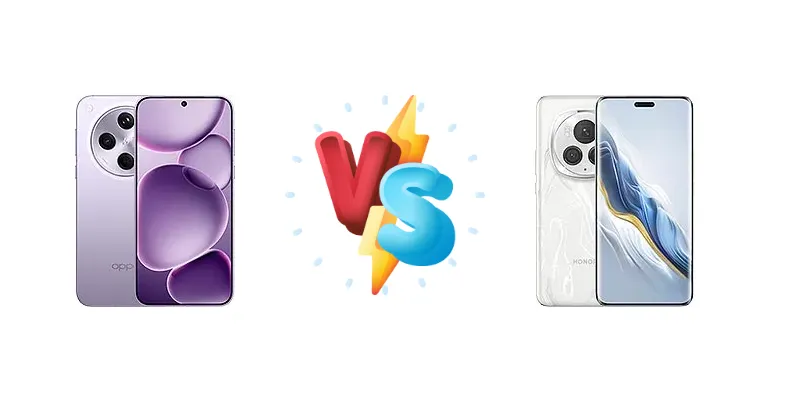
|
🏆 Quick Verdict
For the average user prioritizing sustained performance and battery life, the Honor Magic6 Pro emerges as the winner. Its Snapdragon 8 Gen 3, coupled with a measured 14:06h active use score, provides a more consistent experience. However, the Oppo Find X8s+’s Dimensity 9400+ offers a potential edge in raw CPU power for demanding tasks.
| PHONES | ||
|---|---|---|
| Phone Names | Oppo Find X8s+ | Honor Magic6 Pro |
| Network | ||
|---|---|---|
| 2G bands | GSM 850 / 900 / 1800 / 1900 | GSM 850 / 900 / 1800 / 1900 |
| 3G bands | HSDPA 800 / 850 / 900 / 1700(AWS) / 1900 / 2100 | HSDPA 800 / 850 / 900 / 1700(AWS) / 1900 / 2100 |
| 4G bands | 1, 3, 4, 5, 7, 8, 18, 19, 26, 28, 34, 38, 39, 40, 41, 42, 48, 66 | LTE |
| 5G bands | 1, 3, 5, 7, 8, 26, 28, 38, 40, 41, 48, 66, 77, 78 SA/NSA | SA/NSA |
| Speed | HSPA, LTE, 5G | HSPA, LTE, 5G |
| Technology | GSM / HSPA / LTE / 5G | GSM / CDMA / HSPA / CDMA2000 / LTE / 5G |
| Launch | ||
|---|---|---|
| Announced | 2025, April 10 | 2024, January 11 |
| Status | Available. Released 2025, April 16 | Available. Released 2024, January 18 |
| Body | ||
|---|---|---|
| Build | Glass front, glass back, aluminum frame | Glass front (NanoCrystal Shield), glass back or silicone polymer back (eco leather) |
| Dimensions | 157.5 x 74.5 x 8 mm (6.20 x 2.93 x 0.31 in) | 162.5 x 75.8 x 8.9 mm (6.40 x 2.98 x 0.35 in) |
| SIM | Nano-SIM + Nano-SIM | · Nano-SIM + eSIM· Nano-SIM + Nano-SIM |
| Weight | 198 g (6.98 oz) | 225 g or 229 g (7.94 oz) |
| Display | ||
|---|---|---|
| Protection | - | NanoCrystal Shield |
| Resolution | 1256 x 2760 pixels (~460 ppi density) | 1280 x 2800 pixels, 19.5:9 ratio (~453 ppi density) |
| Size | 6.59 inches, 105.6 cm2 (~90.0% screen-to-body ratio) | 6.8 inches, 112.8 cm2 (~91.6% screen-to-body ratio) |
| Type | AMOLED, 1B colors, 120Hz, 2160Hz PWM, Dolby Vision, HDR Vivid, HDR10+, 800 nits (typ), 1600 nits (HBM) | LTPO OLED, 1B colors, 120Hz, Dolby Vision, HDR, 1600 nits (HBM), 5000 nits (peak) |
| Platform | ||
|---|---|---|
| CPU | Octa-core (1x3.73 GHz Cortex-X925 & 3x3.3 GHz Cortex-X4 & 4x2.4 GHz Cortex-A720) | Octa-core (1x3.3 GHz Cortex-X4 & 3x3.2 GHz Cortex-A720 & 2x3.0 GHz Cortex-A720 & 2x2.3 GHz Cortex-A520) |
| Chipset | Mediatek Dimensity 9400+ (3 nm) | Qualcomm SM8650-AB Snapdragon 8 Gen 3 (4 nm) |
| GPU | Immortalis-G925 MC12 | Adreno 750 |
| OS | Android 15, ColorOS 15 | Android 14, up to 4 major Android upgrades, MagicOS 8 |
| Memory | ||
|---|---|---|
| Card slot | No | No |
| Internal | 256GB 12GB RAM, 512GB 12GB RAM, 512GB 16GB RAM, 1TB 16GB RAM | 256GB 12GB RAM, 256GB 16GB RAM, 512GB 12GB RAM, 512GB 16GB RAM, 1TB 16GB RAM |
| Main Camera | ||
|---|---|---|
| Features | Laser AF, color spectrum sensor, Hasselblad Color Calibration, LED flash, HDR, panorama | Laser AF, color spectrum sensor, LED flash, HDR, panorama |
| Triple | 50 MP, f/1.8, 24mm (wide), 1/1.56", 1.0µm, multi-directional PDAF, OIS 50 MP, f/2.6, 73mm (periscope telephoto), 1/1.95", 0.61µm, 3x optical zoom, multi-directional PDAF, OIS 50 MP, f/2.0, 15mm, 120˚ (ultrawide), 1/2.75", 0.64µm, multi-directional PDAF | 50 MP, f/1.4-2.0, 23mm (wide), 1/1.3", 1.2µm, PDAF, OIS 180 MP, f/2.6, (periscope telephoto), 1/1.49", 0.56µm, PDAF, OIS, 2.5x optical zoom 50 MP, f/2.0, 13mm, 122˚ (ultrawide), 1/2.88", 0.61µm, AF |
| Video | 4K@30/60fps, 1080p@30/60/240fps; gyro-EIS; HDR, 10‑bit video, Dolby Vision | 4K@24/30/60fps, 1080p@30/60/120/240fps, gyro-EIS, OIS, HDR, 10-bit video |
| Selfie camera | ||
|---|---|---|
| Features | Panorama, HDR | - |
| Single | 32 MP, f/2.4, 21mm (wide), 1/2.74", 0.8µm, AF | 50 MP, f/2.0, 22mm (wide), 1/2.93", 0.6µm, AF TOF 3D, (depth/biometrics sensor) |
| Video | 4K@30/60fps, 1080p@30/60fps, gyro-EIS | 4K@30fps, 1080p@30/60fps, gyro-EIS |
| Sound | ||
|---|---|---|
| 35mm jack | No | No |
| Loudspeaker | Yes, with stereo speakers | Yes, with stereo speakers |
| Comms | ||
|---|---|---|
| Bluetooth | 5.4, A2DP, LE, aptX HD, LHDC 5 | 5.3, A2DP, LE, aptX HD |
| Infrared port | Yes | Yes |
| NFC | Yes | Yes |
| Positioning | GPS (L1+L5), BDS (B1I+B1c+B2a+B2b), GALILEO (E1+E5a+E5b), QZSS (L1+L5), GLONASS, NavIC (L5) | GPS (L1+L5), GLONASS, BDS (B1I+B1c+B2a), GALILEO (E1+E5a) |
| Radio | No | No |
| USB | USB Type-C 2.0, OTG | USB Type-C 3.2, DisplayPort 1.2, OTG |
| WLAN | Wi-Fi 802.11 a/b/g/n/ac/6/7, dual-band, Wi-Fi Direct | Wi-Fi 802.11 a/b/g/n/ac/6/7, dual-band, Wi-Fi Direct |
| Features | ||
|---|---|---|
| Sensors | Fingerprint (under display, optical), accelerometer, gyro, proximity, compass | Fingerprint (under display, optical), Face ID, accelerometer, gyro, proximity, compass |
| Battery | ||
|---|---|---|
| Charging | 80W wired, 12W PD, 33W PPS 50W wireless 10W reverse wireless | 80W wired 66W wireless Reverse wireless 5W reverse wired |
| Type | Si/C Li-Ion 6000 mAh | Si/C Li-Ion 5600 mAh |
| Misc | ||
|---|---|---|
| Colors | Black, White, Purple | Black, Green, Blue, Purple, White |
| Models | PLB110 | BVL-AN16, BVL-N49 |
| Price | - | € 455.54 / $ 899.00 / £ 598.99 |
Oppo Find X8s+
- Potentially higher single-core CPU performance with Dimensity 9400+
- Faster reverse wireless charging (10W vs 5W)
- Cutting-edge Mediatek chipset
- Battery life is currently unknown and potentially lower than the Honor
- Wireless charging speed is slower than the Honor
Honor Magic6 Pro
- Exceptional battery life (14:06h active use)
- Brighter display (1578 nits)
- More thermally efficient Snapdragon 8 Gen 3
- Slower reverse wireless charging
- Potentially lower peak CPU performance compared to the Oppo
Display Comparison
The Honor Magic6 Pro boasts a significantly brighter display, reaching a measured 1578 nits peak brightness, making it far more usable in direct sunlight compared to the Oppo Find X8s+ (brightness data unavailable). While both likely employ LTPO technology for adaptive refresh rates, the Honor’s higher peak brightness is a clear advantage. The Oppo’s display specs are currently unknown, but the Honor’s panel is a standout feature, offering excellent visibility and color vibrancy. Bezels are expected to be minimal on both devices, aligning with current flagship trends.
Camera Comparison
Camera details are limited, but the focus should be on the main sensors and image processing. Without specific sensor sizes or aperture information, it’s difficult to make a definitive judgment. However, the presence of OIS (Optical Image Stabilization) is expected on both devices. The image processing style will likely differ – Oppo often leans towards vibrant, saturated colors, while Honor tends towards a more natural look. The usefulness of any secondary cameras (ultrawide, telephoto) will depend on their quality and features, but a 2MP macro lens on either device is unlikely to provide significant value.
Performance
The core difference lies in the chipsets. The Oppo Find X8s+ utilizes the Mediatek Dimensity 9400+ (3nm), featuring a unique CPU configuration with a Cortex-X925 prime core clocked at 3.73 GHz, alongside three Cortex-X4 cores at 3.3 GHz and four Cortex-A720 cores at 2.4 GHz. The Honor Magic6 Pro employs the Qualcomm Snapdragon 8 Gen 3 (4nm) with a Cortex-X4 prime core at 3.3 GHz, three Cortex-A720 cores at 3.2 GHz, two Cortex-A720 cores at 3.0 GHz, and two Cortex-A520 cores at 2.3 GHz. The Dimensity 9400+’s higher clock speed on the X925 suggests potential single-core performance gains, but the Snapdragon 8 Gen 3’s 4nm process offers superior thermal efficiency, potentially leading to less throttling under sustained load. Both devices will likely feature LPDDR5x RAM, but the specific speed is unknown.
Battery Life
The Honor Magic6 Pro demonstrates a clear advantage in battery life, achieving a remarkable 14:06h active use score. While the Oppo Find X8s+’s battery capacity is unknown, the Honor’s endurance is a significant selling point. Charging speeds are competitive, with both supporting 80W wired charging. The Honor also offers 66W wireless charging, significantly faster than the Oppo’s 50W wireless charging. Both devices include reverse wireless charging, but the Honor’s 5W output is lower than the Oppo’s 10W.
Buying Guide
Buy the Oppo Find X8s+ if you are a power user who frequently engages in CPU-intensive tasks like video editing or complex simulations and want to explore the latest in Mediatek silicon. Buy the Honor Magic6 Pro if you prioritize all-day battery life, consistent gaming performance, and a brighter, more visible display, especially in outdoor conditions. The Magic6 Pro is the safer bet for a smooth, reliable experience.