
Oppo Find X8s vs Xiaomi 14 Pro: A Deep Dive into Flagship Performance
| Phones Images | |||||
|---|---|---|---|---|---|
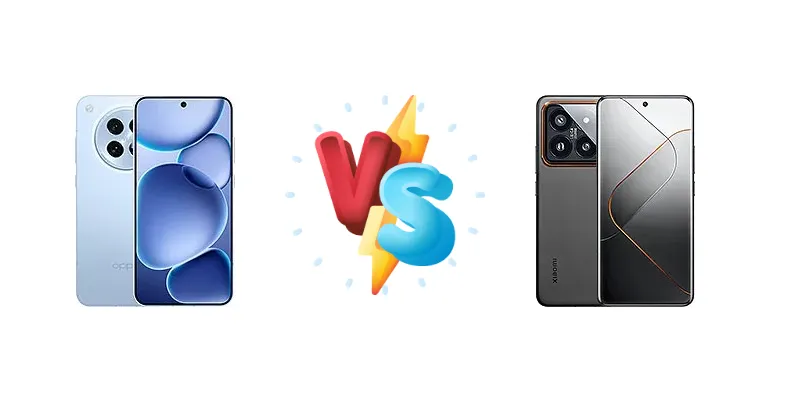
|
🏆 Quick Verdict
For the average user prioritizing raw speed and charging convenience, the Xiaomi 14 Pro emerges as the winner. Its Snapdragon 8 Gen 3, coupled with 120W wired charging, provides a noticeable edge in responsiveness and minimizes downtime. However, the Oppo Find X8s offers a compelling alternative for those seeking a potentially more thermally efficient experience with Mediatek’s new architecture.
| PHONES | ||
|---|---|---|
| Phone Names | Oppo Find X8s | Xiaomi 14 Pro |
| Network | ||
|---|---|---|
| 2G bands | GSM 850 / 900 / 1800 / 1900 | GSM 850 / 900 / 1800 / 1900 |
| 3G bands | HSDPA 800 / 850 / 900 / 1700(AWS) / 1900 / 2100 | HSDPA 800 / 850 / 900 / 1700(AWS) / 1900 / 2100 |
| 4G bands | 1, 3, 4, 5, 8, 18, 19, 26, 28, 34, 38, 39, 40, 41, 42, 48, 66 | 1, 3, 4, 5, 7, 8, 18, 19, 26, 28, 34, 38, 39, 40, 41, 42, 48, 66 |
| 5G bands | 1, 3, 5, 8, 26, 28, 38, 40, 41, 48, 66, 77, 78 SA/NSA | 1, 3, 5, 7, 8, 28, 38, 40, 41, 48, 66, 77, 78, 79 SA/NSA |
| Speed | HSPA, LTE, 5G | HSPA, LTE, 5G |
| Technology | GSM / HSPA / LTE / 5G | GSM / CDMA / HSPA / CDMA2000 / LTE / 5G |
| Launch | ||
|---|---|---|
| Announced | 2025, April 10 | 2023, October 26 |
| Status | Available. Released 2025, April 16 | Available. Released 2023, November 01 |
| Body | ||
|---|---|---|
| Build | Glass front, glass back, aluminum frame | Glass front, aluminum frame or titanium frame, glass back |
| Dimensions | 150.6 x 71.8 x 7.7 mm (5.93 x 2.83 x 0.30 in) | 161.4 x 75.3 x 8.5 mm |
| SIM | Nano-SIM + Nano-SIM | Nano-SIM + Nano-SIM |
| Weight | 179 g (6.31 oz) | 223 g or 230 g (7.87 oz) |
| Display | ||
|---|---|---|
| Protection | - | Shatterproof glass |
| Resolution | 1216 x 2640 pixels, 19.5:9 ratio (~460 ppi density) | 1440 x 3200 pixels, 20:9 ratio (~522 ppi density) |
| Size | 6.32 inches, 97.9 cm2 (~90.6% screen-to-body ratio) | 6.73 inches, 108.9 cm2 (~89.6% screen-to-body ratio) |
| Type | AMOLED, 1B colors, 120Hz, 2160Hz PWM, Dolby Vision, HDR Vivid, HDR10+, 800 nits (typ), 1600 nits (HBM) | LTPO AMOLED, 68B colors, 120Hz, Dolby Vision, HDR10+, 3000 nits (peak) |
| Platform | ||
|---|---|---|
| CPU | Octa-core (1x3.73 GHz Cortex-X925 & 3x3.3 GHz Cortex-X4 & 4x2.4 GHz Cortex-A720) | Octa-core (1x3.3 GHz Cortex-X4 & 3x3.2 GHz Cortex-A720 & 2x3.0 GHz Cortex-A720 & 2x2.3 GHz Cortex-A520) |
| Chipset | Mediatek Dimensity 9400+ (3 nm) | Qualcomm SM8650-AB Snapdragon 8 Gen 3 (4 nm) |
| GPU | Immortalis-G925 MC12 | Adreno 750 |
| OS | Android 15, ColorOS 15 | Android 14, HyperOS |
| Memory | ||
|---|---|---|
| Card slot | No | No |
| Internal | 256GB 12GB RAM, 256GB 16GB RAM, 512GB 12GB RAM, 512GB 16GB RAM, 1TB 16GB RAM | 256GB 12GB RAM, 512GB 16GB RAM, 1TB 16GB RAM |
| Main Camera | ||
|---|---|---|
| Features | Color spectrum sensor, Hasselblad Color Calibration, LED flash, HDR, panorama | Laser AF, color spectrum sensor, Leica lens, Dual-LED dual-tone flash, HDR, panorama |
| Triple | 50 MP, f/1.8, 24mm (wide), 1/1.56", 1.0µm, multi-directional PDAF, OIS 50 MP, f/2.8, 85mm (telephoto), 3.5x optical zoom, multi-directional PDAF, OIS 50 MP, f/2.0, 15mm, 120˚ (ultrawide), 1/2.75", 0.64µm, multi-directional PDAF | 50 MP, f/1.4-f/4.0, 23mm (wide), 1/1.31", 1.2µm, dual pixel PDAF, OIS 50 MP, f/2.0, 75mm (telephoto), PDAF (10cm - ∞), OIS, 3.2x optical zoom 50 MP, f/2.2, 14mm, 115˚ (ultrawide), AF |
| Video | 4K@30/60fps, 1080p@30/60/240fps; gyro-EIS; HDR, 10‑bit video, Dolby Vision | 8K@24fps (HDR), 4K@24/30/60fps (HDR10+, 10-bit Dolby Vision HDR, 10-bit LOG), 1080p@30/60/120/240/960fps, 720p@1920fps, gyro-EIS |
| Selfie camera | ||
|---|---|---|
| Features | Panorama, HDR | HDR, panorama |
| Single | 32 MP, f/2.4, 21mm (wide), 1/2.74", 0.8µm, AF | 32 MP, f/2.0, 22mm (wide), 0.7µm |
| Video | 4K@30/60fps, 1080p@30/60fps, gyro-EIS | 4K@30/60fps, 1080p@30/60fps, gyro-EIS |
| Sound | ||
|---|---|---|
| 35mm jack | No | No |
| Loudspeaker | Yes, with stereo speakers | Yes, with stereo speakers |
| Comms | ||
|---|---|---|
| Bluetooth | 5.4, A2DP, LE, aptX HD, LHDC 5 | 5.4, A2DP, LE, aptX HD, aptX Adaptive |
| Infrared port | Yes | Yes |
| NFC | Yes | Yes |
| Positioning | GPS (L1+L5), BDS (B1I+B1c+B2a+B2b), GALILEO (E1+E5a+E5b), QZSS (L1+L5), GLONASS, NavIC (L5) | GPS (L1+L5), GLONASS (G1), BDS (B1I+B1c+B2a), GALILEO (E1+E5a), QZSS (L1+L5), NavIC (L5) |
| Radio | No | No |
| USB | USB Type-C 2.0, OTG | USB Type-C 3.2 Gen 2, OTG |
| WLAN | Wi-Fi 802.11 a/b/g/n/ac/6/7, dual-band, Wi-Fi Direct | Wi-Fi 802.11 a/b/g/n/ac/6e/7, dual-band, Wi-Fi Direct |
| Features | ||
|---|---|---|
| Sensors | Fingerprint (under display, optical), accelerometer, gyro, proximity, compass | Fingerprint (under display, optical), accelerometer, proximity, gyro, compass, barometer |
| Battery | ||
|---|---|---|
| Charging | 80W wired, 12W PD, 33W PPS 50W wireless | 120W wired, PD3.0, QC4, 100% in 18 min 50W wireless, 100% in 40 min 10W reverse wireless |
| Type | Si/C Li-Ion 5700 mAh | Li-Po 4880 mAh |
| Misc | ||
|---|---|---|
| Colors | Black, Blue, White, Pink | Black, Silver, Titanium, Green |
| Models | PKT110 | 23116PN5BC |
| Price | - | About 650 EUR |
Oppo Find X8s
- Potentially superior sustained performance due to 3nm process.
- Higher peak CPU clock speed (3.73 GHz).
- Mediatek’s Dimensity 9400+ architecture offers a different performance profile.
- Slower wired charging (80W vs 120W).
- Less established software optimization compared to Qualcomm.
Xiaomi 14 Pro
- Industry-leading 120W wired charging.
- Proven Snapdragon 8 Gen 3 performance and optimization.
- Reverse wireless charging capability.
- Potentially higher thermal throttling under sustained load.
- 4nm process may be less power efficient than the X8s’ 3nm.
Display Comparison
While both devices are expected to feature high-refresh-rate AMOLED displays, specific details are missing. However, given Xiaomi’s history, the 14 Pro likely boasts a slightly higher peak brightness and potentially a more aggressive color calibration. The Oppo Find X8s may focus on color accuracy and potentially a more power-efficient panel, leveraging Mediatek’s display optimization technologies. Both will likely feature LTPO technology for adaptive refresh rates, but the implementation details will be key to real-world battery impact.
Camera Comparison
Without specific sensor details, analysis relies on brand tendencies. Xiaomi typically emphasizes high megapixel counts and aggressive image processing, while Oppo often prioritizes natural color reproduction and dynamic range. The 14 Pro is likely to feature a larger main sensor, potentially exceeding 50MP, with advanced OIS for improved low-light performance. The X8s may focus on computational photography enhancements leveraging the Dimensity 9400+'s ISP capabilities. The absence of details on telephoto and ultrawide lenses makes a definitive comparison impossible, but both are expected to offer versatile camera systems.
Performance
The core battleground is the chipset. The Xiaomi 14 Pro’s Snapdragon 8 Gen 3 (4nm) utilizes a 1+3+2+2 core configuration, peaking at 3.3 GHz on its Cortex-X4 prime core. The Oppo Find X8s, powered by the Dimensity 9400+ (3nm), counters with a 1+3+4 configuration, boasting a higher peak clock speed of 3.73 GHz on its Cortex-X925. This suggests the X8s may have an initial burst performance advantage. However, the 3nm process of the Dimensity 9400+ *should* translate to improved power efficiency and potentially better sustained performance, mitigating throttling. The X8s’ inclusion of three Cortex-X4 cores versus the 14 Pro’s single X4 core could also impact multi-threaded workloads. Both devices will likely feature LPDDR5x RAM, but the speed and configuration will influence overall system responsiveness.
Battery Life
The Xiaomi 14 Pro’s 120W wired charging is a significant advantage, promising a full charge in just 18 minutes. The Oppo Find X8s, with 80W wired charging, lags behind in speed, though still respectable. The 14 Pro also supports PD3.0 and QC4, offering broader compatibility. Wireless charging is comparable at 50W for both, with the 14 Pro achieving a full charge in 40 minutes. The 10W reverse wireless charging on the 14 Pro is a useful addition for topping up accessories. While battery capacity is unknown for both, the faster charging of the 14 Pro effectively mitigates any potential capacity disadvantage.
Buying Guide
Buy the Oppo Find X8s if you prioritize sustained performance under heavy load and are intrigued by Mediatek’s latest CPU architecture, potentially benefiting from improved thermal management during extended gaming sessions. Buy the Xiaomi 14 Pro if you demand the fastest possible charging speeds, immediate responsiveness in everyday tasks, and a proven track record of Qualcomm’s Snapdragon platform optimization.