
Oppo Find X8s vs Huawei Mate 60 Pro+: A Deep Dive into Flagship Performance
| Phones Images | |||||
|---|---|---|---|---|---|
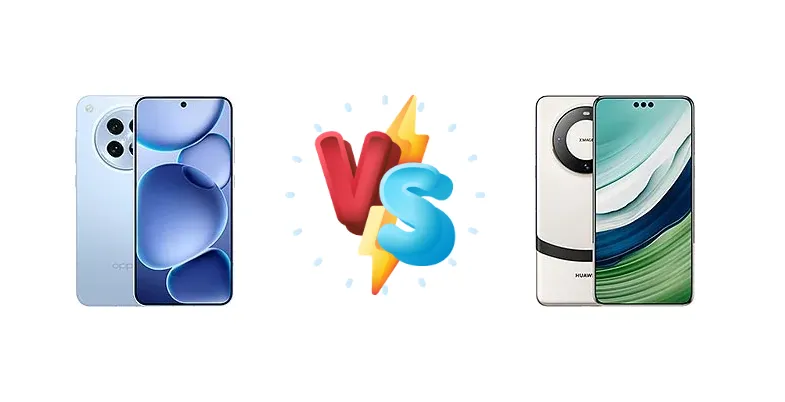
|
🏆 Quick Verdict
For the average user prioritizing peak performance and future-proofing, the Oppo Find X8s emerges as the winner. Its 3nm Dimensity 9400+ chipset offers a significant architectural advantage over the 7nm Kirin 9000S, translating to faster speeds and potentially better efficiency. However, the Mate 60 Pro+’s robust charging and unique ecosystem appeal to a specific audience.
| PHONES | ||
|---|---|---|
| Phone Names | Oppo Find X8s | Huawei Mate 60 Pro+ |
| Network | ||
|---|---|---|
| 2G bands | GSM 850 / 900 / 1800 / 1900 | GSM 850 / 900 / 1800 / 1900 |
| 3G bands | HSDPA 800 / 850 / 900 / 1700(AWS) / 1900 / 2100 | HSDPA 800 / 850 / 900 / 1700(AWS) / 1900 / 2100 |
| 4G bands | 1, 3, 4, 5, 8, 18, 19, 26, 28, 34, 38, 39, 40, 41, 42, 48, 66 | LTE |
| 5G bands | 1, 3, 5, 8, 26, 28, 38, 40, 41, 48, 66, 77, 78 SA/NSA | SA/NSA |
| Speed | HSPA, LTE, 5G | HSPA, LTE, 5G |
| Technology | GSM / HSPA / LTE / 5G | GSM / CDMA / HSPA / CDMA2000 / LTE / 5G |
| Launch | ||
|---|---|---|
| Announced | 2025, April 10 | 2023, September 08 |
| Status | Available. Released 2025, April 16 | Available. Released 2023, September 27 |
| Body | ||
|---|---|---|
| Build | Glass front, glass back, aluminum frame | Glass front, aluminum frame, glass back |
| Dimensions | 150.6 x 71.8 x 7.7 mm (5.93 x 2.83 x 0.30 in) | 163.7 x 79 x 8.1 mm (6.44 x 3.11 x 0.32 in) |
| SIM | Nano-SIM + Nano-SIM | Nano-SIM + Nano-SIM |
| Weight | 179 g (6.31 oz) | 225 g (7.94 oz) |
| Display | ||
|---|---|---|
| Protection | - | Huawei Kunlun Glass 2 |
| Resolution | 1216 x 2640 pixels, 19.5:9 ratio (~460 ppi density) | 1260 x 2720 pixels, 19.5:9 ratio (~440 ppi density) |
| Size | 6.32 inches, 97.9 cm2 (~90.6% screen-to-body ratio) | 6.82 inches, 114.4 cm2 (~88.5% screen-to-body ratio) |
| Type | AMOLED, 1B colors, 120Hz, 2160Hz PWM, Dolby Vision, HDR Vivid, HDR10+, 800 nits (typ), 1600 nits (HBM) | LTPO OLED, 1B colors, 120Hz |
| Platform | ||
|---|---|---|
| CPU | Octa-core (1x3.73 GHz Cortex-X925 & 3x3.3 GHz Cortex-X4 & 4x2.4 GHz Cortex-A720) | Octa-core (1x2.62 GHz Taishan Big & 3x2.15 GHz Taishan Mid & 4x1.53GHz Cortex-A510) |
| Chipset | Mediatek Dimensity 9400+ (3 nm) | Kirin 9000S (7 nm) |
| GPU | Immortalis-G925 MC12 | Maleoon 910 MP4 |
| OS | Android 15, ColorOS 15 | HarmonyOS 4.0 (China) |
| Memory | ||
|---|---|---|
| Card slot | No | Nano Memory (uses shared SIM slot) |
| Internal | 256GB 12GB RAM, 256GB 16GB RAM, 512GB 12GB RAM, 512GB 16GB RAM, 1TB 16GB RAM | 512GB 16GB RAM, 1TB 16GB RAM |
| Main Camera | ||
|---|---|---|
| Features | Color spectrum sensor, Hasselblad Color Calibration, LED flash, HDR, panorama | Laser AF, color spectrum sensor, LED flash, panorama, HDR |
| Triple | 50 MP, f/1.8, 24mm (wide), 1/1.56", 1.0µm, multi-directional PDAF, OIS 50 MP, f/2.8, 85mm (telephoto), 3.5x optical zoom, multi-directional PDAF, OIS 50 MP, f/2.0, 15mm, 120˚ (ultrawide), 1/2.75", 0.64µm, multi-directional PDAF | 48 MP, f/1.4-f/4.0, 24mm (wide), PDAF, OIS 48 MP, f/3.0, 90mm (periscope telephoto), PDAF, OIS, 3.5x optical zoom 40 MP, f/2.2, 13mm, 120˚ (ultrawide), PDAF |
| Video | 4K@30/60fps, 1080p@30/60/240fps; gyro-EIS; HDR, 10‑bit video, Dolby Vision | 4K, 1080p, HDR, gyro-EIS, OIS |
| Selfie camera | ||
|---|---|---|
| Features | Panorama, HDR | HDR, panorama |
| Single | 32 MP, f/2.4, 21mm (wide), 1/2.74", 0.8µm, AF | 13 MP, f/2.4, 18mm (ultrawide) TOF 3D, (depth/biometrics sensor) |
| Video | 4K@30/60fps, 1080p@30/60fps, gyro-EIS | 4K, 1080p, HDR, gyro-EIS |
| Sound | ||
|---|---|---|
| 35mm jack | No | No |
| Loudspeaker | Yes, with stereo speakers | Yes, with stereo speakers |
| Comms | ||
|---|---|---|
| Bluetooth | 5.4, A2DP, LE, aptX HD, LHDC 5 | 5.2, A2DP, LE |
| Infrared port | Yes | Yes |
| NFC | Yes | Yes |
| Positioning | GPS (L1+L5), BDS (B1I+B1c+B2a+B2b), GALILEO (E1+E5a+E5b), QZSS (L1+L5), GLONASS, NavIC (L5) | GPS (L1+L5), GLONASS (L1), BDS (B1I+B1c+B2a+B2b), GALILEO (E1+E5a+E5b), QZSS (L1+L5), NavIC (L5) |
| Radio | No | No |
| USB | USB Type-C 2.0, OTG | USB Type-C 3.1, OTG, DisplayPort 1.2 |
| WLAN | Wi-Fi 802.11 a/b/g/n/ac/6/7, dual-band, Wi-Fi Direct | Wi-Fi 802.11 a/b/g/n/ac/6, dual-band, Wi-Fi Direct |
| Features | ||
|---|---|---|
| Sensors | Fingerprint (under display, optical), accelerometer, gyro, proximity, compass | Face ID, fingerprint (under display, optical), accelerometer, gyro, proximity, barometer, compass |
| Battery | ||
|---|---|---|
| Charging | 80W wired, 12W PD, 33W PPS 50W wireless | 88W wired, 100% in 30 min 50W wireless 20W reverse wireless |
| Type | Si/C Li-Ion 5700 mAh | Li-Po 5000 mAh |
| Misc | ||
|---|---|---|
| Colors | Black, Blue, White, Pink | Black, Light Gold |
| Models | PKT110 | ALN-AL10 |
Oppo Find X8s
- Superior chipset performance with Dimensity 9400+
- More efficient 3nm process node
- Versatile wireless charging options (PD/PPS)
- Potentially less refined camera processing compared to Huawei
- Brand recognition may be lower than Huawei in some markets
Huawei Mate 60 Pro+
- Faster wired charging (88W)
- Robust Huawei ecosystem and software features
- Strong reputation for computational photography
- Older 7nm chipset architecture
- Potential software limitations due to geopolitical factors
- Less power efficient chipset
Display Comparison
While specific display details are absent, both phones are expected to feature high-refresh-rate OLED panels. However, the chipset difference indirectly impacts display performance. The Dimensity 9400+'s superior GPU will drive smoother visuals in graphically intensive applications. The Kirin 9000S, being a 7nm chip, may exhibit slightly higher power consumption when rendering complex scenes, potentially impacting battery life during extended use. Expect both to offer excellent color accuracy, but the Find X8s’ more powerful processing could enable more advanced display calibration features.
Camera Comparison
Without detailed camera specs, we can infer differences based on brand tendencies. Huawei historically excels in computational photography, leveraging its image signal processing (ISP) to produce vibrant, detailed images. The Mate 60 Pro+ likely prioritizes scene recognition and AI-powered enhancements. Oppo, while also strong in camera technology, often leans towards a more natural color profile. The chipset’s ISP capabilities play a crucial role here; the Dimensity 9400+’s newer ISP is likely to offer faster processing speeds and more advanced features like improved HDR and low-light performance. Sensor size and lens apertures will be key differentiators, but without that data, it’s difficult to definitively declare a winner.
Performance
The core of the difference lies in the chipsets. The Oppo Find X8s’ Mediatek Dimensity 9400+ (3nm) boasts a cutting-edge CPU configuration: 1x3.73 GHz Cortex-X925, 3x3.3 GHz Cortex-X4, and 4x2.4 GHz Cortex-A720. This contrasts sharply with the Huawei Mate 60 Pro+’s Kirin 9000S (7nm) with its 1x2.62 GHz Taishan Big, 3x2.15 GHz Taishan Mid, and 4x1.53GHz Cortex-A510. The 3nm process node of the Dimensity 9400+ provides a significant advantage in transistor density and power efficiency, leading to higher clock speeds and improved sustained performance. The Cortex-X925 core in the Find X8s is a newer generation than the Taishan cores in the Mate 60 Pro+, promising architectural improvements in instruction processing. This translates to faster app launch times, smoother multitasking, and superior gaming performance for the Oppo device.
Battery Life
The Huawei Mate 60 Pro+ boasts an 88W wired charging capability, claiming a full charge in 30 minutes, alongside 50W wireless and 20W reverse wireless. The Oppo Find X8s offers 80W wired, 12W PD, 33W PPS, and 50W wireless. While the Mate 60 Pro+ has a slight edge in wired charging speed, the Find X8s offers more versatile wireless charging options with PD and PPS support. The Dimensity 9400+'s superior power efficiency could offset the Mate 60 Pro+'s faster charging, potentially resulting in comparable real-world battery life despite any potential mAh differences.
Buying Guide
Buy the Oppo Find X8s if you need uncompromising performance for gaming, demanding applications, and long-term software support. Its modern chipset architecture and faster charging capabilities make it ideal for power users. Buy the Huawei Mate 60 Pro+ if you prefer a self-contained ecosystem, prioritize fast wired charging, and value the unique features and brand identity that Huawei offers, even with potential software limitations.