
Oppo Find X8s vs Google Pixel 8 Pro: A Deep Dive into Flagship Android
| Phones Images | |||||
|---|---|---|---|---|---|
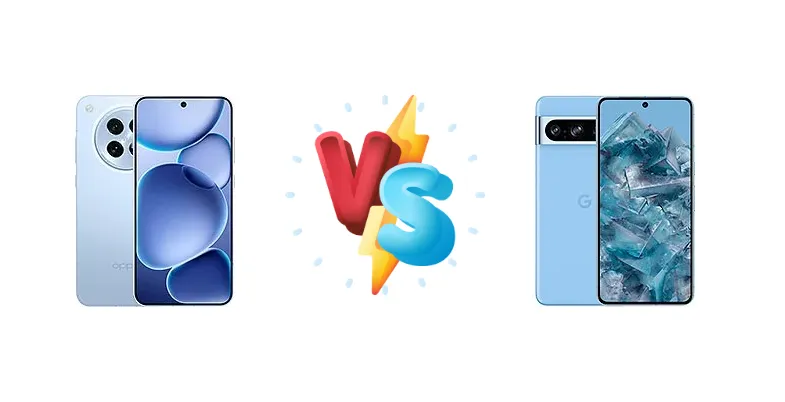
|
🏆 Quick Verdict
For users prioritizing raw processing power and blazing-fast charging, the Oppo Find X8s is the clear winner. However, the Google Pixel 8 Pro’s superior camera system, refined software experience, and longer battery endurance make it the more compelling choice for the average user.
| PHONES | ||
|---|---|---|
| Phone Names | Oppo Find X8s | Google Pixel 8 Pro |
| Network | ||
|---|---|---|
| 2G bands | GSM 850 / 900 / 1800 / 1900 | GSM 850 / 900 / 1800 / 1900 |
| 3G bands | HSDPA 800 / 850 / 900 / 1700(AWS) / 1900 / 2100 | HSDPA 800 / 850 / 900 / 1700(AWS) / 1900 / 2100 |
| 4G bands | 1, 3, 4, 5, 8, 18, 19, 26, 28, 34, 38, 39, 40, 41, 42, 48, 66 | 1, 2, 3, 4, 5, 7, 8, 12, 13, 14, 17, 18, 19, 20, 25, 26, 28, 29, 30, 38, 39, 40, 41, 46, 48, 66, 71 - G1MNW |
| 5G bands | 1, 3, 5, 8, 26, 28, 38, 40, 41, 48, 66, 77, 78 SA/NSA | 1, 2, 3, 5, 7, 8, 12, 20, 25, 26, 28, 29, 30, 38, 40, 41, 48, 66, 70, 71, 77, 78, 257, 258, 260, 261 SA/NSA/Sub6/mmWave - G1MNW |
| Speed | HSPA, LTE, 5G | HSPA, LTE, 5G |
| Technology | GSM / HSPA / LTE / 5G | GSM / HSPA / LTE / 5G |
| Launch | ||
|---|---|---|
| Announced | 2025, April 10 | 2023, October 04 |
| Status | Available. Released 2025, April 16 | Available. Released 2023, October 12 |
| Body | ||
|---|---|---|
| Build | Glass front, glass back, aluminum frame | Glass front (Gorilla Glass Victus 2), glass back (Gorilla Glass Victus 2), aluminum frame |
| Dimensions | 150.6 x 71.8 x 7.7 mm (5.93 x 2.83 x 0.30 in) | 162.6 x 76.5 x 8.8 mm (6.40 x 3.01 x 0.35 in) |
| SIM | Nano-SIM + Nano-SIM | Nano-SIM + eSIM |
| Weight | 179 g (6.31 oz) | 213 g (7.51 oz) |
| Display | ||
|---|---|---|
| Protection | - | Corning Gorilla Glass Victus 2 |
| Resolution | 1216 x 2640 pixels, 19.5:9 ratio (~460 ppi density) | 1344 x 2992 pixels, 20:9 ratio (~489 ppi density) |
| Size | 6.32 inches, 97.9 cm2 (~90.6% screen-to-body ratio) | 6.7 inches, 108.7 cm2 (~87.4% screen-to-body ratio) |
| Type | AMOLED, 1B colors, 120Hz, 2160Hz PWM, Dolby Vision, HDR Vivid, HDR10+, 800 nits (typ), 1600 nits (HBM) | LTPO OLED, 120Hz, HDR10+, 1600 nits (HBM), 2400 nits (peak) |
| Platform | ||
|---|---|---|
| CPU | Octa-core (1x3.73 GHz Cortex-X925 & 3x3.3 GHz Cortex-X4 & 4x2.4 GHz Cortex-A720) | Nona-core (1x3.0 GHz Cortex-X3 & 4x2.45 GHz Cortex-A715 & 4x2.15 GHz Cortex-A510) |
| Chipset | Mediatek Dimensity 9400+ (3 nm) | Google Tensor G3 (4 nm) |
| GPU | Immortalis-G925 MC12 | Immortalis-G715s MC10 |
| OS | Android 15, ColorOS 15 | Android 14, upgradable to Android 16, up to 7 major Android upgrades |
| Memory | ||
|---|---|---|
| Card slot | No | No |
| Internal | 256GB 12GB RAM, 256GB 16GB RAM, 512GB 12GB RAM, 512GB 16GB RAM, 1TB 16GB RAM | 128GB 12GB RAM, 256GB 12GB RAM, 512GB 12GB RAM, 1TB 12GB RAM |
| Main Camera | ||
|---|---|---|
| Features | Color spectrum sensor, Hasselblad Color Calibration, LED flash, HDR, panorama | Multi-zone Laser AF, Dual-LED flash, Pixel Shift, Ultra-HDR, panorama, Best Take, Zoom Enhance |
| Triple | 50 MP, f/1.8, 24mm (wide), 1/1.56", 1.0µm, multi-directional PDAF, OIS 50 MP, f/2.8, 85mm (telephoto), 3.5x optical zoom, multi-directional PDAF, OIS 50 MP, f/2.0, 15mm, 120˚ (ultrawide), 1/2.75", 0.64µm, multi-directional PDAF | 50 MP, f/1.7, 25mm (wide), 1/1.31", 1.2µm, dual pixel PDAF, OIS 48 MP, f/2.8, 113mm (periscope telephoto), 1/2.55", 0.7µm, dual pixel PDAF, OIS, 5x optical zoom 48 MP, f/2.0, 126˚ (ultrawide), 1/2.0", 0.8µm, dual pixel PDAF |
| Video | 4K@30/60fps, 1080p@30/60/240fps; gyro-EIS; HDR, 10‑bit video, Dolby Vision | 4K@30/60fps, 1080p@24/30/60/120/240fps; gyro-EIS, OIS, 10-bit HDR |
| Selfie camera | ||
|---|---|---|
| Features | Panorama, HDR | HDR, panorama |
| Single | 32 MP, f/2.4, 21mm (wide), 1/2.74", 0.8µm, AF | 10.5 MP, f/2.2, 20mm (ultrawide), 1/3.1", 1.22µm, PDAF |
| Video | 4K@30/60fps, 1080p@30/60fps, gyro-EIS | 4K@24/30/60fps, 1080p@30/60fps |
| Sound | ||
|---|---|---|
| 35mm jack | No | No |
| Loudspeaker | Yes, with stereo speakers | Yes, with stereo speakers |
| Comms | ||
|---|---|---|
| Bluetooth | 5.4, A2DP, LE, aptX HD, LHDC 5 | 5.3, A2DP, LE, aptX HD |
| Infrared port | Yes | - |
| NFC | Yes | Yes |
| Positioning | GPS (L1+L5), BDS (B1I+B1c+B2a+B2b), GALILEO (E1+E5a+E5b), QZSS (L1+L5), GLONASS, NavIC (L5) | GPS (L1+L5), GLONASS (G1), GALILEO (E1+E5a), QZSS (L1+L5) |
| Radio | No | No |
| USB | USB Type-C 2.0, OTG | USB Type-C 3.2 |
| WLAN | Wi-Fi 802.11 a/b/g/n/ac/6/7, dual-band, Wi-Fi Direct | Wi-Fi 802.11 a/b/g/n/ac/6e/7, tri-band, Wi-Fi Direct |
| Features | ||
|---|---|---|
| Sensors | Fingerprint (under display, optical), accelerometer, gyro, proximity, compass | Fingerprint (under display, optical), accelerometer, gyro, proximity, compass, barometer, thermometer (skin temperature) |
| Battery | ||
|---|---|---|
| Charging | 80W wired, 12W PD, 33W PPS 50W wireless | 30W wired, PD3.0, PPS, 50% in 30 min 23W wireless Reverse wireless Bypass charging |
| Type | Si/C Li-Ion 5700 mAh | Li-Ion 5050 mAh |
| Misc | ||
|---|---|---|
| Colors | Black, Blue, White, Pink | Obsidian, Porcelain, Bay, Mint |
| Models | PKT110 | GC3VE, G1MNW |
| Price | - | € 362.00 / $ 289.97 / £ 329.95 / ₹ 54,999 |
Oppo Find X8s
- Superior processing power with Dimensity 9400+
- Blazing-fast 80W wired charging
- Potentially better thermal management due to 3nm process
- Battery life data currently unavailable
- Camera performance unproven against Pixel 8 Pro
Google Pixel 8 Pro
- Exceptional camera system with AI enhancements
- Long battery life (11:14h active use, 90h endurance)
- Seamless software experience and guaranteed updates
- Slower charging speeds (30W wired)
- Tensor G3 chip is less powerful than Dimensity 9400+
Display Comparison
The Pixel 8 Pro boasts a measured peak brightness of 1600 nits, ensuring excellent visibility even in direct sunlight. While the Find X8s’ display specifications are currently unknown, Oppo typically employs high-quality AMOLED panels. The Pixel 8 Pro’s LTPO technology allows for a variable refresh rate, optimizing battery life. Without comparable refresh rate data for the Find X8s, the Pixel 8 Pro currently holds an advantage in display efficiency and outdoor visibility.
Camera Comparison
The Pixel 8 Pro is renowned for its computational photography prowess, leveraging Google’s AI algorithms to deliver consistently excellent image quality. While specific sensor details for the Find X8s are unavailable, Oppo has been increasing its focus on camera performance. The Pixel 8 Pro’s image processing excels in dynamic range and low-light conditions. The Find X8s will need to demonstrate a significant hardware advantage (larger sensor, wider aperture) to compete with the Pixel 8 Pro’s software-driven image quality. The Pixel 8 Pro’s video capabilities are also highly regarded, offering cinematic stabilization and advanced editing features.
Performance
The Oppo Find X8s’ Mediatek Dimensity 9400+ (3nm) is architecturally superior to the Google Tensor G3 (4nm). The Dimensity 9400+ features a Cortex-X925 prime core clocked at 3.73 GHz, alongside three Cortex-X4 cores at 3.3 GHz, and four Cortex-A720 efficiency cores. This contrasts with the Pixel 8 Pro’s nona-core setup, which includes a Cortex-X3 at 3.0 GHz. The 3nm process node of the Dimensity 9400+ promises greater power efficiency and thermal headroom, potentially leading to sustained performance advantages in demanding applications. The Pixel 8 Pro relies on Google’s software optimizations to mitigate the Tensor G3’s inherent limitations.
Battery Life
The Google Pixel 8 Pro achieves an impressive 11:14h of active use and an endurance rating of 90 hours, indicating excellent battery life. The Oppo Find X8s, while lacking specific battery endurance data, compensates with significantly faster charging speeds: 80W wired, 50W wireless, compared to the Pixel 8 Pro’s 30W wired and 23W wireless. The Find X8s can reach 50% charge in a shorter timeframe, but the Pixel 8 Pro’s overall endurance provides a more relaxed user experience. The Pixel 8 Pro also offers reverse wireless charging and bypass charging, features absent in the Find X8s.
Buying Guide
Buy the Oppo Find X8s if you demand the absolute fastest Android performance for demanding tasks like gaming and video editing, and if 80W wired charging is a priority. Buy the Google Pixel 8 Pro if you value a consistently excellent camera, seamless software updates, and a more holistic user experience centered around Google’s AI capabilities.