
Oppo Find X8 vs Xiaomi 14 Ultra: A Deep Dive into Flagship Android Power
| Phones Images | |||||
|---|---|---|---|---|---|
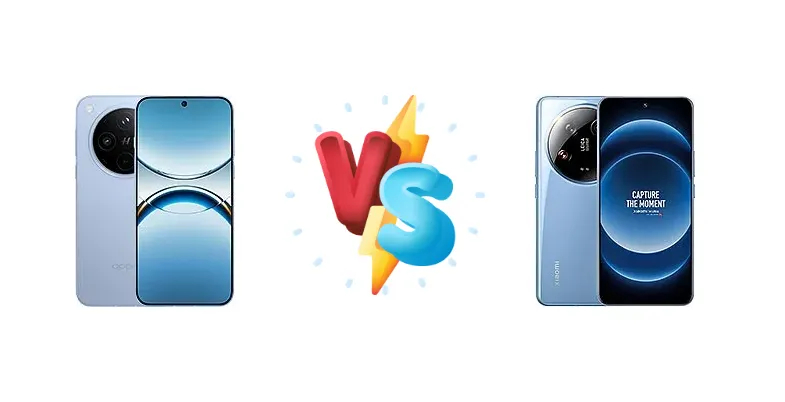
|
🏆 Quick Verdict
For the average user prioritizing sustained performance and battery life, the Oppo Find X8 emerges as the winner. Its Dimensity 9400 chipset and 13:58 active use score provide a noticeable advantage. However, the Xiaomi 14 Ultra’s faster charging and potentially superior camera system make it a compelling alternative for specific needs.
| PHONES | ||
|---|---|---|
| Phone Names | Oppo Find X8 | Xiaomi 14 Ultra |
| Network | ||
|---|---|---|
| 2G bands | GSM 850 / 900 / 1800 / 1900 | GSM 850 / 900 / 1800 / 1900 |
| 3G bands | HSDPA 800 / 850 / 900 / 1700(AWS) / 1900 / 2100 | HSDPA 800 / 850 / 900 / 1700(AWS) / 1900 / 2100 |
| 4G bands | 1, 2, 3, 4, 5, 7, 8, 12, 17, 18, 19, 20, 26, 28, 38, 39, 40, 41, 42, 66 - International | 1, 2, 3, 4, 5, 7, 8, 18, 19, 20, 26, 28, 38, 40, 41, 42, 48, 66 - International |
| 5G bands | 1, 2, 3, 5, 7, 8, 12, 20, 28, 38, 40, 41, 66, 77, 78 SA/NSA - International | 1, 2, 3, 5, 7, 8, 20, 28, 38, 40, 41, 48, 66, 77, 78, 79 SA/NSA - International |
| Speed | HSPA, LTE, 5G | HSPA, LTE, 5G |
| Technology | GSM / HSPA / LTE / 5G | GSM / CDMA / HSPA / EVDO / LTE / 5G |
| Launch | ||
|---|---|---|
| Announced | 2024, October 24 | 2024, February 22 |
| Status | Available. Released 2024, October 30 | Available. Released 2024, February 22 |
| Body | ||
|---|---|---|
| Build | Glass front (Gorilla Glass 7i), glass back (Gorilla Glass 7i), aluminum frame | Glass front (Shield Glass), glass back or silicone polymer back (eco leather), titanium frame (grade 5) or aluminum alloy frame |
| Dimensions | 157.4 x 74.3 x 7.9 mm (6.20 x 2.93 x 0.31 in) | 161.4 x 75.3 x 9.2 mm (6.35 x 2.96 x 0.36 in) |
| SIM | · Nano-SIM + eSIM· Nano-SIM + Nano-SIM | Nano-SIM + Nano-SIM |
| Weight | 193 g (6.81 oz) | 219.8 / 224.4 / 229.5 g (7.76 oz) |
| Display | ||
|---|---|---|
| Protection | Corning Gorilla Glass 7i | Xiaomi Shield Glass |
| Resolution | 1256 x 2760 pixels (~460 ppi density) | 1440 x 3200 pixels, 20:9 ratio (~522 ppi density) |
| Size | 6.59 inches, 105.6 cm2 (~90.3% screen-to-body ratio) | 6.73 inches, 108.9 cm2 (~89.6% screen-to-body ratio) |
| Type | AMOLED, 1B colors, 120Hz, 3840Hz PWM, Dolby Vision, HDR10+, 800 nits (typ), 1600 nits (HBM), 4500 nits (peak) | LTPO AMOLED, 68B colors, 120Hz, 1920Hz PWM, Dolby Vision, HDR10+, 1000 nits (typ), 3000 nits (peak) |
| Platform | ||
|---|---|---|
| CPU | Octa-core (1x3.63 GHz Cortex-X925 & 3x3.3 GHz Cortex-X4 & 4x2.4 GHz Cortex-A720) | Octa-core (1x3.3 GHz Cortex-X4 & 3x3.2 GHz Cortex-A720 & 2x3.0 GHz Cortex-A720 & 2x2.3 GHz Cortex-A520) |
| Chipset | Mediatek Dimensity 9400 (3 nm) | Qualcomm SM8650-AB Snapdragon 8 Gen 3 (4 nm) |
| GPU | Immortalis-G925 | Adreno 750 |
| OS | Android 15, up to 5 major Android upgrades, ColorOS 15 | Android 14, up to 4 major Android upgrades, HyperOS |
| Memory | ||
|---|---|---|
| Card slot | No | No |
| Internal | 256GB 12GB RAM, 256GB 16GB RAM, 512GB 12GB RAM, 512GB 16GB RAM, 1TB 16GB RAM | 256GB 12GB RAM, 512GB 16GB RAM, 1TB 16GB RAM |
| Main Camera | ||
|---|---|---|
| Features | Laser AF, color spectrum sensor, Hasselblad Color Calibration, LED flash, HDR, panorama | Laser AF, color spectrum sensor, Leica lenses, Dual-LED flash, HDR, panorama, 67mm filter ring holder (optional) |
| Quad | - | 50 MP, f/1.6-f/4.0, 23mm (wide), 1.0"-type, 1.6µm, dual pixel PDAF, OIS 50 MP, f/1.8, 75mm (telephoto), 1/2.51", 0.7µm, dual pixel PDAF (10cm - ∞), OIS, 3.2x optical zoom 50 MP, f/2.5, 120mm (periscope telephoto), 1/2.51", 0.7µm, dual pixel PDAF (30cm - ∞), OIS, 5x optical zoom 50 MP, f/1.8, 12mm, 122˚ (ultrawide), 1/2.51", 0.7µm, dual pixel PDAF TOF 3D, (depth) |
| Triple | 50 MP, f/1.8, 24mm (wide), 1/1.56", 1.0µm, multi-directional PDAF, OIS 50 MP, f/2.6, 73mm (periscope telephoto), 1/1.95", 0.61µm, 3x optical zoom, multi-directional PDAF, OIS 50 MP, f/2.0, 15mm, 120˚ (ultrawide), 1/2.76", 0.64µm, multi-directional PDAF | - |
| Video | 4K@30/60fps, 1080p@30/60/240fps; gyro-EIS; HDR, 10‑bit video, Dolby Vision | 8K@24/30fps, 4K@24/30/60/120fps, 1080p@30/60/120/240/480/960/1920fps, gyro-EIS, Dolby Vision HDR 10-bit rec. (4K@60fps, 1080p) |
| Selfie camera | ||
|---|---|---|
| Features | Panorama | HDR, panorama |
| Single | 32 MP, f/2.4, 21mm (wide), 1/2.74", 0.8µm | 32 MP, f/2.0, 22mm (wide), 1/3.14", 0.7µm |
| Video | 4K@30/60fps, 1080p@30/60fps, gyro-EIS | 4K@30/60fps, 1080p@30/60fps, gyro-EIS |
| Sound | ||
|---|---|---|
| 35mm jack | No | No |
| Loudspeaker | Yes, with stereo speakers | Yes, with stereo speakers |
| Comms | ||
|---|---|---|
| Bluetooth | 5.4, A2DP, LE, aptX HD, LHDC 5 | 5.4, A2DP, LE, aptX HD, aptX Adaptive, LHDC |
| Infrared port | Yes | Yes |
| NFC | Yes | Yes |
| Positioning | GPS (L1+L5), BDS (B1I+B1c+B2a+B2b), GALILEO (E1+E5a+E5b), QZSS (L1+L5), GLONASS, NavIC (L5) | GPS (L1+L5), GLONASS (L1), BDS (B1I+B1c+B2a), GALILEO (E1+E5a), QZSS (L1+L5), NavIC (L5) |
| Radio | No | No |
| USB | USB Type-C 3.0 (Global), 2.0 (China), OTG | USB Type-C 3.2 Gen 2, DisplayPort, OTG |
| WLAN | Wi-Fi 802.11 a/b/g/n/ac/6/7, dual-band, Wi-Fi Direct | Wi-Fi 802.11 a/b/g/n/ac/6e/7, tri-band, Wi-Fi Direct |
| Features | ||
|---|---|---|
| Sensors | Fingerprint (under display, optical), accelerometer, gyro, proximity, compass | Fingerprint (under display, optical), accelerometer, proximity, gyro, compass, barometer |
| Battery | ||
|---|---|---|
| Charging | 80W wired, PD 55W, PPS, UFCS 50W wireless 10W reverse wireless | 90W wired, PD3.0, QC4, 100% in 33 min 80W wireless, 100% in 46 min 10W reverse wireless |
| Type | Si/C Li-Ion 5630 mAh | Market-dependent versions:· 5000 mAh (Global)· 5300 mAh (China only) |
| Misc | ||
|---|---|---|
| Colors | Star Grey, Space Black, Shell Pink, Blue | Black, Blue, White, Titanium Gray |
| Models | CPH2651, PKB110 | 24031PN0DC, 24030PN60G |
| Price | $ 948.56 / ₹ 74,990 | € 663.14 |
| SAR | - | 0.83 W/kg (head) 0.82 W/kg (body) |
| SAR EU | - | 1.00 W/kg (head) 1.00 W/kg (body) |
Oppo Find X8
- Superior battery life (13:58h active use)
- Potentially faster CPU performance with Dimensity 9400
- Higher peak display brightness
- Charging speeds slightly slower than Xiaomi 14 Ultra
- Camera system potentially less advanced than Xiaomi 14 Ultra
Xiaomi 14 Ultra
- Faster wired and wireless charging
- Likely superior camera system with advanced features
- Optimized Snapdragon 8 Gen 3 software
- Shorter battery life (11:25h active use)
- Slightly lower peak display brightness
Display Comparison
Both devices feature high-end displays, but the Oppo Find X8 takes a slight lead with its measured peak brightness of 1364 nits, compared to the Xiaomi 14 Ultra’s 1281 nits. This translates to better visibility in direct sunlight. While both likely employ LTPO technology for adaptive refresh rates, the Find X8’s higher brightness suggests a more advanced panel capable of wider dynamic range. Bezels appear comparable based on available imagery, and color accuracy is expected to be excellent on both, though independent testing would be needed to confirm.
Camera Comparison
While detailed camera specs are missing, the Xiaomi 14 Ultra is widely expected to feature a more sophisticated camera system, potentially including a larger main sensor and advanced computational photography algorithms. Xiaomi’s history emphasizes camera innovation, and the ‘Ultra’ branding signifies a premium imaging experience. The Oppo Find X8’s camera capabilities are likely excellent, but may prioritize a more balanced approach rather than pushing the boundaries of mobile photography. Without sensor size and aperture data, a definitive comparison is impossible, but the Xiaomi 14 Ultra is positioned as the stronger contender for photography enthusiasts.
Performance
The core difference lies in the chipsets. The Oppo Find X8’s Mediatek Dimensity 9400, built on a 3nm process, boasts a unique CPU configuration with a Cortex-X925 prime core clocked at 3.63 GHz, alongside three Cortex-X4 cores at 3.3 GHz and four Cortex-A720 cores at 2.4 GHz. This contrasts with the Xiaomi 14 Ultra’s Snapdragon 8 Gen 3 (4nm) which utilizes a 1x3.3 GHz Cortex-X4, 3x3.2 GHz Cortex-A720, 2x3.0 GHz Cortex-A720, and 2x2.3 GHz Cortex-A520 configuration. The Dimensity 9400’s newer architecture and higher clock speeds on its prime core suggest a potential advantage in single-core performance. However, the Snapdragon 8 Gen 3 benefits from Qualcomm’s optimized software and potentially better thermal management, mitigating throttling under sustained load. Both devices utilize LPDDR5x RAM, but the specific speed isn't provided, making a direct comparison impossible.
Battery Life
The Oppo Find X8 delivers a significantly longer active use battery score of 13:58h, compared to the Xiaomi 14 Ultra’s 11:25h. This suggests superior power efficiency from the Dimensity 9400 chipset. While the Xiaomi 14 Ultra compensates with faster charging – 90W wired (33 minutes to 100%) and 80W wireless (46 minutes to 100%) – the Find X8’s 80W wired, 55W PD, UFCS, 50W wireless, and 10W reverse wireless options provide ample charging flexibility. The Xiaomi’s faster wired and wireless charging are convenient, but the Find X8’s longer runtime reduces the need to charge as frequently.
Buying Guide
Buy the Oppo Find X8 if you need uncompromising CPU performance for demanding tasks like video editing or gaming, and value exceptional battery endurance. Buy the Xiaomi 14 Ultra if you prioritize a versatile camera system with advanced features, and faster charging is a critical requirement, even if it means slightly shorter battery life.