
Oppo Find X8 vs. vivo iQOO 12 Pro: A Flagship Face-Off Between Mediatek and Qualcomm
| Phones Images | |||||
|---|---|---|---|---|---|
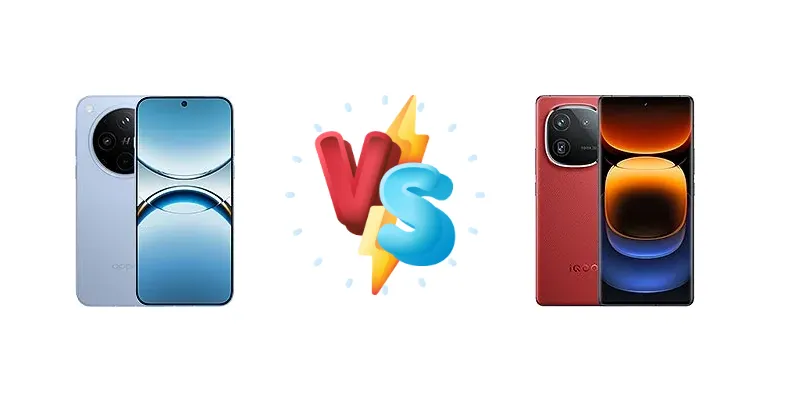
|
🏆 Quick Verdict
For the average user prioritizing sustained performance and rapid charging, the vivo iQOO 12 Pro emerges as the winner. Its Snapdragon 8 Gen 3, coupled with 120W charging, offers a more consistently powerful experience. However, the Oppo Find X8’s Dimensity 9400 and excellent display brightness make it a compelling alternative.
| PHONES | ||
|---|---|---|
| Phone Names | Oppo Find X8 | vivo iQOO 12 Pro |
| Network | ||
|---|---|---|
| 2G bands | GSM 850 / 900 / 1800 / 1900 | GSM 850 / 900 / 1800 / 1900 |
| 3G bands | HSDPA 800 / 850 / 900 / 1700(AWS) / 1900 / 2100 | HSDPA 800 / 850 / 900 / 1700(AWS) / 1900 / 2100 |
| 4G bands | 1, 2, 3, 4, 5, 7, 8, 12, 17, 18, 19, 20, 26, 28, 38, 39, 40, 41, 42, 66 - International | 1, 2, 3, 4, 5, 7, 8, 12, 17, 18, 19, 20, 25, 26, 28, 34, 38, 39, 40, 41, 42, 66 |
| 5G bands | 1, 2, 3, 5, 7, 8, 12, 20, 28, 38, 40, 41, 66, 77, 78 SA/NSA - International | 1, 2, 3, 5, 7, 8, 12, 20, 25, 26, 28, 66, 38, 40, 41, 77, 78 SA/NSA |
| Speed | HSPA, LTE, 5G | HSPA, LTE, 5G |
| Technology | GSM / HSPA / LTE / 5G | GSM / CDMA / HSPA / CDMA2000 / LTE / 5G |
| Launch | ||
|---|---|---|
| Announced | 2024, October 24 | 2023, November 07 |
| Status | Available. Released 2024, October 30 | Available. Released 2023, November 14 |
| Body | ||
|---|---|---|
| Build | Glass front (Gorilla Glass 7i), glass back (Gorilla Glass 7i), aluminum frame | - |
| Dimensions | 157.4 x 74.3 x 7.9 mm (6.20 x 2.93 x 0.31 in) | 164.6 x 75.4 x 8.6 mm or 8.8 mm |
| SIM | · Nano-SIM + eSIM· Nano-SIM + Nano-SIM | Nano-SIM + Nano-SIM |
| Weight | 193 g (6.81 oz) | 205 g or 210 g (7.23 oz) |
| Display | ||
|---|---|---|
| Protection | Corning Gorilla Glass 7i | - |
| Resolution | 1256 x 2760 pixels (~460 ppi density) | 1440 x 3200 pixels, 20:9 ratio (~518 ppi density) |
| Size | 6.59 inches, 105.6 cm2 (~90.3% screen-to-body ratio) | 6.78 inches, 111.0 cm2 (~89.4% screen-to-body ratio) |
| Type | AMOLED, 1B colors, 120Hz, 3840Hz PWM, Dolby Vision, HDR10+, 800 nits (typ), 1600 nits (HBM), 4500 nits (peak) | LTPO AMOLED, 1B colors, 144Hz, HDR10+, 1600 nits (HBM), 3000 nits (peak) |
| Platform | ||
|---|---|---|
| CPU | Octa-core (1x3.63 GHz Cortex-X925 & 3x3.3 GHz Cortex-X4 & 4x2.4 GHz Cortex-A720) | Octa-core (1x3.3 GHz Cortex-X4 & 3x3.2 GHz Cortex-A720 & 2x3.0 GHz Cortex-A720 & 2x2.3 GHz Cortex-A520) |
| Chipset | Mediatek Dimensity 9400 (3 nm) | Qualcomm SM8650-AB Snapdragon 8 Gen 3 (4 nm) |
| GPU | Immortalis-G925 | Adreno 750 |
| OS | Android 15, up to 5 major Android upgrades, ColorOS 15 | Android 14, up to 2 major Android upgrades, Funtouch 14 (International), OriginOS 4 (China) |
| Memory | ||
|---|---|---|
| Card slot | No | No |
| Internal | 256GB 12GB RAM, 256GB 16GB RAM, 512GB 12GB RAM, 512GB 16GB RAM, 1TB 16GB RAM | 256GB 16GB RAM, 512GB 16GB RAM, 1TB 16GB RAM |
| Main Camera | ||
|---|---|---|
| Features | Laser AF, color spectrum sensor, Hasselblad Color Calibration, LED flash, HDR, panorama | Color spectrum sensor, Dual-LED flash, HDR, panorama |
| Triple | 50 MP, f/1.8, 24mm (wide), 1/1.56", 1.0µm, multi-directional PDAF, OIS 50 MP, f/2.6, 73mm (periscope telephoto), 1/1.95", 0.61µm, 3x optical zoom, multi-directional PDAF, OIS 50 MP, f/2.0, 15mm, 120˚ (ultrawide), 1/2.76", 0.64µm, multi-directional PDAF | 50 MP, f/1.7, 23mm (wide), 1/1.3", 1.2µm, ulti-directional PDAF, OIS 64 MP, f/2.6, 70mm (periscope telephoto), 1/2.0", PDAF, OIS, 3x optical zoom 50 MP, f/2.0, 15mm, 119˚ (ultrawide), AF |
| Video | 4K@30/60fps, 1080p@30/60/240fps; gyro-EIS; HDR, 10‑bit video, Dolby Vision | 8K@30fps, 4K@24/30/60fps, 1080p@30/60/120/240fps, gyro-EIS |
| Selfie camera | ||
|---|---|---|
| Features | Panorama | HDR |
| Single | 32 MP, f/2.4, 21mm (wide), 1/2.74", 0.8µm | 16 MP, f/2.5, (wide) |
| Video | 4K@30/60fps, 1080p@30/60fps, gyro-EIS | 1080p@30fps, gyro-EIS |
| Sound | ||
|---|---|---|
| 35mm jack | No | No |
| Loudspeaker | Yes, with stereo speakers | Yes, with stereo speakers |
| Comms | ||
|---|---|---|
| Bluetooth | 5.4, A2DP, LE, aptX HD, LHDC 5 | 5.4, A2DP, LE, aptX HD, aptX Adaptive, aptX Lossless |
| Infrared port | Yes | Yes |
| NFC | Yes | Yes |
| Positioning | GPS (L1+L5), BDS (B1I+B1c+B2a+B2b), GALILEO (E1+E5a+E5b), QZSS (L1+L5), GLONASS, NavIC (L5) | GPS (L1+L5), GLONASS (G1), BDS (B1I+B1c+B2a), GALILEO (E1+E5a), QZSS (L1+L5) |
| Radio | No | No |
| USB | USB Type-C 3.0 (Global), 2.0 (China), OTG | USB Type-C 2.0, OTG |
| WLAN | Wi-Fi 802.11 a/b/g/n/ac/6/7, dual-band, Wi-Fi Direct | Wi-Fi 802.11 a/b/g/n/ac/6/7, tri-band, Wi-Fi Direct |
| Features | ||
|---|---|---|
| Sensors | Fingerprint (under display, optical), accelerometer, gyro, proximity, compass | Fingerprint (under display, ultrasonic), accelerometer, gyro, proximity, compass |
| Battery | ||
|---|---|---|
| Charging | 80W wired, PD 55W, PPS, UFCS 50W wireless 10W reverse wireless | 120W wired 50W wireless 10W reverse wireless |
| Type | Si/C Li-Ion 5630 mAh | 5100 mAh |
| Misc | ||
|---|---|---|
| Colors | Star Grey, Space Black, Shell Pink, Blue | Black, Red, White (BMW M branding) |
| Models | CPH2651, PKB110 | V2329A |
| Price | $ 948.56 / ₹ 74,990 | About 650 EUR |
Oppo Find X8
- Brighter display for outdoor use
- Potentially better thermal efficiency with 3nm Dimensity 9400
- Excellent battery life (13:58h active use)
- Slower wired charging (80W)
- Dimensity 9400’s real-world performance needs independent verification
vivo iQOO 12 Pro
- Faster 120W wired charging
- Proven Snapdragon 8 Gen 3 performance
- Mature software optimization
- Likely lower peak display brightness
- Battery life may be slightly less than the Oppo Find X8
Display Comparison
The Oppo Find X8 boasts a measured peak brightness of 1364 nits, providing exceptional visibility in direct sunlight. While the iQOO 12 Pro’s display specifications aren’t provided, it’s likely to be competitive, but the Find X8 holds a clear advantage in measured brightness. Both devices likely employ LTPO technology for adaptive refresh rates, conserving battery life. The Find X8’s brightness advantage will be particularly noticeable for users who frequently use their phones outdoors or in brightly lit environments.
Camera Comparison
Without detailed camera specifications, a direct comparison is difficult. However, both brands are known for delivering high-quality camera experiences. The iQOO 12 Pro, given vivo’s camera heritage, likely prioritizes vibrant colors and strong low-light performance. The Oppo Find X8, leveraging its image processing algorithms, may lean towards a more natural look. The absence of information regarding sensor sizes and OIS capabilities prevents a definitive assessment, but both phones will likely feature capable main sensors.
Performance
The core of the battle lies in the chipsets. The iQOO 12 Pro’s Snapdragon 8 Gen 3 (4nm) is a well-established performer, known for its raw power and efficiency. The Oppo Find X8’s Dimensity 9400 (3nm) aims to leapfrog Qualcomm with a more advanced manufacturing process. The Dimensity 9400’s CPU configuration – a 1x3.63 GHz Cortex-X925, 3x3.3 GHz Cortex-X4, and 4x2.4 GHz Cortex-A720 – suggests a focus on peak performance, while the iQOO 12 Pro’s 1x3.3 GHz Cortex-X4, 3x3.2 GHz Cortex-A720, 2x3.0 GHz Cortex-A720, and 2x2.3 GHz Cortex-A520 configuration offers a more balanced approach. The 3nm process of the Dimensity 9400 *should* translate to better thermal efficiency, but real-world testing is crucial to confirm this. The iQOO 12 Pro benefits from Qualcomm’s optimizations and a mature software ecosystem.
Battery Life
The Oppo Find X8 achieves an impressive 13:58h active use score, demonstrating excellent battery life. The iQOO 12 Pro’s battery capacity is unknown, but its 120W wired charging significantly surpasses the Find X8’s 80W. This means the iQOO 12 Pro can replenish its battery much faster, minimizing downtime. Both phones offer 50W wireless charging and 10W reverse wireless charging. The iQOO 12 Pro’s charging speed is a major advantage for users who frequently need to top up their battery quickly.
Buying Guide
Buy the Oppo Find X8 if you prioritize a brighter display for outdoor visibility and are intrigued by Mediatek’s latest CPU architecture. Buy the vivo iQOO 12 Pro if you demand the fastest possible charging speeds, consistently high frame rates in gaming, and a proven track record of thermal management with the Snapdragon 8 Gen 3.