
Oppo Find X8 vs Samsung Galaxy S24+: A Deep Dive into Android Flagship Performance
| Phones Images | |||||
|---|---|---|---|---|---|
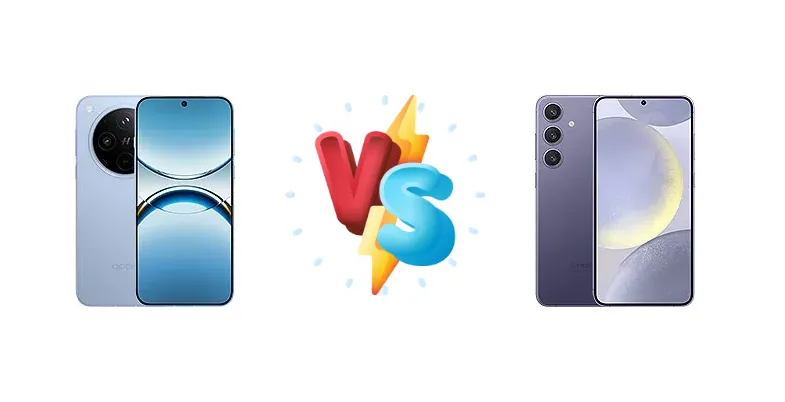
|
🏆 Quick Verdict
For the average user prioritizing all-around performance and a polished software experience, the Samsung Galaxy S24+ is the safer bet. However, the Oppo Find X8’s Dimensity 9400 offers a compelling alternative, potentially delivering superior CPU performance and faster charging, making it ideal for power users and those seeking the latest in mobile silicon.
| PHONES | ||
|---|---|---|
| Phone Names | Oppo Find X8 | Samsung Galaxy S24+ |
| Network | ||
|---|---|---|
| 2G bands | GSM 850 / 900 / 1800 / 1900 | GSM 850 / 900 / 1800 / 1900 |
| 3G bands | HSDPA 800 / 850 / 900 / 1700(AWS) / 1900 / 2100 | HSDPA 850 / 900 / 1700(AWS) / 1900 / 2100 |
| 4G bands | 1, 2, 3, 4, 5, 7, 8, 12, 17, 18, 19, 20, 26, 28, 38, 39, 40, 41, 42, 66 - International | 1, 2, 3, 4, 5, 7, 8, 12, 13, 17, 18, 19, 20, 25, 26, 28, 32, 38, 39, 40, 41, 66 - International |
| 5G bands | 1, 2, 3, 5, 7, 8, 12, 20, 28, 38, 40, 41, 66, 77, 78 SA/NSA - International | 1, 2, 3, 5, 7, 8, 12, 20, 25, 26, 28, 38, 40, 41, 66, 75, 77, 78 SA/NSA/Sub6 - International |
| Speed | HSPA, LTE, 5G | HSPA, LTE (up to 7CA), 5G |
| Technology | GSM / HSPA / LTE / 5G | GSM / CDMA / HSPA / EVDO / LTE / 5G |
| Launch | ||
|---|---|---|
| Announced | 2024, October 24 | 2024, January 17 |
| Status | Available. Released 2024, October 30 | Available. Released 2024, January 24 |
| Body | ||
|---|---|---|
| Build | Glass front (Gorilla Glass 7i), glass back (Gorilla Glass 7i), aluminum frame | Glass front (Gorilla Glass Victus 2), glass back (Gorilla Glass Victus 2), aluminum frame |
| Dimensions | 157.4 x 74.3 x 7.9 mm (6.20 x 2.93 x 0.31 in) | 158.5 x 75.9 x 7.7 mm (6.24 x 2.99 x 0.30 in) |
| SIM | · Nano-SIM + eSIM· Nano-SIM + Nano-SIM | · Nano-SIM + Nano-SIM + eSIM + eSIM (max 2 at a time) - INT· Nano-SIM + eSIM + eSIM (max 2 at a time) - USA· Nano-SIM + Nano-SIM - CN |
| Weight | 193 g (6.81 oz) | 196 g or 197 g (6.91 oz) |
| Display | ||
|---|---|---|
| Protection | Corning Gorilla Glass 7i | Corning Gorilla Glass Victus 2 |
| Resolution | 1256 x 2760 pixels (~460 ppi density) | 1440 x 3120 pixels, 19.5:9 ratio (~513 ppi density) |
| Size | 6.59 inches, 105.6 cm2 (~90.3% screen-to-body ratio) | 6.7 inches, 110.2 cm2 (~91.6% screen-to-body ratio) |
| Type | AMOLED, 1B colors, 120Hz, 3840Hz PWM, Dolby Vision, HDR10+, 800 nits (typ), 1600 nits (HBM), 4500 nits (peak) | Dynamic LTPO AMOLED 2X, 120Hz, HDR10+, 2600 nits (peak) |
| Platform | ||
|---|---|---|
| CPU | Octa-core (1x3.63 GHz Cortex-X925 & 3x3.3 GHz Cortex-X4 & 4x2.4 GHz Cortex-A720) | 8-core (1x3.39GHz Cortex-X4 & 3x3.1GHz Cortex-A720 & 2x2.9GHz Cortex-A720 & 2x2.2GHz Cortex-A520)10-core (1x3.2GHz Cortex-X4 & 2x2.9GHz Cortex-A720 & 3x2.6GHz Cortex-A720 & 4x1.95GHz Cortex-A520) |
| Chipset | Mediatek Dimensity 9400 (3 nm) | Qualcomm SM8650-AC Snapdragon 8 Gen 3 (4 nm) - USA/Canada/ChinaExynos 2400 (4 nm) - International |
| GPU | Immortalis-G925 | Adreno 750 (1 GHz) - USA/Canada/ChinaXclipse 940 - International |
| OS | Android 15, up to 5 major Android upgrades, ColorOS 15 | Android 14, up to 7 major Android upgrades, One UI 8.0 |
| Memory | ||
|---|---|---|
| Card slot | No | No |
| Internal | 256GB 12GB RAM, 256GB 16GB RAM, 512GB 12GB RAM, 512GB 16GB RAM, 1TB 16GB RAM | 256GB 12GB RAM, 512GB 12GB RAM |
| Main Camera | ||
|---|---|---|
| Features | Laser AF, color spectrum sensor, Hasselblad Color Calibration, LED flash, HDR, panorama | LED flash, auto-HDR, panorama |
| Triple | 50 MP, f/1.8, 24mm (wide), 1/1.56", 1.0µm, multi-directional PDAF, OIS 50 MP, f/2.6, 73mm (periscope telephoto), 1/1.95", 0.61µm, 3x optical zoom, multi-directional PDAF, OIS 50 MP, f/2.0, 15mm, 120˚ (ultrawide), 1/2.76", 0.64µm, multi-directional PDAF | 50 MP, f/1.8, 24mm (wide), 1/1.56", 1.0µm, dual pixel PDAF, OIS 10 MP, f/2.4, 67mm (telephoto), 1/3.94", 1.0µm, PDAF, OIS, 3x optical zoom 12 MP, f/2.2, 13mm, 120˚ (ultrawide), 1/2.55" 1.4µm, Super Steady video |
| Video | 4K@30/60fps, 1080p@30/60/240fps; gyro-EIS; HDR, 10‑bit video, Dolby Vision | 8K@24/30fps, 4K@30/60fps, 1080p@30/60/120/240fps, HDR10+, stereo sound rec., gyro-EIS |
| Selfie camera | ||
|---|---|---|
| Features | Panorama | HDR, HDR10+ |
| Single | 32 MP, f/2.4, 21mm (wide), 1/2.74", 0.8µm | 12 MP, f/2.2, 26mm (wide), 1/3.2", 1.12µm, dual pixel PDAF |
| Video | 4K@30/60fps, 1080p@30/60fps, gyro-EIS | 4K@30/60fps, 1080p@30fps |
| Sound | ||
|---|---|---|
| 35mm jack | No | No |
| Loudspeaker | Yes, with stereo speakers | Yes, with stereo speakers |
| Comms | ||
|---|---|---|
| Bluetooth | 5.4, A2DP, LE, aptX HD, LHDC 5 | 5.3, A2DP, LE |
| Infrared port | Yes | - |
| NFC | Yes | Yes |
| Positioning | GPS (L1+L5), BDS (B1I+B1c+B2a+B2b), GALILEO (E1+E5a+E5b), QZSS (L1+L5), GLONASS, NavIC (L5) | GPS, GLONASS, BDS, GALILEO, QZSS |
| Radio | No | No |
| USB | USB Type-C 3.0 (Global), 2.0 (China), OTG | USB Type-C 3.2, DisplayPort 1.2, OTG |
| WLAN | Wi-Fi 802.11 a/b/g/n/ac/6/7, dual-band, Wi-Fi Direct | Wi-Fi 802.11 a/b/g/n/ac/6e, tri-band, Wi-Fi Direct |
| Features | ||
|---|---|---|
| Sensors | Fingerprint (under display, optical), accelerometer, gyro, proximity, compass | Fingerprint (under display, ultrasonic), accelerometer, gyro, proximity, compass, barometer |
| Battery | ||
|---|---|---|
| Charging | 80W wired, PD 55W, PPS, UFCS 50W wireless 10W reverse wireless | 45W wired, PD3.0, 65% in 30 min 15W wireless (Qi) 4.5W reverse wireless |
| Type | Si/C Li-Ion 5630 mAh | Li-Ion 4900 mAh |
| Misc | ||
|---|---|---|
| Colors | Star Grey, Space Black, Shell Pink, Blue | Onyx Black, Marble Grey, Cobalt Violet, Amber Yellow, Jade Green, Sandstone Orange, Sapphire Blue |
| Models | CPH2651, PKB110 | SM-S926B, SM-S926B/DS, SM-S926U, SM-S926U1, SM-S926W, SM-S926N, SM-S9260, SM-S926E, SM-S926E/DS |
| Price | $ 948.56 / ₹ 74,990 | $ 429.50 / € 549.00 / £ 445.98 |
| SAR | - | 1.16 W/kg (head) 0.84 W/kg (body) |
| SAR EU | - | 0.74 W/kg (head) 1.25 W/kg (body) |
Oppo Find X8
- Superior battery life (13:58h active use)
- Faster wired and wireless charging speeds
- Potentially higher CPU performance with Dimensity 9400
- Cutting-edge 3nm chipset
- Less established software ecosystem
- Camera specifications unknown, potential uncertainty
Samsung Galaxy S24+
- Brighter display (1452 nits)
- Proven Snapdragon 8 Gen 3 (or capable Exynos 2400)
- Refined software experience and long-term support
- Established camera system with versatile features
- Shorter battery life (12:30h active use)
- Slower charging speeds compared to Oppo Find X8
- Exynos variant may exhibit lower performance/efficiency
Display Comparison
The Samsung Galaxy S24+ boasts a brighter display, reaching 1452 nits measured, compared to the Oppo Find X8’s 1364 nits. While both displays are excellent, the S24+'s higher peak brightness translates to better visibility under direct sunlight. Both are likely to employ LTPO technology for adaptive refresh rates, conserving battery life, though this isn't explicitly stated. The S24+'s display is also known for its vibrant color accuracy, a hallmark of Samsung’s panels, while Oppo typically focuses on natural color reproduction. Bezels are expected to be minimal on both devices, contributing to an immersive viewing experience.
Camera Comparison
The context data only mentions 'Photo / Video' for the S24+, lacking specific sensor details. However, Samsung’s flagship cameras are renowned for their versatility and image processing. Expect a multi-camera system with a high-resolution main sensor, likely 50MP or higher, with optical image stabilization (OIS). The Oppo Find X8’s camera specifications are also absent, but Oppo has been consistently improving its camera technology. The quality of image processing algorithms will be a key differentiator. While megapixel count isn't everything, a larger sensor size generally improves low-light performance. The absence of details on the Oppo's camera system makes a direct comparison difficult, but it's safe to assume Samsung has a more established and refined camera system.
Performance
The core of this comparison lies in the chipsets. The Oppo Find X8’s Mediatek Dimensity 9400, built on a 3nm process, features a unique CPU configuration: 1x3.63 GHz Cortex-X925, 3x3.3 GHz Cortex-X4, and 4x2.4 GHz Cortex-A720. This contrasts with the Samsung Galaxy S24+'s Snapdragon 8 Gen 3 (4nm) – or the Exynos 2400 (also 4nm) in international markets. The Dimensity 9400’s Cortex-X925 core is a newer, potentially more efficient design than the X4 in the Snapdragon, suggesting a performance advantage in single-threaded tasks. However, the Snapdragon 8 Gen 3’s Adreno GPU is a known quantity, offering excellent gaming performance. The Exynos 2400’s performance is a known variable, often trailing the Snapdragon in efficiency and sustained performance. Both phones will likely utilize LPDDR5x RAM, but the speed and configuration could vary, impacting multitasking capabilities. Thermal management will be crucial; the 3nm Dimensity 9400 *should* offer better efficiency, but Oppo’s thermal design will ultimately determine its ability to sustain peak performance.
Battery Life
The Oppo Find X8 demonstrates a clear advantage in battery life, achieving an active use score of 13:58h, compared to the Samsung Galaxy S24+'s 12:30h. This nearly 90-minute difference is significant. However, the S24+ compensates with faster charging: 45W wired (65% in 30 minutes) versus the Find X8’s 80W wired, PD 55W, UFCS. The Find X8 also supports 50W wireless charging, significantly faster than the S24+'s 15W Qi wireless charging. The Find X8’s 10W reverse wireless charging is also superior to the S24+'s 4.5W. While the S24+’s battery capacity isn’t specified, the longer active use time of the Find X8 suggests a more efficient combination of battery size and power management.
Buying Guide
Buy the Oppo Find X8 if you need maximum CPU performance for demanding tasks like video editing or emulation, and value the fastest charging speeds available. You're willing to potentially navigate a less-established software ecosystem for cutting-edge hardware. Buy the Samsung Galaxy S24+ if you prefer a refined, feature-rich experience with a proven track record, excellent camera capabilities, and the broader ecosystem benefits of the Samsung brand. You prioritize stability and long-term software support.