
Oppo Find X8 Ultra vs Xiaomi 14 Ultra: The Ultimate Flagship Showdown
| Phones Images | |||||
|---|---|---|---|---|---|
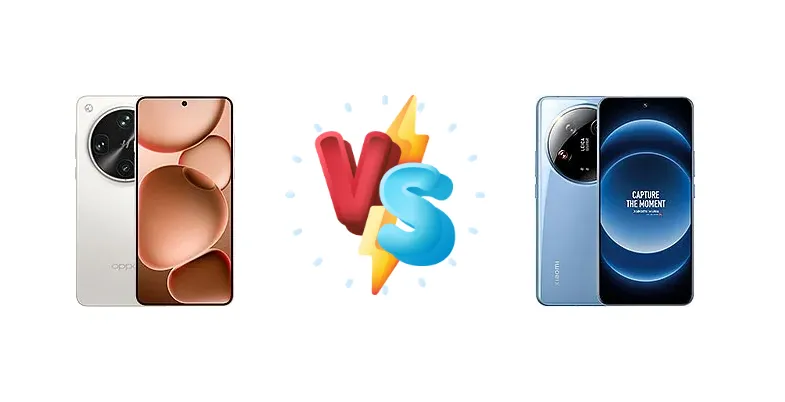
|
🏆 Quick Verdict
For the average user prioritizing all-day battery life and consistent performance, the Oppo Find X8 Ultra emerges as the winner. Its Snapdragon 8 Elite and optimized power management deliver a remarkable 16:20h of active use. However, the Xiaomi 14 Ultra’s brighter display and faster charging are compelling advantages for specific users.
| PHONES | ||
|---|---|---|
| Phone Names | Oppo Find X8 Ultra | Xiaomi 14 Ultra |
| Network | ||
|---|---|---|
| 2G bands | GSM 850 / 900 / 1800 / 1900 | GSM 850 / 900 / 1800 / 1900 |
| 3G bands | HSDPA 800 / 850 / 900 / 1700(AWS) / 1900 / 2100 | HSDPA 800 / 850 / 900 / 1700(AWS) / 1900 / 2100 |
| 4G bands | 1, 3, 4, 5, 7, 8, 18, 19, 20, 26, 28, 34, 38, 39, 40, 41, 42, 48, 66 | 1, 2, 3, 4, 5, 7, 8, 18, 19, 20, 26, 28, 38, 40, 41, 42, 48, 66 - International |
| 5G bands | 1, 3, 5, 7, 8, 20, 28, 38, 40, 41, 66, 77, 78, 79, 80, 81, 83, 84 SA/NSA | 1, 2, 3, 5, 7, 8, 20, 28, 38, 40, 41, 48, 66, 77, 78, 79 SA/NSA - International |
| Speed | HSPA, LTE, 5G | HSPA, LTE, 5G |
| Technology | GSM / HSPA / LTE / 5G | GSM / CDMA / HSPA / EVDO / LTE / 5G |
| Launch | ||
|---|---|---|
| Announced | 2025, April 10 | 2024, February 22 |
| Status | Available. Released 2025, April 16 | Available. Released 2024, February 22 |
| Body | ||
|---|---|---|
| Build | - | Glass front (Shield Glass), glass back or silicone polymer back (eco leather), titanium frame (grade 5) or aluminum alloy frame |
| Dimensions | 163.1 x 76.8 x 8.8 mm (6.42 x 3.02 x 0.35 in) | 161.4 x 75.3 x 9.2 mm (6.35 x 2.96 x 0.36 in) |
| SIM | Nano-SIM + Nano-SIM | Nano-SIM + Nano-SIM |
| Weight | 226 g (7.97 oz) | 219.8 / 224.4 / 229.5 g (7.76 oz) |
| Display | ||
|---|---|---|
| Protection | Corning Gorilla Glass (unspecified version) | Xiaomi Shield Glass |
| Resolution | 1440 x 3168 pixels (~510 ppi density) | 1440 x 3200 pixels, 20:9 ratio (~522 ppi density) |
| Size | 6.82 inches, 113.0 cm2 (~90.2% screen-to-body ratio) | 6.73 inches, 108.9 cm2 (~89.6% screen-to-body ratio) |
| Type | LTPO AMOLED, 1B colors, 120Hz, 2160Hz PWM, Dolby Vision, HDR Vivid, HDR10+, 800 nits (typ), 1600 nits (HBM), 2500 nits (peak) | LTPO AMOLED, 68B colors, 120Hz, 1920Hz PWM, Dolby Vision, HDR10+, 1000 nits (typ), 3000 nits (peak) |
| Platform | ||
|---|---|---|
| CPU | Octa-core (2x4.32 GHz Oryon V2 Phoenix L + 6x3.53 GHz Oryon V2 Phoenix M) | Octa-core (1x3.3 GHz Cortex-X4 & 3x3.2 GHz Cortex-A720 & 2x3.0 GHz Cortex-A720 & 2x2.3 GHz Cortex-A520) |
| Chipset | Qualcomm SM8750-AB Snapdragon 8 Elite (3 nm) | Qualcomm SM8650-AB Snapdragon 8 Gen 3 (4 nm) |
| GPU | Adreno 830 | Adreno 750 |
| OS | Android 15, ColorOS 15 | Android 14, up to 4 major Android upgrades, HyperOS |
| Memory | ||
|---|---|---|
| Card slot | No | No |
| Internal | 256GB 12GB RAM, 512GB 16GB RAM, 1TB 16GB RAM | 256GB 12GB RAM, 512GB 16GB RAM, 1TB 16GB RAM |
| Main Camera | ||
|---|---|---|
| Features | Laser AF, color spectrum sensor, Hasselblad Color Calibration, LED flash, HDR, panorama | Laser AF, color spectrum sensor, Leica lenses, Dual-LED flash, HDR, panorama, 67mm filter ring holder (optional) |
| Quad | 50 MP, f/1.8, 23mm (wide), 1.0"-type, 1.6µm, dual pixel PDAF, OIS 50 MP, f/2.1, 70mm (periscope telephoto), 1/1.56", 1.0µm, 3x optical zoom, multi-directional PDAF (10cm - ∞), OIS 50 MP, f/3.1, 135mm (periscope telephoto), 1/1/.95", 0.8µm, 6x optical zoom, dual pixel PDAF (35cm - ∞), OIS 50 MP, f/2.0, 15mm, 120˚ (ultrawide), 1/2.75", 0.64µm, PDAF | 50 MP, f/1.6-f/4.0, 23mm (wide), 1.0"-type, 1.6µm, dual pixel PDAF, OIS 50 MP, f/1.8, 75mm (telephoto), 1/2.51", 0.7µm, dual pixel PDAF (10cm - ∞), OIS, 3.2x optical zoom 50 MP, f/2.5, 120mm (periscope telephoto), 1/2.51", 0.7µm, dual pixel PDAF (30cm - ∞), OIS, 5x optical zoom 50 MP, f/1.8, 12mm, 122˚ (ultrawide), 1/2.51", 0.7µm, dual pixel PDAF TOF 3D, (depth) |
| Video | 4K@30/60/120fps, 1080p@30/60/120/240fps; gyro-EIS; HDR, 10‑bit video, Dolby Vision | 8K@24/30fps, 4K@24/30/60/120fps, 1080p@30/60/120/240/480/960/1920fps, gyro-EIS, Dolby Vision HDR 10-bit rec. (4K@60fps, 1080p) |
| Selfie camera | ||
|---|---|---|
| Features | Panorama, HDR | HDR, panorama |
| Single | 32 MP, f/2.4, 21mm (wide), 1/2.74", 0.8µm, PDAF | 32 MP, f/2.0, 22mm (wide), 1/3.14", 0.7µm |
| Video | 4K@30/60fps, 1080p@30/60fps, gyro-EIS | 4K@30/60fps, 1080p@30/60fps, gyro-EIS |
| Sound | ||
|---|---|---|
| 35mm jack | No | No |
| Loudspeaker | Yes, with stereo speakers | Yes, with stereo speakers |
| Comms | ||
|---|---|---|
| Bluetooth | 5.4, A2DP, LE, aptX HD, LHDC 5 | 5.4, A2DP, LE, aptX HD, aptX Adaptive, LHDC |
| Infrared port | Yes | Yes |
| NFC | Yes | Yes |
| Positioning | GPS (L1+L5), BDS (B1I+B1c+B2a), GALILEO (E1+E5a), QZSS (L1+L5), GLONASS | GPS (L1+L5), GLONASS (L1), BDS (B1I+B1c+B2a), GALILEO (E1+E5a), QZSS (L1+L5), NavIC (L5) |
| Radio | No | No |
| USB | USB Type-C 3.2, OTG | USB Type-C 3.2 Gen 2, DisplayPort, OTG |
| WLAN | Wi-Fi 802.11 a/b/g/n/ac/6/7, dual-band, Wi-Fi Direct | Wi-Fi 802.11 a/b/g/n/ac/6e/7, tri-band, Wi-Fi Direct |
| Features | ||
|---|---|---|
| Sensors | Fingerprint (under display, ultrasonic), accelerometer, gyro, proximity, compass | Fingerprint (under display, optical), accelerometer, proximity, gyro, compass, barometer |
| Battery | ||
|---|---|---|
| Charging | 100W wired, 18W PD, 18W QC, 55W PPS 50W wireless 10W reverse wireless | 90W wired, PD3.0, QC4, 100% in 33 min 80W wireless, 100% in 46 min 10W reverse wireless |
| Type | Si/C Li-Ion 6100 mAh | Market-dependent versions:· 5000 mAh (Global)· 5300 mAh (China only) |
| Misc | ||
|---|---|---|
| Colors | Matte Black, Pure White, Shell Pink | Black, Blue, White, Titanium Gray |
| Models | PKJ110, PKU110 | 24031PN0DC, 24030PN60G |
| Price | - | € 663.14 |
| SAR | - | 0.83 W/kg (head) 0.82 W/kg (body) |
| SAR EU | - | 1.00 W/kg (head) 1.00 W/kg (body) |
Oppo Find X8 Ultra
- Exceptional battery life (16:20h active use)
- Snapdragon 8 Elite offers sustained performance
- Competitive charging speeds (100W wired, 50W wireless)
- Lower peak display brightness compared to Xiaomi 14 Ultra
- Camera processing style may be less aggressive
Xiaomi 14 Ultra
- Brighter display (1281 nits) for outdoor visibility
- Faster charging speeds (90W wired, 80W wireless)
- Potentially more versatile camera system
- Significantly shorter battery life (11:25h active use)
- Snapdragon 8 Gen 3 may throttle under sustained load
Display Comparison
The Xiaomi 14 Ultra boasts a brighter display, reaching a measured 1281 nits compared to the Oppo Find X8 Ultra’s 1157 nits. This difference is noticeable in direct sunlight, giving the 14 Ultra an edge for outdoor visibility. Both likely utilize LTPO technology for adaptive refresh rates, conserving battery, but the 14 Ultra’s higher peak brightness is a clear advantage for HDR content. While both are expected to have excellent color accuracy, the Xiaomi’s brightness provides a more impactful viewing experience.
Camera Comparison
Without detailed camera specs, a direct comparison is limited. However, both phones are expected to feature top-tier camera systems. The Xiaomi 14 Ultra, given Xiaomi’s history, will likely emphasize computational photography and versatile zoom capabilities. The Oppo Find X8 Ultra, while also capable, may lean towards more natural image processing. The chipset differences could also play a role; the Snapdragon 8 Elite’s enhanced AI capabilities might translate to improved image processing algorithms. We anticipate both phones to excel in low-light photography, but the 14 Ultra’s potential for more aggressive image stacking could give it an edge in extremely challenging conditions.
Performance
The core difference lies in the chipsets. The Oppo Find X8 Ultra features the Qualcomm SM8750-AB Snapdragon 8 Elite (3nm), utilizing Oryon V2 Phoenix cores – a custom design focused on efficiency and sustained performance. The Xiaomi 14 Ultra employs the Snapdragon 8 Gen 3 (4nm) with a more traditional Cortex CPU configuration. While the Gen 3 offers strong peak performance (3.3 GHz Cortex-X4), the 3nm process and Oryon architecture of the 8 Elite in the X8 Ultra suggest superior thermal management and longer-term performance consistency. The X8 Ultra’s CPU configuration (2x4.32 GHz + 6x3.53 GHz) indicates a focus on both high-performance and efficiency cores, potentially outperforming the 14 Ultra in multi-threaded workloads.
Battery Life
The Oppo Find X8 Ultra’s active use score of 16:20h significantly surpasses the Xiaomi 14 Ultra’s 11:25h. This is a substantial difference, indicating the Snapdragon 8 Elite’s efficiency and potentially a larger battery capacity (though not specified). While the Xiaomi 14 Ultra offers faster charging – 90W wired (33 min to 100%) and 80W wireless (46 min to 100%) – the Oppo Find X8 Ultra’s 100W wired, 50W wireless, and 10W reverse wireless provide competitive charging speeds. The X8 Ultra’s longer battery life mitigates the need for frequent charging, making it ideal for users who prioritize endurance.
Buying Guide
Buy the Oppo Find X8 Ultra if you need exceptional battery life for demanding tasks like video editing or extended gaming sessions, and value sustained performance over peak bursts. Buy the Xiaomi 14 Ultra if you prioritize a brighter, more vibrant display for media consumption, and appreciate the convenience of faster wired and wireless charging, even if it comes at the cost of some battery endurance.