
Oppo Find X8 Ultra vs. OnePlus 12R: A Detailed Performance and Feature Comparison
| Phones Images | |||||
|---|---|---|---|---|---|
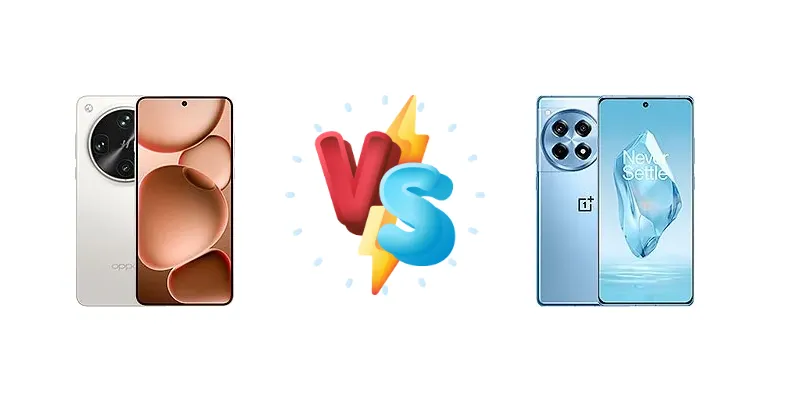
|
🏆 Quick Verdict
For users prioritizing peak performance and future-proofing, the Oppo Find X8 Ultra is the clear winner. Its Snapdragon 8 Elite chipset and slightly longer battery life justify the price premium. However, the OnePlus 12R delivers exceptional value, offering near-flagship performance at a more accessible price point.
| PHONES | ||
|---|---|---|
| Phone Names | Oppo Find X8 Ultra | OnePlus 12R |
| Network | ||
|---|---|---|
| 2G bands | GSM 850 / 900 / 1800 / 1900 | GSM 850 / 900 / 1800 / 1900 |
| 3G bands | HSDPA 800 / 850 / 900 / 1700(AWS) / 1900 / 2100 | HSDPA 850 / 900 / 1700(AWS) / 1900 / 2100 |
| 4G bands | 1, 3, 4, 5, 7, 8, 18, 19, 20, 26, 28, 34, 38, 39, 40, 41, 42, 48, 66 | 1, 2, 3, 4, 5, 7, 8, 12, 17, 18, 19, 20, 26, 28, 32, 38, 39, 40, 41, 66 |
| 5G bands | 1, 3, 5, 7, 8, 20, 28, 38, 40, 41, 66, 77, 78, 79, 80, 81, 83, 84 SA/NSA | 1, 2, 3, 5, 7, 8, 12, 20, 28, 38, 40, 41, 66, 77, 78 SA/NSA |
| Speed | HSPA, LTE, 5G | HSPA, LTE, 5G |
| Technology | GSM / HSPA / LTE / 5G | GSM / CDMA / HSPA / LTE / 5G |
| Launch | ||
|---|---|---|
| Announced | 2025, April 10 | 2024, January 23 |
| Status | Available. Released 2025, April 16 | Available. Released 2024, February 06 |
| Body | ||
|---|---|---|
| Build | - | Glass front (Gorilla Glass Victus 2), aluminum frame, glass back |
| Dimensions | 163.1 x 76.8 x 8.8 mm (6.42 x 3.02 x 0.35 in) | 163.3 x 75.3 x 8.8 mm (6.43 x 2.96 x 0.35 in) |
| SIM | Nano-SIM + Nano-SIM | · Nano-SIM + Nano-SIM + eSIM (max 2 at a time)· Nano-SIM + Nano-SIM |
| Weight | 226 g (7.97 oz) | 207 g (7.30 oz) |
| Display | ||
|---|---|---|
| Protection | Corning Gorilla Glass (unspecified version) | Corning Gorilla Glass Victus 2 |
| Resolution | 1440 x 3168 pixels (~510 ppi density) | 1264 x 2780 pixels (~450 ppi density) |
| Size | 6.82 inches, 113.0 cm2 (~90.2% screen-to-body ratio) | 6.78 inches, 111.7 cm2 (~90.9% screen-to-body ratio) |
| Type | LTPO AMOLED, 1B colors, 120Hz, 2160Hz PWM, Dolby Vision, HDR Vivid, HDR10+, 800 nits (typ), 1600 nits (HBM), 2500 nits (peak) | LTPO4 AMOLED, 1B colors, 120Hz, HDR10+, Dolby Vision, 1600 nits (HBM), 4500 nits (peak) |
| Platform | ||
|---|---|---|
| CPU | Octa-core (2x4.32 GHz Oryon V2 Phoenix L + 6x3.53 GHz Oryon V2 Phoenix M) | Octa-core (1x3.2 GHz Cortex-X3 & 2x2.8 GHz Cortex-A715 & 2x2.8 GHz Cortex-A710 & 3x2.0 GHz Cortex-A510) |
| Chipset | Qualcomm SM8750-AB Snapdragon 8 Elite (3 nm) | Qualcomm SM8550-AB Snapdragon 8 Gen 2 (4 nm) |
| GPU | Adreno 830 | Adreno 740 |
| OS | Android 15, ColorOS 15 | Android 14, up to 3 major Android upgrades, OxygenOS 15 |
| Memory | ||
|---|---|---|
| Card slot | No | No |
| Internal | 256GB 12GB RAM, 512GB 16GB RAM, 1TB 16GB RAM | 128GB 8GB RAM, 256GB 8GB RAM, 256GB 12GB RAM, 256GB 16GB RAM |
| Main Camera | ||
|---|---|---|
| Features | Laser AF, color spectrum sensor, Hasselblad Color Calibration, LED flash, HDR, panorama | Laser AF, color spectrum sensor, LED flash, HDR, panorama |
| Quad | 50 MP, f/1.8, 23mm (wide), 1.0"-type, 1.6µm, dual pixel PDAF, OIS 50 MP, f/2.1, 70mm (periscope telephoto), 1/1.56", 1.0µm, 3x optical zoom, multi-directional PDAF (10cm - ∞), OIS 50 MP, f/3.1, 135mm (periscope telephoto), 1/1/.95", 0.8µm, 6x optical zoom, dual pixel PDAF (35cm - ∞), OIS 50 MP, f/2.0, 15mm, 120˚ (ultrawide), 1/2.75", 0.64µm, PDAF | - |
| Triple | - | 50 MP, f/1.8, 24mm (wide), 1/1.56", 1.0µm, multi-directional PDAF, OIS 8 MP, f/2.2, 16mm, 112˚ (ultrawide), 1/4.0", 1.12µm 2 MP (macro) |
| Video | 4K@30/60/120fps, 1080p@30/60/120/240fps; gyro-EIS; HDR, 10‑bit video, Dolby Vision | 4K@30/60fps, 1080p@30/60/120/240fps, gyro-EIS, OIS |
| Selfie camera | ||
|---|---|---|
| Features | Panorama, HDR | HDR, panorama |
| Single | 32 MP, f/2.4, 21mm (wide), 1/2.74", 0.8µm, PDAF | 16 MP, f/2.4, 26mm (wide), 1/3", 1.0µm |
| Video | 4K@30/60fps, 1080p@30/60fps, gyro-EIS | 1080p@30fps, gyro-EIS |
| Sound | ||
|---|---|---|
| 35mm jack | No | No |
| Loudspeaker | Yes, with stereo speakers | Yes, with stereo speakers |
| Comms | ||
|---|---|---|
| Bluetooth | 5.4, A2DP, LE, aptX HD, LHDC 5 | 5.3, A2DP, LE, aptX HD |
| Infrared port | Yes | Yes |
| NFC | Yes | Yes |
| Positioning | GPS (L1+L5), BDS (B1I+B1c+B2a), GALILEO (E1+E5a), QZSS (L1+L5), GLONASS | GPS, GALILEO, GLONASS, BDS, QZSS |
| Radio | No | No |
| USB | USB Type-C 3.2, OTG | USB Type-C 2.0 |
| WLAN | Wi-Fi 802.11 a/b/g/n/ac/6/7, dual-band, Wi-Fi Direct | Wi-Fi 802.11 a/b/g/n/ac/6/7, dual-band |
| Features | ||
|---|---|---|
| Sensors | Fingerprint (under display, ultrasonic), accelerometer, gyro, proximity, compass | Fingerprint (under display, optical), accelerometer, gyro, proximity, compass |
| Battery | ||
|---|---|---|
| Charging | 100W wired, 18W PD, 18W QC, 55W PPS 50W wireless 10W reverse wireless | 100W wired, 100% in 26 min |
| Type | Si/C Li-Ion 6100 mAh | Li-Ion 5500 mAh |
| Misc | ||
|---|---|---|
| Colors | Matte Black, Pure White, Shell Pink | Iron Gray, Cool Blue, Electric Violet, Sunset Dune |
| Models | PKJ110, PKU110 | CPH2609, CPH2585, CPH2611 |
| Price | - | € 410.84 / $ 399.95 / £ 649.00 |
| SAR | - | 1.19 W/kg (head) 0.82 W/kg (body) |
Oppo Find X8 Ultra
- Superior performance with Snapdragon 8 Elite
- Longer battery life (16:20h active use)
- More versatile charging options (50W wireless, 10W reverse wireless)
- Likely higher price point
- Potential for software bloat (typical of Oppo)
OnePlus 12R
- Excellent value for money
- Fast 100W wired charging (26 min full charge)
- Solid performance with Snapdragon 8 Gen 2
- Shorter battery life (14:32h active use)
- Less advanced charging features
Display Comparison
Both the Oppo Find X8 Ultra and OnePlus 12R boast excellent displays, achieving peak brightness levels of 1157 nits and 1181 nits respectively. While the OnePlus 12R marginally edges out the X8 Ultra in peak brightness, the difference is unlikely to be noticeable in most real-world scenarios. Both likely employ LTPO technology for adaptive refresh rates, though this isn't explicitly stated. The quality of the panel itself (color accuracy, viewing angles) will be a key differentiator, but without further data, it's difficult to declare a clear winner. Bezels are expected to be minimal on both devices, aligning with current flagship trends.
Camera Comparison
Without detailed camera specifications, a direct comparison is limited. However, given Oppo’s history, the Find X8 Ultra is likely to feature a more advanced camera system with larger sensors and more sophisticated image processing. The OnePlus 12R will likely focus on delivering a solid, reliable camera experience, but may not match the X8 Ultra’s potential for low-light performance or dynamic range. The absence of information regarding sensor sizes and lens apertures prevents a more granular analysis. We can assume both phones will offer a variety of shooting modes, but the X8 Ultra is expected to excel in computational photography.
Performance
The core difference lies in the chipsets. The Oppo Find X8 Ultra’s Snapdragon 8 Elite (3nm) utilizes Oryon V2 Phoenix cores – a custom design – clocked up to 4.32 GHz, promising significant performance gains over the OnePlus 12R’s Snapdragon 8 Gen 2 (4nm). The Gen 2 employs a more traditional core configuration (Cortex-X3, A715, A710, A510) with a peak clock speed of 3.2 GHz. The 3nm process of the 8 Elite translates to improved power efficiency and thermal management, potentially leading to sustained performance during extended gaming sessions. The X8 Ultra will likely exhibit faster app loading times, smoother multitasking, and higher frame rates in demanding games. The OnePlus 12R, however, remains a very capable performer, and the difference may not be perceptible for everyday tasks.
Battery Life
The Oppo Find X8 Ultra achieves an active use battery score of 16:20h, while the OnePlus 12R manages 14:32h. This suggests the X8 Ultra offers superior battery endurance, likely due to the more efficient Snapdragon 8 Elite chipset. Both devices support 100W wired charging, with the OnePlus 12R claiming a full charge in 26 minutes. The X8 Ultra offers more versatile charging options with 50W wireless and 10W reverse wireless, compared to the 18W PD/QC/PPS and 18W wireless on the 12R. The X8 Ultra’s combination of longer battery life and more charging flexibility provides a significant advantage.
Buying Guide
Buy the Oppo Find X8 Ultra if you demand the absolute best in processing power for demanding tasks like video editing, high-end gaming, and consistently fast multitasking. Buy the OnePlus 12R if you prioritize a balance of performance and affordability, seeking a smooth and responsive experience without breaking the bank, and are comfortable with a slightly older chipset.