
Oppo Find X8 Ultra vs Honor Magic6 Pro: A Deep Dive into Flagship Performance
| Phones Images | |||||
|---|---|---|---|---|---|
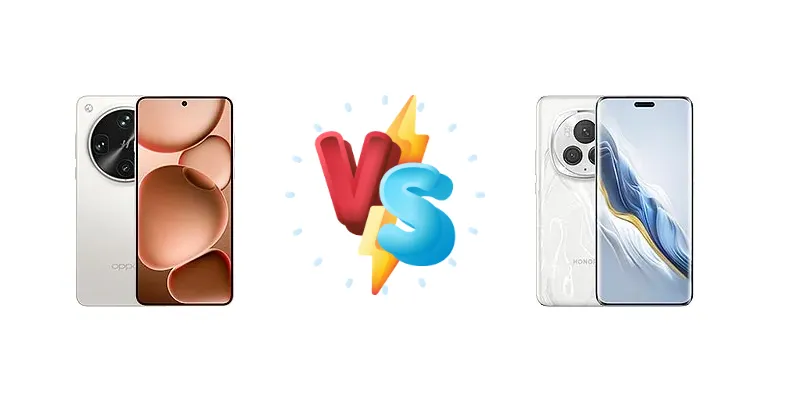
|
🏆 Quick Verdict
For users prioritizing raw performance and sustained gaming, the Oppo Find X8 Ultra emerges as the winner. Its Snapdragon 8 Elite chipset and superior active use battery life of 16:20h provide a noticeable edge. However, the Honor Magic6 Pro’s brighter display and faster wireless charging make it a compelling alternative.
| PHONES | ||
|---|---|---|
| Phone Names | Oppo Find X8 Ultra | Honor Magic6 Pro |
| Network | ||
|---|---|---|
| 2G bands | GSM 850 / 900 / 1800 / 1900 | GSM 850 / 900 / 1800 / 1900 |
| 3G bands | HSDPA 800 / 850 / 900 / 1700(AWS) / 1900 / 2100 | HSDPA 800 / 850 / 900 / 1700(AWS) / 1900 / 2100 |
| 4G bands | 1, 3, 4, 5, 7, 8, 18, 19, 20, 26, 28, 34, 38, 39, 40, 41, 42, 48, 66 | LTE |
| 5G bands | 1, 3, 5, 7, 8, 20, 28, 38, 40, 41, 66, 77, 78, 79, 80, 81, 83, 84 SA/NSA | SA/NSA |
| Speed | HSPA, LTE, 5G | HSPA, LTE, 5G |
| Technology | GSM / HSPA / LTE / 5G | GSM / CDMA / HSPA / CDMA2000 / LTE / 5G |
| Launch | ||
|---|---|---|
| Announced | 2025, April 10 | 2024, January 11 |
| Status | Available. Released 2025, April 16 | Available. Released 2024, January 18 |
| Body | ||
|---|---|---|
| Build | - | Glass front (NanoCrystal Shield), glass back or silicone polymer back (eco leather) |
| Dimensions | 163.1 x 76.8 x 8.8 mm (6.42 x 3.02 x 0.35 in) | 162.5 x 75.8 x 8.9 mm (6.40 x 2.98 x 0.35 in) |
| SIM | Nano-SIM + Nano-SIM | · Nano-SIM + eSIM· Nano-SIM + Nano-SIM |
| Weight | 226 g (7.97 oz) | 225 g or 229 g (7.94 oz) |
| Display | ||
|---|---|---|
| Protection | Corning Gorilla Glass (unspecified version) | NanoCrystal Shield |
| Resolution | 1440 x 3168 pixels (~510 ppi density) | 1280 x 2800 pixels, 19.5:9 ratio (~453 ppi density) |
| Size | 6.82 inches, 113.0 cm2 (~90.2% screen-to-body ratio) | 6.8 inches, 112.8 cm2 (~91.6% screen-to-body ratio) |
| Type | LTPO AMOLED, 1B colors, 120Hz, 2160Hz PWM, Dolby Vision, HDR Vivid, HDR10+, 800 nits (typ), 1600 nits (HBM), 2500 nits (peak) | LTPO OLED, 1B colors, 120Hz, Dolby Vision, HDR, 1600 nits (HBM), 5000 nits (peak) |
| Platform | ||
|---|---|---|
| CPU | Octa-core (2x4.32 GHz Oryon V2 Phoenix L + 6x3.53 GHz Oryon V2 Phoenix M) | Octa-core (1x3.3 GHz Cortex-X4 & 3x3.2 GHz Cortex-A720 & 2x3.0 GHz Cortex-A720 & 2x2.3 GHz Cortex-A520) |
| Chipset | Qualcomm SM8750-AB Snapdragon 8 Elite (3 nm) | Qualcomm SM8650-AB Snapdragon 8 Gen 3 (4 nm) |
| GPU | Adreno 830 | Adreno 750 |
| OS | Android 15, ColorOS 15 | Android 14, up to 4 major Android upgrades, MagicOS 8 |
| Memory | ||
|---|---|---|
| Card slot | No | No |
| Internal | 256GB 12GB RAM, 512GB 16GB RAM, 1TB 16GB RAM | 256GB 12GB RAM, 256GB 16GB RAM, 512GB 12GB RAM, 512GB 16GB RAM, 1TB 16GB RAM |
| Main Camera | ||
|---|---|---|
| Features | Laser AF, color spectrum sensor, Hasselblad Color Calibration, LED flash, HDR, panorama | Laser AF, color spectrum sensor, LED flash, HDR, panorama |
| Quad | 50 MP, f/1.8, 23mm (wide), 1.0"-type, 1.6µm, dual pixel PDAF, OIS 50 MP, f/2.1, 70mm (periscope telephoto), 1/1.56", 1.0µm, 3x optical zoom, multi-directional PDAF (10cm - ∞), OIS 50 MP, f/3.1, 135mm (periscope telephoto), 1/1/.95", 0.8µm, 6x optical zoom, dual pixel PDAF (35cm - ∞), OIS 50 MP, f/2.0, 15mm, 120˚ (ultrawide), 1/2.75", 0.64µm, PDAF | - |
| Triple | - | 50 MP, f/1.4-2.0, 23mm (wide), 1/1.3", 1.2µm, PDAF, OIS 180 MP, f/2.6, (periscope telephoto), 1/1.49", 0.56µm, PDAF, OIS, 2.5x optical zoom 50 MP, f/2.0, 13mm, 122˚ (ultrawide), 1/2.88", 0.61µm, AF |
| Video | 4K@30/60/120fps, 1080p@30/60/120/240fps; gyro-EIS; HDR, 10‑bit video, Dolby Vision | 4K@24/30/60fps, 1080p@30/60/120/240fps, gyro-EIS, OIS, HDR, 10-bit video |
| Selfie camera | ||
|---|---|---|
| Features | Panorama, HDR | - |
| Single | 32 MP, f/2.4, 21mm (wide), 1/2.74", 0.8µm, PDAF | 50 MP, f/2.0, 22mm (wide), 1/2.93", 0.6µm, AF TOF 3D, (depth/biometrics sensor) |
| Video | 4K@30/60fps, 1080p@30/60fps, gyro-EIS | 4K@30fps, 1080p@30/60fps, gyro-EIS |
| Sound | ||
|---|---|---|
| 35mm jack | No | No |
| Loudspeaker | Yes, with stereo speakers | Yes, with stereo speakers |
| Comms | ||
|---|---|---|
| Bluetooth | 5.4, A2DP, LE, aptX HD, LHDC 5 | 5.3, A2DP, LE, aptX HD |
| Infrared port | Yes | Yes |
| NFC | Yes | Yes |
| Positioning | GPS (L1+L5), BDS (B1I+B1c+B2a), GALILEO (E1+E5a), QZSS (L1+L5), GLONASS | GPS (L1+L5), GLONASS, BDS (B1I+B1c+B2a), GALILEO (E1+E5a) |
| Radio | No | No |
| USB | USB Type-C 3.2, OTG | USB Type-C 3.2, DisplayPort 1.2, OTG |
| WLAN | Wi-Fi 802.11 a/b/g/n/ac/6/7, dual-band, Wi-Fi Direct | Wi-Fi 802.11 a/b/g/n/ac/6/7, dual-band, Wi-Fi Direct |
| Features | ||
|---|---|---|
| Sensors | Fingerprint (under display, ultrasonic), accelerometer, gyro, proximity, compass | Fingerprint (under display, optical), Face ID, accelerometer, gyro, proximity, compass |
| Battery | ||
|---|---|---|
| Charging | 100W wired, 18W PD, 18W QC, 55W PPS 50W wireless 10W reverse wireless | 80W wired 66W wireless Reverse wireless 5W reverse wired |
| Type | Si/C Li-Ion 6100 mAh | Si/C Li-Ion 5600 mAh |
| Misc | ||
|---|---|---|
| Colors | Matte Black, Pure White, Shell Pink | Black, Green, Blue, Purple, White |
| Models | PKJ110, PKU110 | BVL-AN16, BVL-N49 |
| Price | - | € 455.54 / $ 899.00 / £ 598.99 |
Oppo Find X8 Ultra
- Superior active use battery life (16:20h)
- More powerful Snapdragon 8 Elite chipset
- Faster 100W wired charging
- Lower peak display brightness (1157 nits)
- Wireless charging is slower than Magic6 Pro
Honor Magic6 Pro
- Significantly brighter display (1578 nits)
- Faster 66W wireless charging
- Potentially more refined software experience
- Shorter active use battery life (14:06h)
- Less powerful Snapdragon 8 Gen 3 chipset
Display Comparison
The Honor Magic6 Pro boasts a significantly brighter display, reaching a measured 1578 nits compared to the Oppo Find X8 Ultra’s 1157 nits. This difference translates to superior visibility in direct sunlight. While both likely employ LTPO technology for adaptive refresh rates, the Magic6 Pro’s peak brightness is a clear advantage for outdoor users. Details regarding color accuracy and panel type (e.g., AMOLED vs. E6) are missing, but both are expected to deliver vibrant and high-contrast visuals typical of flagship devices. The X8 Ultra’s lower peak brightness may be less impactful for indoor viewing, but the difference is substantial outdoors.
Camera Comparison
Without detailed camera specifications, a direct comparison is limited. However, both devices are expected to feature advanced camera systems. The focus should be on sensor size, optical image stabilization (OIS), and image processing algorithms. The absence of information on sensor resolution or lens apertures makes it difficult to assess image quality. It’s reasonable to assume both phones will offer excellent low-light performance and high dynamic range, but the X8 Ultra’s processing pipeline may prioritize detail retention, while the Magic6 Pro could lean towards more vibrant, social media-ready images.
Performance
The Oppo Find X8 Ultra’s Snapdragon 8 Elite (3nm) represents Qualcomm’s most powerful mobile platform, featuring a unique octa-core configuration with Oryon V2 Phoenix cores clocked up to 4.32 GHz. This contrasts with the Honor Magic6 Pro’s Snapdragon 8 Gen 3 (4nm), which utilizes a more conventional Cortex-X4 prime core at 3.3 GHz. The 3nm process of the 8 Elite should offer improved thermal efficiency and potentially higher sustained performance compared to the 4nm Gen 3. While both chipsets are incredibly capable, the X8 Ultra’s architecture suggests a lead in demanding tasks. The X8 Ultra’s LPDDR5x RAM configuration is assumed to be similar to the Magic6 Pro, but the chipset difference is the key differentiator.
Battery Life
The Oppo Find X8 Ultra demonstrates superior battery endurance with an active use score of 16:20h, exceeding the Honor Magic6 Pro’s 14:06h. This difference, despite the Magic6 Pro’s faster 80W wired charging and 66W wireless charging (compared to the X8 Ultra’s 100W wired and 50W wireless), highlights the importance of chipset efficiency. The X8 Ultra’s Snapdragon 8 Elite, despite its higher performance, appears to be more power-efficient. The Magic6 Pro’s faster charging speeds partially offset the battery life deficit, allowing for quicker top-ups, but the X8 Ultra offers longer unplugged usage.
Buying Guide
Buy the Oppo Find X8 Ultra if you need uncompromising performance for gaming, content creation, or heavy multitasking, and value extended battery life. Buy the Honor Magic6 Pro if you prioritize a stunningly bright display for outdoor visibility, exceptionally fast wireless charging, and a slightly more refined software experience focused on AI features.