
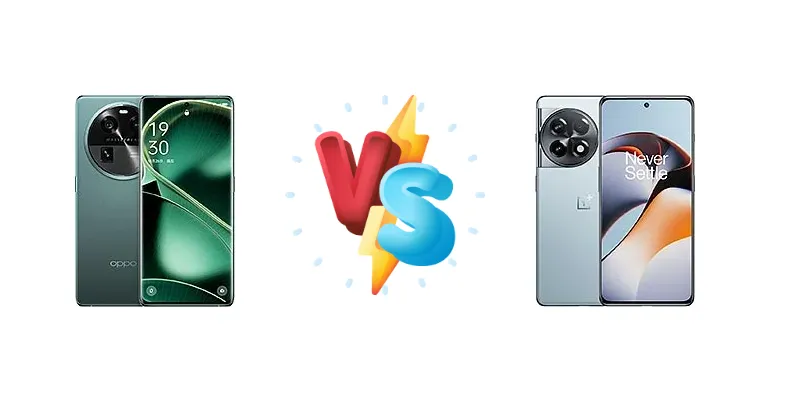
Oppo Find X6 vs OnePlus 11R: A Deep Dive into Performance and Value
| Phones Images | |||||
|---|---|---|---|---|---|
|
🏆 Quick Verdict
For most users, the OnePlus 11R emerges as the slightly better value. Its Snapdragon 8+ Gen 1 provides consistently strong performance, and the 100W charging is a significant advantage. While the Find X6’s Dimensity 9200 is capable, the 11R’s more mature software optimization and faster charging give it a practical edge.
| PHONES | ||
|---|---|---|
| Phone Names | Oppo Find X6 | OnePlus 11R |
| Network | ||
|---|---|---|
| 2G bands | GSM 850 / 900 / 1800 / 1900 | GSM 850 / 900 / 1800 / 1900 |
| 3G bands | HSDPA 800 / 850 / 900 / 1700(AWS) / 1900 / 2100 | HSDPA 850 / 900 / 1700(AWS) / 2100 |
| 4G bands | 1, 2, 3, 4, 5, 7, 8, 12, 17, 18, 19, 20, 26, 28, 34, 38, 39, 40, 41, 66 | 1, 3, 4, 5, 8, 28, 34, 38, 39, 40, 41 |
| 5G bands | 1, 3, 5, 7, 8, 20, 28, 38, 40, 41, 66, 77, 78, 79 SA/NSA | 1, 3, 5, 8, 28, 40, 41, 77, 78 SA/NSA |
| Speed | HSPA, LTE, 5G | HSPA, LTE (3CA), 5G |
| Technology | GSM / CDMA / HSPA / CDMA2000 / LTE / 5G | GSM / CDMA / HSPA / LTE / 5G |
| CDMA2000 1x | CDMA 800 | |
| Launch | ||
|---|---|---|
| Announced | 2023, March 21 | 2023, February 07 |
| Status | Available. Released 2023, March 24 | Available. Released 2023, February 21 |
| Body | ||
|---|---|---|
| Build | - | Glass front, glass back (Gorilla Glass 5), plastic frame |
| Dimensions | 162.9 x 74.1 x 9 mm (6.41 x 2.92 x 0.35 in) | 163.4 x 74.3 x 8.7 mm (6.43 x 2.93 x 0.34 in) |
| SIM | Nano-SIM + Nano-SIM | Nano-SIM + Nano-SIM |
| Weight | 207 g (7.30 oz) | 204 g (7.20 oz) |
| IP64 dustproof and water splashproof | - | |
| Display | ||
|---|---|---|
| Protection | Unspecified | - |
| Resolution | 1240 x 2772 pixels, 20:9 ratio (~451 ppi density) | 1240 x 2772 pixels, 20:9 ratio (~451 ppi density) |
| Size | 6.74 inches, 109.2 cm2 (~90.5% screen-to-body ratio) | 6.74 inches, 109.2 cm2 (~90.0% screen-to-body ratio) |
| Type | AMOLED, 1B colors, 120Hz, HDR10+, 1100 nits (HBM), 1450 nits (peak) | Fluid AMOLED, 1B colors, 120Hz, HDR10+, 1450 nits (peak) |
| Platform | ||
|---|---|---|
| CPU | Octa-core (1x3.05 GHz Cortex-X3 & 3x2.85 GHz Cortex-A715 & 4x1.80 GHz Cortex-A510) | Octa-core (1x3.0 GHz Cortex-X2 & 3x2.5 GHz Cortex-A710 & 4x1.80 GHz Cortex-A510) |
| Chipset | Mediatek Dimensity 9200 (4 nm) | Qualcomm SM8475 Snapdragon 8+ Gen 1 (4 nm) |
| GPU | Immortalis-G715 MC11 | Adreno 730 |
| OS | Android 13, ColorOS 13.1 | Android 13, upgradable to Android 15, OxygenOS 15 |
| Memory | ||
|---|---|---|
| Card slot | No | No |
| Internal | 256GB 12GB RAM, 512GB 16GB RAM | 128GB 8GB RAM, 256GB 16GB RAM, 512GB 18GB RAM |
| UFS 4.0 | UFS 3.1 | |
| Main Camera | ||
|---|---|---|
| Features | Hasselblad Color Calibration, color spectrum sensor, LED flash, HDR, panorama | Color spectrum sensor, LED flash, HDR, panorama |
| Single | - | 16 MP, f/2.4, 24mm (wide), 1/3.09", 1.0µm |
| Triple | 50 MP, f/1.8, 24mm (wide), 1/1.56", 1.0µm, multi-directional PDAF, OIS 50 MP, f/2.6, 65mm (periscope telephoto), 1/1.56", 1.0µm, 2.8x optical zoom, PDAF, OIS 50 MP, f/2.0, 15mm, 112˚, (ultrawide), 1/2.76", 0.64µm, PDAF | 50 MP, f/1.8, 24mm (wide), 1/1.56", 1.0µm, multi-directional PDAF, OIS 8 MP, f/2.2, 120˚ (ultrawide), 1/4.0", 1.12µm 2 MP (macro) |
| Video | 4K@30/60fps, 1080p@30/60/240fps; gyro-EIS; HDR, 10‑bit video | 4K@30/60fps, 1080p@30/60/240fps, gyro-EIS |
| Selfie camera | ||
|---|---|---|
| Features | Panorama | HDR |
| Single | 32 MP, f/2.4, 21mm (wide), 1/2.74", 0.8µm, PDAF | 16 MP, f/2.4, 24mm (wide), 1/3.09", 1.0µm |
| Video | 1080p@30fps, gyro-EIS | 1080p@30fps |
| Sound | ||
|---|---|---|
| 3.5mm jack | No | No |
| 35mm jack | No | No |
| Loudspeaker | Yes, with stereo speakers | Yes, with stereo speakers |
| - | 24-bit/192kHz audio | |
| Comms | ||
|---|---|---|
| Bluetooth | 5.3, A2DP, LE, aptX HD | 5.3, A2DP, LE, aptX HD |
| Infrared port | Yes | Yes |
| NFC | Yes | Yes |
| Positioning | GPS (L1+L5), GLONASS (G1), BDS (B1I+B1c+B2a++B2b), GALILEO (E1+E5a+E5b), QZSS (L1+L5) | GPS (L1+L5), GLONASS (G1), BDS (B1I+B1c+B2a), GALILEO (E1+E5a), QZSS (L1+L5) |
| Radio | No | No |
| USB | USB Type-C, OTG | USB Type-C 2.0 |
| WLAN | Wi-Fi 802.11 a/b/g/n/ac/6/7, tri-band, Wi-Fi Direct | Wi-Fi 802.11 a/b/g/n/ac/6, dual-band |
| Features | ||
|---|---|---|
| Sensors | Fingerprint (under display, optical), accelerometer, gyro, proximity, compass | Fingerprint (under display, optical), accelerometer, gyro, proximity, compass |
| Battery | ||
|---|---|---|
| Charging | 80W wired, PD, 50% in 12 min | 100W wired |
| Type | Li-Po 4800 mAh | Li-Po 5000 mAh |
| Misc | ||
|---|---|---|
| Colors | Black, Green, Gold | Galactic Silver, Sonic Black, Solar Red |
| Models | PGFM10 | CPH2487 |
| Price | About 760 EUR | About 600 EUR |
| SAR | - | 1.16 W/kg (head) 0.61 W/kg (body) |
Oppo Find X6
- Potentially higher peak CPU performance with Dimensity 9200
- Oppo’s typically vibrant image processing
- May offer a more premium build quality
- Slower 80W charging compared to the 11R
- MediaTek chipset may have less software optimization
- Potential for higher price
OnePlus 11R
- Faster 100W charging for quicker top-ups
- Snapdragon 8+ Gen 1 offers consistent performance
- Mature software optimization and gaming support
- Slightly older chipset compared to Dimensity 9200
- OnePlus’s OxygenOS can be divisive
- May have a less premium design
Display Comparison
Detailed display specifications are missing, but assuming both phones target a similar 120Hz AMOLED experience, the key differentiator will be peak brightness and color calibration. The Find X6, being a more premium offering, *may* boast higher peak brightness for better outdoor visibility. However, without concrete data, it's difficult to definitively state an advantage. Both likely employ PWM dimming for low-light viewing, but the specific frequency is crucial for users sensitive to flicker.
Camera Comparison
Camera details are limited, but the image processing philosophies of Oppo and OnePlus are distinct. Oppo typically favors vibrant, saturated colors, while OnePlus leans towards a more natural look. The Snapdragon 8+ Gen 1’s ISP is well-regarded for its image processing capabilities, potentially giving the 11R an edge in dynamic range and low-light performance. Without knowing sensor sizes and lens apertures, it’s difficult to make a definitive judgment, but the 11R’s established image processing pipeline is a strong point.
Performance
The core battle lies between the Mediatek Dimensity 9200 (4nm) and the Qualcomm Snapdragon 8+ Gen 1 (4nm). The Dimensity 9200 features a Cortex-X3 prime core clocked at 3.05 GHz, while the 11R uses a Cortex-X2 at 3.0 GHz. While the X3 is theoretically faster, the Snapdragon 8+ Gen 1 benefits from Qualcomm’s established optimization and a more mature software ecosystem. The 11R’s Adreno 730 GPU is a proven performer, likely offering a smoother gaming experience than the Dimensity 9200’s Mali-G715 MC11, especially in titles not specifically optimized for MediaTek chips. Both phones utilize LPDDR5x RAM, ensuring fast memory access.
Battery Life
The OnePlus 11R’s 100W wired charging is a clear advantage, promising a full charge in under 30 minutes. The Oppo Find X6’s 80W charging, while still fast, is noticeably slower. Battery capacity is unknown for both, but the faster charging of the 11R mitigates any potential disadvantage from a slightly smaller battery. The 4nm process node of both chipsets contributes to improved power efficiency, but the Snapdragon 8+ Gen 1 is known for its excellent thermal management, potentially leading to longer sustained performance under load.
Buying Guide
Buy the Oppo Find X6 if you prioritize potential peak performance and are willing to accept slightly slower charging speeds. Its Dimensity 9200 offers a theoretical performance ceiling that might appeal to power users. Buy the OnePlus 11R if you value consistent, reliable performance, incredibly fast 100W charging, and a more refined software experience, all at a potentially lower price point.