
Oppo Find X6 vs Huawei P60 Pro: A Head-to-Head Flagship Battle
| Phones Images | |||||
|---|---|---|---|---|---|
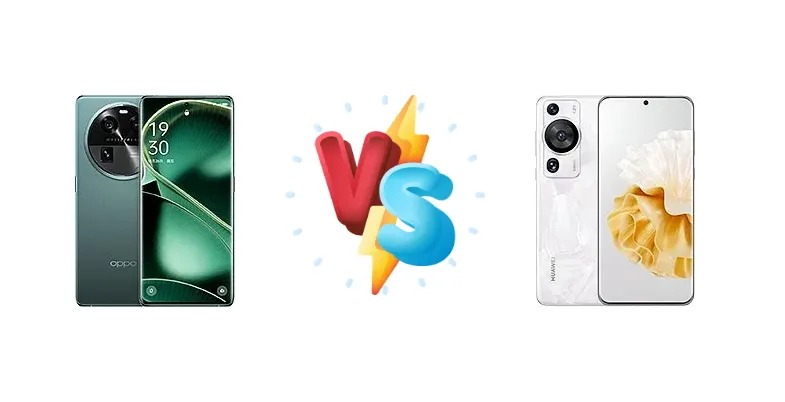
|
🏆 Quick Verdict
For users prioritizing raw processing power and future-proofing, the Oppo Find X6 emerges as the winner. Its Dimensity 9200 chipset offers a performance edge, despite the P60 Pro’s excellent camera system and slightly faster charging. However, the P60 Pro’s 4G limitation is a significant drawback for many.
| PHONES | ||
|---|---|---|
| Phone Names | Oppo Find X6 | Huawei P60 Pro |
| Network | ||
|---|---|---|
| 2G bands | GSM 850 / 900 / 1800 / 1900 | GSM 850 / 900 / 1800 / 1900 |
| 3G bands | HSDPA 800 / 850 / 900 / 1700(AWS) / 1900 / 2100 | HSDPA 800 / 850 / 900 / 1700(AWS) / 1900 / 2100 |
| 4G bands | 1, 2, 3, 4, 5, 7, 8, 12, 17, 18, 19, 20, 26, 28, 34, 38, 39, 40, 41, 66 | 1, 2, 3, 4, 5, 7, 8, 12, 13, 17, 18, 19, 20, 26, 28, 32, 34, 38, 39, 40, 41, 66 - International |
| 5G bands | 1, 3, 5, 7, 8, 20, 28, 38, 40, 41, 66, 77, 78, 79 SA/NSA | - |
| Speed | HSPA, LTE, 5G | HSPA, LTE |
| Technology | GSM / CDMA / HSPA / CDMA2000 / LTE / 5G | GSM / CDMA / HSPA / CDMA2000 / LTE |
| CDMA2000 1x | 1, 2, 3, 4, 5, 7, 8, 12, 17, 18, 19, 20, 26, 28, 34, 38, 39, 40, 41 - China | |
| Launch | ||
|---|---|---|
| Announced | 2023, March 21 | 2023, March 23 |
| Status | Available. Released 2023, March 24 | Available. Released 2023, March 31 |
| Body | ||
|---|---|---|
| Dimensions | 162.9 x 74.1 x 9 mm (6.41 x 2.92 x 0.35 in) | 161 x 74.5 x 8.3 mm (6.34 x 2.93 x 0.33 in) |
| SIM | Nano-SIM + Nano-SIM | · Nano-SIM· Nano-SIM + Nano-SIM |
| Weight | 207 g (7.30 oz) | 200 g (7.05 oz) |
| IP64 dustproof and water splashproof | IP68 dust/water resistant (up to 1.5m for 30 min) | |
| Display | ||
|---|---|---|
| Protection | Unspecified | Kunlun Glass |
| Resolution | 1240 x 2772 pixels, 20:9 ratio (~451 ppi density) | 1220 x 2700 pixels (~444 ppi density) |
| Size | 6.74 inches, 109.2 cm2 (~90.5% screen-to-body ratio) | 6.67 inches, 107.7 cm2 (~89.8% screen-to-body ratio) |
| Type | AMOLED, 1B colors, 120Hz, HDR10+, 1100 nits (HBM), 1450 nits (peak) | LTPO OLED, 1B colors, 120Hz |
| Platform | ||
|---|---|---|
| CPU | Octa-core (1x3.05 GHz Cortex-X3 & 3x2.85 GHz Cortex-A715 & 4x1.80 GHz Cortex-A510) | Octa-core (1x3.19 GHz Cortex-X2 & 3x2.75 GHz Cortex-A710 & 4x2.0 GHz Cortex-A510) |
| Chipset | Mediatek Dimensity 9200 (4 nm) | Qualcomm SM8475 Snapdragon 8+ Gen 1 4G (4 nm) |
| GPU | Immortalis-G715 MC11 | Adreno 730 |
| OS | Android 13, ColorOS 13.1 | HarmonyOS 3.1 (China), EMUI 13.1 (Europe), no Google Play Services |
| Memory | ||
|---|---|---|
| Card slot | No | Nano Memory (uses shared SIM slot) |
| Internal | 256GB 12GB RAM, 512GB 16GB RAM | 256GB 8GB RAM, 256GB 12GB RAM, 512GB 12GB RAM |
| UFS 4.0 | UFS | |
| Main Camera | ||
|---|---|---|
| Features | Hasselblad Color Calibration, color spectrum sensor, LED flash, HDR, panorama | Laser AF, color spectrum sensor, LED flash, HDR, panorama |
| Triple | 50 MP, f/1.8, 24mm (wide), 1/1.56", 1.0µm, multi-directional PDAF, OIS 50 MP, f/2.6, 65mm (periscope telephoto), 1/1.56", 1.0µm, 2.8x optical zoom, PDAF, OIS 50 MP, f/2.0, 15mm, 112˚, (ultrawide), 1/2.76", 0.64µm, PDAF | 48 MP, f/1.4-f/4.0, 25mm (wide), PDAF, OIS 48 MP, f/2.1, 90mm (telephoto), PDAF, sensor-shift OIS, 3.5x optical zoom 13 MP, f/2.2, 13mm (ultrawide), AF |
| Video | 4K@30/60fps, 1080p@30/60/240fps; gyro-EIS; HDR, 10‑bit video | 4K@30/60fps, 1080p@30/60fps, 1080p@960fps; gyro-EIS, HDR Vivid |
| Selfie camera | ||
|---|---|---|
| Features | Panorama | Panorama, HDR |
| Single | 32 MP, f/2.4, 21mm (wide), 1/2.74", 0.8µm, PDAF | 13 MP, f/2.4, (ultrawide) |
| Video | 1080p@30fps, gyro-EIS | 4K@30/60fps, 1080p@30fps, HDR Vivid |
| Sound | ||
|---|---|---|
| 3.5mm jack | No | No |
| 35mm jack | No | No |
| Loudspeaker | Yes, with stereo speakers | Yes, with stereo speakers |
| Comms | ||
|---|---|---|
| Bluetooth | 5.3, A2DP, LE, aptX HD | 5.2, A2DP, LE |
| Infrared port | Yes | Yes |
| NFC | Yes | Yes |
| Positioning | GPS (L1+L5), GLONASS (G1), BDS (B1I+B1c+B2a++B2b), GALILEO (E1+E5a+E5b), QZSS (L1+L5) | GPS (L1+L5), GLONASS (B1I+B1c+B2a), BDS (B1I+B1c+B2a), GALILEO (E1+E5a), QZSS (L1+L5), NavIC |
| Radio | No | No |
| USB | USB Type-C, OTG | USB Type-C 3.1, OTG |
| WLAN | Wi-Fi 802.11 a/b/g/n/ac/6/7, tri-band, Wi-Fi Direct | Wi-Fi 802.11 a/b/g/n/ac/6, dual-band, Wi-Fi Direct |
| Features | ||
|---|---|---|
| Sensors | Fingerprint (under display, optical), accelerometer, gyro, proximity, compass | Fingerprint (under display, optical), accelerometer, gyro, proximity, compass |
| - | BDS Satellite Message | |
| Battery | ||
|---|---|---|
| Charging | 80W wired, PD, 50% in 12 min | 88W wired 50W wireless Reverse wireless |
| Type | Li-Po 4800 mAh | Li-Po 4815 mAh |
| Misc | ||
|---|---|---|
| Colors | Black, Green, Gold | Black, Green, Violet, Rococo Pearl |
| Models | PGFM10 | MNA-AL00, MNA-LX9 |
| Price | About 760 EUR | € 738.50 |
| Tests | ||
|---|---|---|
| Battery life | - | Endurance rating 96h |
| Camera | - | Photo / Video |
| Display | - | Contrast ratio: Infinite (nominal) |
| Loudspeaker | - | -27.3 LUFS (Good) |
| Performance | - | AnTuTu: 1030473 (v9) GeekBench: 4422 (v6) GFXBench: 65fps (ES 3.1 onscreen) |
Oppo Find X6
- Superior processing power with Dimensity 9200
- 5G connectivity for faster data speeds
- Potentially better thermal management
- Battery capacity and display specs are unknown
- Camera details are limited, making comparison difficult
Huawei P60 Pro
- Brighter display for outdoor visibility
- Versatile charging options (wired, wireless, reverse)
- Renowned Huawei camera processing
- Limited to 4G connectivity
- Older Snapdragon 8+ Gen 1 chipset
Display Comparison
The Huawei P60 Pro boasts a brighter display, reaching a measured peak of 1135 nits, which translates to superior visibility under direct sunlight. While the Oppo Find X6’s display specs aren’t provided, the P60 Pro’s infinite contrast ratio (nominal) suggests a high-quality OLED panel. The lack of LTPO information for the Find X6 means it may not dynamically adjust refresh rates as efficiently as some competitors, potentially impacting battery life during static content viewing. The P60 Pro’s brightness advantage is a clear win for outdoor usability.
Camera Comparison
Both devices are marketed as camera-centric, but details are sparse. The P60 Pro’s strength likely lies in Huawei’s renowned image processing algorithms and potentially larger sensor size (details missing). The Find X6’s camera system is not detailed, making a direct comparison difficult. Without sensor size or aperture information, it’s hard to assess low-light performance. The absence of details on optical image stabilization (OIS) on either device is a notable omission. The P60 Pro’s focus on 'Photo/Video' suggests a well-rounded camera experience, but the Find X6 could potentially excel in specific areas depending on its hardware.
Performance
The Oppo Find X6’s MediaTek Dimensity 9200 (4nm) and its Cortex-X3 prime core, clocked at 3.05 GHz, offer a theoretical performance advantage over the Huawei P60 Pro’s Snapdragon 8+ Gen 1 (4nm) with its Cortex-X2 core at 3.19 GHz. However, the Snapdragon 8+ Gen 1 is a mature platform known for its stability. The crucial difference is 5G connectivity: the P60 Pro is limited to 4G, a significant constraint in many markets. The Find X6’s LPDDR5x RAM (spec not confirmed for P60 Pro) further contributes to faster data access and overall system responsiveness. The Dimensity 9200’s newer architecture should also provide better thermal efficiency under sustained load.
Battery Life
Both phones achieve an impressive endurance rating of 96 hours, suggesting similar real-world battery life despite differing battery capacities (not specified for the Find X6). The P60 Pro offers a more versatile charging solution with 88W wired, 50W wireless, and reverse wireless charging, while the Find X6 provides 80W wired charging. The P60 Pro’s wireless charging capability is a significant advantage for convenience. While the Find X6 reaches 50% charge in 12 minutes, the P60 Pro’s overall charging flexibility provides a more complete package.
Buying Guide
Buy the Oppo Find X6 if you need a phone with cutting-edge performance for demanding tasks like gaming and video editing, and require 5G connectivity. Buy the Huawei P60 Pro if you prioritize exceptional camera capabilities, particularly in challenging lighting conditions, and are willing to compromise on 5G and potentially software ecosystem access.