
Oppo Find X6 vs Google Pixel 7 Pro: A Deep Dive into Flagship Android
| Phones Images | |||||
|---|---|---|---|---|---|
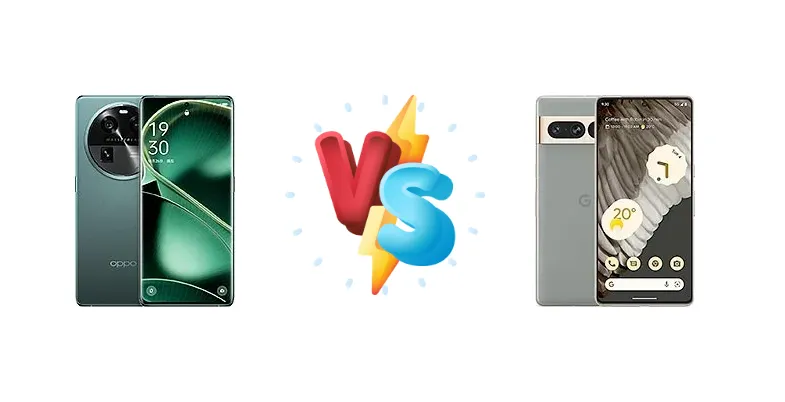
|
🏆 Quick Verdict
For users prioritizing peak performance and incredibly fast charging, the Oppo Find X6 is the clear winner. However, the Google Pixel 7 Pro excels in computational photography and offers a uniquely polished software experience, making it ideal for those deeply invested in the Google ecosystem.
| PHONES | ||
|---|---|---|
| Phone Names | Oppo Find X6 | Google Pixel 7 Pro |
| Network | ||
|---|---|---|
| 2G bands | GSM 850 / 900 / 1800 / 1900 | GSM 850 / 900 / 1800 / 1900 |
| 3G bands | HSDPA 800 / 850 / 900 / 1700(AWS) / 1900 / 2100 | HSDPA 800 / 850 / 900 / 1700(AWS) / 1900 / 2100 |
| 4G bands | 1, 2, 3, 4, 5, 7, 8, 12, 17, 18, 19, 20, 26, 28, 34, 38, 39, 40, 41, 66 | 1, 2, 3, 4, 5, 7, 8, 12, 13, 14, 17, 18, 19, 20, 25, 26, 28, 29, 30, 38, 39, 40, 41, 42, 46, 48, 66, 71 - GE2AE |
| 5G bands | 1, 3, 5, 7, 8, 20, 28, 38, 40, 41, 66, 77, 78, 79 SA/NSA | 1, 2, 3, 5, 7, 8, 12, 14, 20, 25, 28, 30, 38, 40, 41, 48, 66, 71, 77, 78, 257, 258, 260, 261 SA/NSA/Sub6/mmWave - GE2AE |
| Speed | HSPA, LTE, 5G | HSPA, LTE, 5G |
| Technology | GSM / CDMA / HSPA / CDMA2000 / LTE / 5G | GSM / CDMA / HSPA / EVDO / LTE / 5G |
| CDMA2000 1x | 1, 2, 3, 5, 7, 8, 12, 14, 20, 25, 28, 30, 38, 40, 41, 48, 66, 71, 75, 76, 77, 78 SA/NSA/Sub6 - GP4BC | |
| Launch | ||
|---|---|---|
| Announced | 2023, March 21 | 2022, October 06 |
| Status | Available. Released 2023, March 24 | Available. Released 2022, October 13 |
| Body | ||
|---|---|---|
| Build | - | Glass front (Gorilla Glass Victus), glass back (Gorilla Glass Victus), aluminum frame |
| Dimensions | 162.9 x 74.1 x 9 mm (6.41 x 2.92 x 0.35 in) | 162.9 x 76.6 x 8.9 mm (6.41 x 3.02 x 0.35 in) |
| SIM | Nano-SIM + Nano-SIM | Nano-SIM + eSIM |
| Weight | 207 g (7.30 oz) | 212 g (7.48 oz) |
| IP64 dustproof and water splashproof | IP68 dust/water resistant (up to 1.5m for 30 min) | |
| Display | ||
|---|---|---|
| Protection | Unspecified | Corning Gorilla Glass Victus |
| Resolution | 1240 x 2772 pixels, 20:9 ratio (~451 ppi density) | 1440 x 3120 pixels, 19.5:9 ratio (~512 ppi density) |
| Size | 6.74 inches, 109.2 cm2 (~90.5% screen-to-body ratio) | 6.7 inches, 110.6 cm2 (~88.7% screen-to-body ratio) |
| Type | AMOLED, 1B colors, 120Hz, HDR10+, 1100 nits (HBM), 1450 nits (peak) | LTPO AMOLED, 120Hz, HDR10+, 1000 nits (HBM), 1500 nits (peak) |
| - | Always-on display | |
| Platform | ||
|---|---|---|
| CPU | Octa-core (1x3.05 GHz Cortex-X3 & 3x2.85 GHz Cortex-A715 & 4x1.80 GHz Cortex-A510) | Octa-core (2x2.85 GHz Cortex-X1 & 2x2.35 GHz Cortex-A78 & 4x1.80 GHz Cortex-A55) |
| Chipset | Mediatek Dimensity 9200 (4 nm) | Google Tensor G2 (5 nm) |
| GPU | Immortalis-G715 MC11 | Mali-G710 MP7 |
| OS | Android 13, ColorOS 13.1 | Android 13, upgradable to Android 15, up to 5 major Android upgrades |
| Memory | ||
|---|---|---|
| Card slot | No | No |
| Internal | 256GB 12GB RAM, 512GB 16GB RAM | 128GB 8GB RAM, 256GB 8GB RAM, 128GB 12GB RAM, 256GB 12GB RAM, 512GB 12GB RAM |
| UFS 4.0 | UFS 3.1 | |
| Main Camera | ||
|---|---|---|
| Features | Hasselblad Color Calibration, color spectrum sensor, LED flash, HDR, panorama | Laser AF, Dual-LED flash, Pixel Shift, Auto-HDR, panorama |
| Single | - | 10.8 MP, f/2.2, 21mm (ultrawide), 1/3.1", 1.22µm |
| Triple | 50 MP, f/1.8, 24mm (wide), 1/1.56", 1.0µm, multi-directional PDAF, OIS 50 MP, f/2.6, 65mm (periscope telephoto), 1/1.56", 1.0µm, 2.8x optical zoom, PDAF, OIS 50 MP, f/2.0, 15mm, 112˚, (ultrawide), 1/2.76", 0.64µm, PDAF | 50 MP, f/1.9, 25mm (wide), 1/1.31", 1.2µm, dual pixel PDAF, OIS 48 MP, f/3.5, 120mm (periscope telephoto), 1/2.55", 0.7µm, dual pixel PDAF, OIS, 5x optical zoom 12 MP, f/2.2, 126˚ (ultrawide), 1/2.9", 1.25µm, AF |
| Video | 4K@30/60fps, 1080p@30/60/240fps; gyro-EIS; HDR, 10‑bit video | 4K@30/60fps, 1080p@30/60/120/240fps; gyro-EIS, OIS, 10-bit HDR |
| Selfie camera | ||
|---|---|---|
| Features | Panorama | HDR, panorama |
| Single | 32 MP, f/2.4, 21mm (wide), 1/2.74", 0.8µm, PDAF | 10.8 MP, f/2.2, 21mm (ultrawide), 1/3.1", 1.22µm |
| Video | 1080p@30fps, gyro-EIS | 4K@30/60fps, 1080p@30/60fps |
| Sound | ||
|---|---|---|
| 3.5mm jack | No | No |
| 35mm jack | No | No |
| Loudspeaker | Yes, with stereo speakers | Yes, with stereo speakers |
| Comms | ||
|---|---|---|
| Bluetooth | 5.3, A2DP, LE, aptX HD | 5.2, A2DP, LE, aptX HD |
| Infrared port | Yes | - |
| NFC | Yes | Yes |
| Positioning | GPS (L1+L5), GLONASS (G1), BDS (B1I+B1c+B2a++B2b), GALILEO (E1+E5a+E5b), QZSS (L1+L5) | GPS (L1+L5), GLONASS (G1), BDS (B1I+B1c+B2a), GALILEO (E1+E5a), QZSS (L1+L5) |
| Radio | No | No |
| USB | USB Type-C, OTG | USB Type-C 3.2 |
| WLAN | Wi-Fi 802.11 a/b/g/n/ac/6/7, tri-band, Wi-Fi Direct | Wi-Fi 802.11 a/b/g/n/ac/6e, tri-band, Wi-Fi Direct |
| Features | ||
|---|---|---|
| Sensors | Fingerprint (under display, optical), accelerometer, gyro, proximity, compass | Fingerprint (under display, optical), accelerometer, gyro, proximity, compass, barometer |
| - | Ultra Wideband (UWB) support | |
| Battery | ||
|---|---|---|
| Charging | 80W wired, PD, 50% in 12 min | 23W wired, PD3.0, 50% in 30 min 23W wireless Reverse wireless |
| Type | Li-Po 4800 mAh | Li-Ion 5000 mAh |
| Misc | ||
|---|---|---|
| Colors | Black, Green, Gold | Obsidian, Snow, Hazel |
| Models | PGFM10 | GP4BC, GE2AE, GFE4J |
| Price | About 760 EUR | € 248.84 / $ 204.00 / £ 259.99 / ₹ 36,999 |
| Tests | ||
|---|---|---|
| Battery life | - | Endurance rating 83h |
| Camera | - | Photo / Video |
| Display | - | Contrast ratio: Infinite (nominal) |
| Loudspeaker | - | -24.8 LUFS (Very good) |
| Performance | - | AnTuTu: 796369 (v9) GeekBench: 3187 (v5.1) GFXBench: 34fps (ES 3.1 onscreen) |
Oppo Find X6
- Significantly faster 80W charging
- Potentially superior CPU performance with Dimensity 9200
- Likely advanced camera hardware (based on Oppo's track record)
- Software experience may not be as refined as Pixel
- Lack of detailed display specifications
Google Pixel 7 Pro
- Exceptional computational photography and image processing
- Seamless Google software experience and AI features
- Bright and vibrant display with high contrast
- Slower 23W charging
- Tensor G2 may be less powerful than Dimensity 9200 in raw tasks
Display Comparison
The Google Pixel 7 Pro boasts a measured peak brightness of 1090 nits, providing excellent visibility outdoors. While the Oppo Find X6’s display specs aren’t provided, Oppo typically employs high-quality panels. The Pixel 7 Pro’s ‘infinite’ contrast ratio suggests a true OLED experience, delivering deep blacks. Without specific details on the Find X6’s panel technology (LTPO, PWM dimming rate), it’s difficult to definitively declare a winner, but the Pixel 7 Pro’s brightness is a known quantity.
Camera Comparison
Both phones are advertised as excelling in photo and video, but their approaches differ. The Pixel 7 Pro leverages Google’s computational photography prowess, known for its realistic image processing and Super Res Zoom. The Oppo Find X6, while lacking specific sensor details in the provided data, likely features a high-resolution main sensor (Oppo often leads in this area) and benefits from the Dimensity 9200’s powerful ISP. The Pixel 7 Pro’s strength lies in its consistent image quality across various lighting conditions, while the Find X6 may offer more flexibility for advanced users who prefer manual controls. Without sensor size information for the Find X6, a direct comparison is difficult, but Oppo’s history suggests a focus on hardware capabilities.
Performance
The Oppo Find X6’s MediaTek Dimensity 9200, fabricated on a 4nm process, is a powerhouse. Its Cortex-X3 prime core clocked at 3.05 GHz promises superior single-core performance compared to the Pixel 7 Pro’s 2.85 GHz Cortex-X1 cores. The Dimensity 9200’s architecture (1+3+4) also appears more balanced than the Pixel’s (2+2+4). However, the Google Tensor G2 (5nm) is optimized for machine learning tasks, giving the Pixel 7 Pro an edge in AI-powered features like voice recognition and image processing. The 4nm node of the Dimensity 9200 should also offer better thermal efficiency, potentially reducing throttling during sustained workloads.
Battery Life
Both devices achieve an endurance rating of 83 hours, indicating comparable battery life despite differing charging approaches. The Pixel 7 Pro offers 23W wired charging, taking 30 minutes to reach 50%, alongside 23W wireless and reverse wireless charging. The Oppo Find X6, with its 80W wired charging, significantly outperforms the Pixel, reaching 50% charge in just 12 minutes. This faster charging is a major advantage for users who prioritize convenience and quick top-ups. While battery capacity isn’t specified, the Find X6’s charging speed effectively mitigates any potential capacity disadvantage.
Buying Guide
Buy the Oppo Find X6 if you need uncompromising performance for demanding tasks like gaming or video editing, and value the convenience of 80W SuperVOOC charging. Buy the Google Pixel 7 Pro if you prefer a seamless software experience, exceptional camera processing, and a phone that learns and adapts to your usage patterns through Google’s AI.